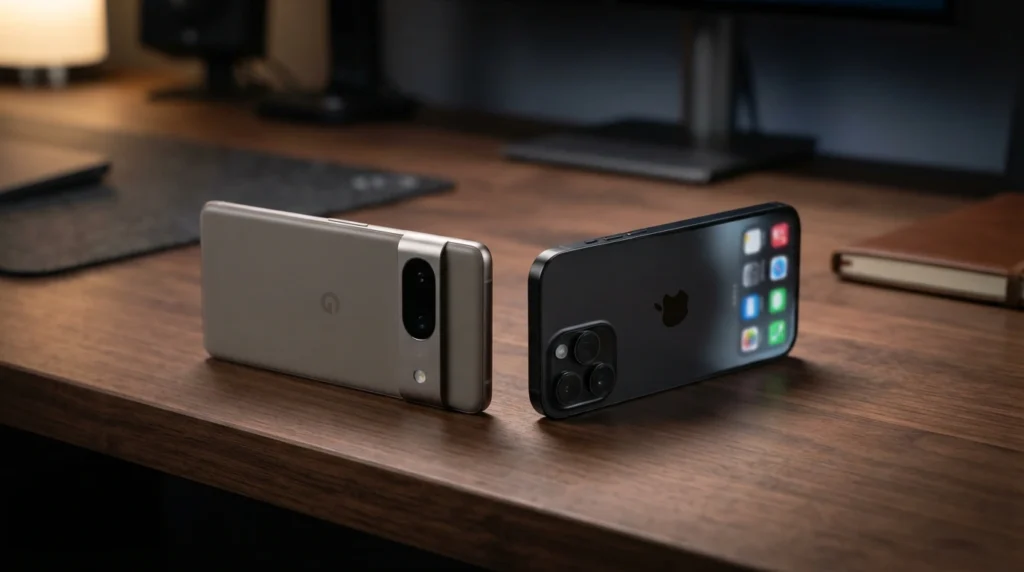
The Google Pixel 11 and the Apple iPhone 17 are two phones that need careful consideration if you’re looking for a new flagship smartphone in the US.
Both phones cater to consumers who desire high-end cameras, slick screens, robust performance, extended software support, and practical AI features. They do, however, use somewhat distinct strategies.
Google’s Gemini-powered AI, computational photography, Android 17, and Google services are all major features of the Pixel 11. With iOS, Apple Intelligence, the A19 chip, ProMotion, and close connection with other Apple products, the iPhone 17 adopts a more refined ecosystem-first strategy.
On August 12, 2026, Google formally unveiled the Pixel 11 series. The iPhone 17 starts at $799 with 256GB of storage, while the regular Pixel 11 costs roughly $899.
Which one should you get, then?
The design, display, cameras, performance, battery life, software, AI features, pricing, advantages and disadvantages, and overall value for American consumers are all examined in this thorough comparison of the Google Pixel 11 vs iPhone 17.
A Brief Comparison of the Google Pixel 11 and iPhone 17
The more AI-focused choice is the Pixel 11.
It has 256GB of base storage, 12GB of RAM, and Google’s latest Tensor G6 CPU. Additionally, Google has enhanced its video tools, camera system, zoom capabilities, and Gemini-powered software features.
The more ecosystem-focused choice is the iPhone 17.
Apple’s phone comes with 256GB of storage, a 6.3-inch OLED display with adaptive 120Hz ProMotion, and the A19 CPU. Additionally, the iPhone, Mac, Apple Watch, AirPods, and other Apple products continue to prioritize privacy, security, and integration.
Comparison Table
| Feature | Google Pixel 11 | iPhone 17 |
|---|
| Starting price | About $899 | $799 |
| Base storage | 256GB | 256GB |
| RAM | 12GB | Not officially disclosed in the same way |
| Processor | Google Tensor G6 | Apple A19 |
| Operating system | Android 17 | iOS 26 |
| Display | 6.3-inch OLED, up to 120Hz | 6.3-inch OLED, up to 120Hz |
| Rear cameras | Triple-camera system | Dual-camera system |
| Main camera | 48MP | 48MP |
| Telephoto | Yes, up to 5x optical zoom | No dedicated telephoto |
| Front camera | 10.5MP | 18MP |
| Water resistance | IP68 | IP68 |
| Base storage | 256GB | 256GB |
| Main strength | AI and photography | Performance and ecosystem |
Market-specific specifications may differ, and several Pixel 11 features are derived from Google’s recently revealed 2026 model.
Design and Construction Quality
The Pixel 11 adds a thinner camera bar while maintaining Google’s iconic Pixel design.
Instead of making the camera housing appear as large as it did in earlier Pixel generations, Google has improved it so that it feels more merged with the body. Additionally, the phone has a sturdy front glass with IP68 water and dust protection and an aluminum frame.
The iPhone 17 adheres to Apple’s well-known flat-sided design style.
It has an aluminum construction with a color-infused glass back and a Ceramic Shield 2 front. Black, White, Mist Blue, Sage, and Lavender are among the finishes that Apple provides.
Both phones have a high-end appearance.
For consumers who appreciate Google’s camera-bar design, the Pixel 11 may be more unique. In contrast, the iPhone 17 looks crisper and more understated.
Winners: iPhone 17 for minimalist design; Pixel 11 for unique design.
Show Comparison
Because you engage with your phone’s screen on a daily basis, display quality is crucial.
The 6.3-inch OLED screen of the Pixel 11 has an adjustable refresh rate of up to 120 Hz. With a maximum brightness of about 3,000 nits, it is ideal for outdoor use.
A 6.3-inch OLED screen is another feature of the iPhone 17.
ProMotion with variable refresh rates up to 120Hz has now been added to the basic iPhone 17 by Apple. Additionally, the screen supports HDR, True Tone, Always-On display, and an outdoor peak brightness of up to 3,000 nits.
One of the most significant enhancements to the iPhone 17 is this.
For years, consumers who wanted a high-refresh-rate display had to switch to a Pro iPhone. That is altered by the iPhone 17.
Both displays should feel incredibly smooth during regular use.
Both phones should have seamless social media scrolling, website surfing, gaming, and app switching.
Winner: Tie.
Performance comparison between the iPhone 17 and Pixel 11
Apple’s strategy becomes more intriguing when it comes to performance.
Apple’s A19 processor powers the iPhone 17. It has a 16-core neural engine, a six-core CPU, a five-core GPU with neural accelerators, and hardware-accelerated ray tracing.
In terms of CPU and GPU performance, Apple’s proprietary silicon has historically been very powerful.
Google’s Tensor G6 processor powers the Pixel 11.
Tensor was created by Google with AI, machine learning, speech functions, photography, and Google’s wider software experience in mind. Additionally, the Pixel 11 comes with 12GB of RAM.
Thus, the priorities of the two phones are different.
The iPhone 17 is probably a safer option if you’re interested in gaming, demanding apps, video editing, and raw processing power.
The Pixel 11 becomes much more appealing if you are interested in AI tools, image processing, voice recognition, translation, and Google’s clever software features.
Winners: Pixel 11 for AI-focused processing; iPhone 17 for sheer performance.
Comparison of Cameras
The Pixel 11’s camera capability might be the main factor in the decision.
Google has added new AI-powered photography capabilities and improved the Pixel 11 camera system. According to current specifications released following Google’s introduction, the basic Pixel 11 has a 48MP primary camera, a 13MP ultrawide camera, and a telephoto camera with 5x optical zoom.
Additionally, Google is launching features including Creator Suite tools, Magic Capture, better Nite Sight, and greater video stabilization.
It’s obvious that the Pixel 11 was made to simplify photography for those who don’t want to retouch every picture by hand.
For many years, one of the main benefits of the Pixel line has been Google’s computational photography.
There is a 48MP primary camera and a 48MP ultrawide camera in the iPhone 17.
Apple’s picture processing, video technologies, and new 18MP front-facing camera are also advantageous to its camera system. For social media creators and video calls, the iPhone 17 has features like Center Stage and Dual Capture.
But there is a significant distinction.
There isn’t a specialized telephoto camera on the basic iPhone 17.
For customers who often take pictures of far-off scenes, this gives the Pixel 11 an advantage.
Both phones should provide good results for casual photography.
The Pixel 11 boasts the most ambitious hardware and software combination for computational photography, zoom photography, and AI-assisted editing.
The iPhone is still quite competitive when it comes to social media content, video recording, and Apple’s established video ecosystem.
Winner: iPhone 17 for social media and video content; Pixel 11 for camera versatility.
Features of AI
One of the main distinctions between contemporary cellphones is increasingly AI.
Google is centering the Pixel 11 experience around artificial intelligence.
With Android 17 and Gemini Intelligence, the phone offers features including live media translation, enhanced voice-to-text, camera-based Circle to Search enhancements, Magic Capture, and other AI-assisted tools.
Google’s approach is straightforward: instead of just introducing AI as a stand-alone app, make the phone seem more useful.
With Apple Intelligence, the iPhone 17 adopts a different strategy.
Apple places a strong emphasis on integration with daily tasks and privacy. Apple emphasizes privacy safeguards regarding user data, and Apple Intelligence is embedded throughout the company’s software experience.
Apple Intelligence may seem more natural to someone who is already a part of Apple’s ecosystem.
The Pixel 11 is perhaps a superior option for consumers who want Google’s Gemini ecosystem, smart photography tools, translation, search, and AI-first features.
Pixel 11 was the winner.
Charging and Battery Life
Another area where the Pixel 11 has drawn significant attention is battery life.
According to stated statistics, the basic Pixel 11 has a battery of about 4,985mAh, but Google claims that the new Pixel 11 series may provide more than 30 hours of battery life.
Additionally, the Pixel 11 is compatible with faster wireless charging via the more recent Qi2.2 standard.
Apple does not use battery capacity in the same manner when marketing the iPhone 17.
Rather, Apple concentrates on software optimization and real-world battery predictions.
According to Tom’s Guide, the iPhone 17’s battery lasts about 12 hours and 47 minutes.
Naturally, brightness, cellular connectivity, gaming, camera use, and other variables will all affect battery performance.
However, on paper, Google has an advantage due to the Pixel 11’s larger claimed battery.
Pixel 11 was the winner.
Updates and Software
Android 17 is installed on the Pixel 11.
With Gemini integration, customization choices, Google services, and Pixel-only features, customers get Google’s most recent Android experience.
Additionally, Google promises to support the Pixel 11’s software for seven years.
Apple’s most recent iOS version is available on the iPhone 17.
Long-term software updates are a hallmark of Apple’s reputation, and the company’s control over both hardware and software enables it to support older iPhones for many years.
The number of years you receive updates is not the main concern.
It is your preferred operating system.
Android provides greater flexibility and customization.
iOS provides better connectivity with Apple’s ecosystem and a more straightforward UI.
Winner: Depending on your ecology, a tie.
Ecosystem: Google vs. Apple
In this particular category, making a decision can be quite simple.
The iPhone 17 makes perfect sense if you already have an iPad, MacBook, Apple Watch, or AirPods.
It is challenging to leave Apple’s ecosystem because to features like AirDrop, iCloud, FaceTime, Apple Watch connectivity, and cross-device continuity.
The ecology at Google is more transparent.
Android tablets, Chromebooks, Google services, Pixel Watch devices, and other Android accessories are all easily compatible with the Pixel 11.
Additionally, Google provides services on several platforms, including Google Photos, Google Drive, Gmail, Maps, and Gemini.
The Pixel 11 might feel more natural if Google services are the center of your digital life.
Winners: Pixel 11 for cross-platform Google services and iPhone 17 for ecosystem connectivity.
Value and Storage
The base storage capacity of both phones is 256GB.
For customers that keep a lot of images, videos, apps, and offline media, it is a welcome improvement.
“The iPhone 17 enters the US market with a starting price of $799
At launch, Google’s regular flagship is roughly $100 more expensive than the Pixel 11, which starts at about $899.
The difference in pricing is significant.
The Pixel 11 does provide greater RAM, Google’s most recent AI technologies, a more flexible camera arrangement, and robust battery hardware.
However, the iPhone 17 offers 256GB of storage and a 120Hz ProMotion display at a lower starting price.
The iPhone 17 makes a compelling case for pure value.
The iPhone 17 was the winner.
Google Pixel 11 Benefits and Drawbacks
Outstanding AI-powered capabilities
Adaptable triple-camera setup
A specialized telephoto camera
Robust computational photography with 12GB RAM
256GB of basic storage
Vibrant 120Hz OLED screen
Big battery
Seven years of software assistance
robust Google ecosystem
Benefits of Gemini integration Cons
greater initial cost compared to the iPhone 17
Tensor might not have the same raw performance as Apple’s processor.
Users who prefer conventional smartphone controls might find some AI functions less helpful.
Android ecosystem integration varies depending on the brand and accessory.
Pros and Cons of the iPhone 17
reduced starting price of $799
Outstanding A19 performance
ProMotion display at 120 Hz
robust 256GB basic storage for video recording
Outstanding Apple ecosystem
Robust long-term software support
Integration of Apple Intelligence
Superior construction quality
Excellent qualities of the front-facing camera
Drawbacks
No specialized telephoto lens
Hardware flexibility is lower than that of the Pixel 11
Compared to Android, iOS offers less customization.
Certain ecosystem features complement other Apple goods the best.
The cost of higher storage tiers increases
Which Phone’s Camera Is Better?
I would pick the Google Pixel 11 if your main interests are still photography and zoom.
It has more flexibility because to the specialized telephoto camera, and Google’s computational photography and AI technologies are key advantages.
The iPhone 17 is a great substitute if video, social media, FaceTime, and reliable point-and-shoot outcomes are your top priorities.
Which Phone Is Better for Playing Video Games?
For serious mobile gaming, the iPhone 17 is a superior option.
The A19 chip has a strong GPU with hardware-accelerated ray tracing and is built for great performance.
Although Google’s Tensor processors have traditionally concentrated more on AI and machine learning than directly fighting for benchmark leadership, the Pixel 11 is by no means a slouch.
Which AI-Friendly Phone Is Better?
This category is won by the Pixel 11.
The phone was designed by Google with Gemini and AI-powered experiences in mind.
AI feels more like a feature of the phone than an add-on thanks to features like Magic Capture, enhanced voice-to-text, translation, Circle to Search, and clever photo tools.
What Kind of Phone Should You Purchase?
What you value most will determine the response.
If you’d like, pick the Google Pixel 11:
Increased adaptability of the camera
A specialized zoom camera
Features of Google Gemini
Increased personalization
AI-powered photography with a big battery
Google’s experience with Android
If you’d like, pick the iPhone 17:
Improved performance in raw form
A reduced initial cost
Outstanding video capture
The environment of Apple
iOS ease of use
120 Hz ProMotion
Smooth interaction with Apple Watch, Mac, and AirPods
For the majority of US consumers, the iPhone 17 is the safer option overall due to its lower price and superior performance, display technology, cameras, and ecosystem connectivity.
But perhaps the Pixel 11 is more thrilling.
It delves deeper into AI, provides a more flexible camera system, and offers Android customers a potent substitute for Apple’s increasingly refined regular iPhone.
Final Decision
It’s not really about whose phone has more features in the Google Pixel 11 vs. iPhone 17 contest.
It concerns two distinct smartphone ideologies.
Google envisions the Pixel 11 as a smartphone that doubles as an intelligent assistant.
Apple envisions the iPhone 17 as a sophisticated, potent gadget that integrates easily with the rest of your digital life.
In terms of AI, camera diversity, zoom, battery hardware, and Android flexibility, the Pixel 11 triumphs.
In terms of performance, video, ecosystem integration, and beginning pricing, the iPhone 17 prevails.
Purchase the iPhone 17 if you are already well-versed in Apple’s ecosystem.
Purchase the Pixel 11 if you want Google’s most recent AI and camera capabilities along with the flexibility of Android.
For value and performance, I would recommend the iPhone 17 to the typical US consumer, but the Pixel 11 is a better option for those who are interested in photography and artificial intelligence.
FAQ
s the iPhone 17 inferior than the Pixel 11?
In general, neither phone is superior. While the iPhone 17 is superior in terms of raw performance, video, ecosystem integration, and cost, the Pixel 11 is superior in terms of AI, photography variety, and zoom.
Is the Pixel 11 less expensive than the iPhone 17?
No, according to current launch information, the iPhone 17 starts at $799 in the US, while the Pixel 11 costs roughly $899.
Is the camera of the Pixel 11 superior to that of the iPhone 17?
Because it contains a specialized telephoto camera, the Pixel 11 offers an advantage in terms of camera versatility. In terms of front-camera and video functionality, the iPhone 17 is still very competitive.
Which has a better display, the iPhone 17 or the Pixel 11?
Both smartphones feature 6.3-inch OLED panels with refresh rates reaching 120Hz, delivering an equally smooth viewing experience for everyday tasks.
Is the iPhone 17 suitable for gaming?
Indeed. The iPhone 17 supports hardware-accelerated ray tracing, and the A19 chip offers outstanding performance.
Does the Pixel 11 have more RAM?
The Pixel 11 has 12GB of RAM by default.
Which phone’s AI is superior?
With Gemini, AI photography, translation, speech tools, and intelligent search capabilities, Pixel 11 has the more robust AI-focused approach.
In 2026, should I purchase an iPhone 17 or a Pixel 11?
If you value AI and photography, get the Pixel 11. If performance, video, ecosystem integration, and a lower starting price are important to you, go for the iPhone 17.