One of the most intriguing smartphone competitions of 2026 is the Google Pixel 11 vs. Pixel 10 showdown. Google has persisted in its approach of fusing unique Tensor processors, robust AI capabilities, computational photography, and clean Android OS. But the Pixel 11 is more than just an updated version of the Pixel 10. More storage at the bottom level, faster wireless charging, enhanced AI capabilities, a newer Tensor G6 architecture, and various camera and software improvements are all included.
The Pixel 10 is still a pretty powerful smartphone, tho. A 6.3-inch 120Hz OLED display, a triple camera system with a 5x telephoto lens, a 4,970mAh battery, a Tensor G5 engine, 12GB RAM, and seven years of software and security upgrades are all included.
So, is the Pixel 10 a better deal or should you purchase the more recent Pixel 11?
Design, display, performance, cameras, battery, charging, software, AI, storage, pricing, advantages and disadvantages, and the decision to buy are all covered in this thorough comparison of the Pixel 11 and Pixel 10.
A Brief Comparison of the Google Pixel 11 and Pixel 10
The Pixel 10 is the basic Pixel model from the previous generation, whereas the Pixel 11 is Google’s flagship device from the more recent version.
The phone’s interior is where the biggest difference is found. Google’s Tensor G5 chip powers the Pixel 10, while the more recent Tensor G6 platform powers the Pixel 11. According to current launch reports, the Pixel 10 comes with either 128GB or 256GB of storage, while the Pixel 11 also comes with 256GB.
The 6.3-inch Actua OLED screen of the Pixel 10 features a refresh rate of 60–120 Hz, a resolution of 1080 × 2424, and a maximum brightness of 3,000 nits.
The improvement is more about refinement than a totally new phone experience because the Pixel 11 maintains a same small 6.3-inch footprint. According to recent hands-on reporting, the Pixel 11 is not so much a radical overhaul as it is a relatively evolutionary design.
Pixel 11 vs Pixel 10: Key Specifications
| Feature | Google Pixel 11 | Google Pixel 10 |
|---|
| Generation | 2026 | 2025 |
| Display | 6.3-inch OLED class | 6.3-inch Actua OLED |
| Refresh Rate | Up to 120Hz | 60–120Hz |
| Processor | Tensor G6 | Tensor G5 |
| RAM | 12GB | 12GB |
| Base Storage | 256GB | 128GB |
| Rear Cameras | Triple-camera system with upgraded computational photography | 48MP + 13MP + 10.8MP telephoto |
| Telephoto | 5x-class telephoto | 5x optical telephoto |
| Maximum Zoom | Up to 30x reported | Up to 20x Super Res Zoom |
| Battery | Similar large-capacity class | 4,970mAh typical |
| Wired Charging | Improved charging system | Up to 55% in about 30 minutes with compatible 30W+ charger |
| Wireless Charging | Qi2.2 support reported | Qi2 up to 15W |
| Software | Android 17 | Android 16 at launch |
| Security Updates | Long-term Pixel support | 7 years |
| Starting US Price | $899 | $799 at launch |
Design and Construction Quality
For the Pixel 11, Google did not entirely reimagine the Pixel design. Rather, the business has improved the well-known Pixel brand.
The Pixel 10 already boasts Gorilla Glass Victus 2 protection and a high-end metal frame. It is appropriate for regular exposure to rain, splashes, and unintentional water contact because of its IP68 dust and water resistance rating.
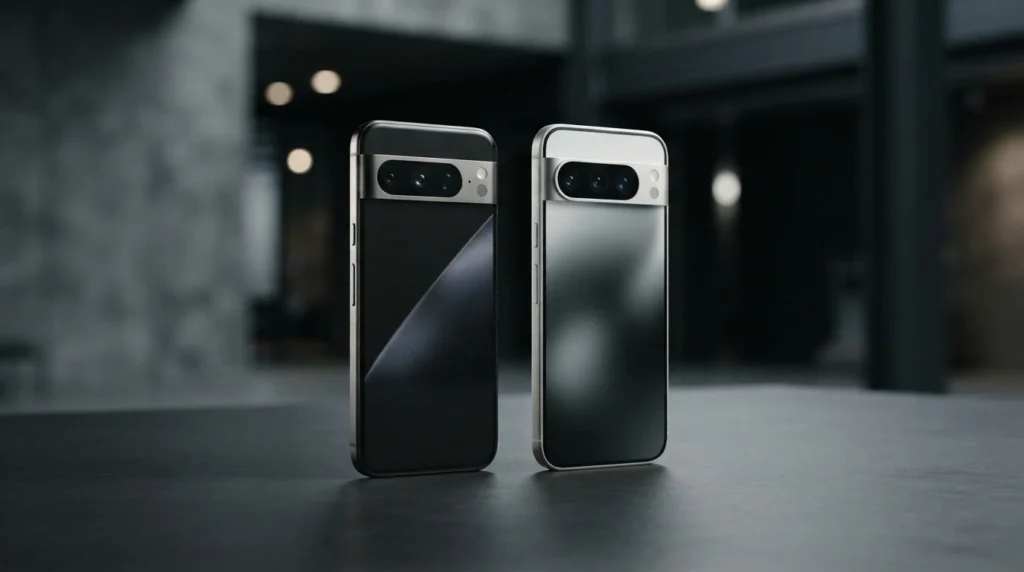
The Pixel 11 maintains the iconic Pixel camera-bar design, but it looks cleaner and more sophisticated. According to recent hands-on coverage, the regular Pixel 11 maintains its small 6.3-inch form factor and is comfortable to hold.
This is wonderful news for anyone who adored the Pixel 10’s appearance. The Pixel 11 might seem less intriguing to those who were hoping for a radically new phone.
Pixel 11 is the design winner.
Rather than starting from scratch, the Pixel 11 succeeds by improving an already popular design. Owners of Pixel 10s shouldn’t upgrade just because it looks better, tho.
Show Comparison
One area where the Pixel 10 and Pixel 11 differ from one another is the display.
The 6.3-inch Actua OLED display on the Pixel 10 has a resolution of 1080 × 2424, 422 PPI, HDR compatibility, and a smooth display that operates at 60–120 Hz. Google gives it a maximum brightness rating of 3,000 nits and a maximum HDR rating of 2,000 nits.
This indicates that the Pixel 10 already has an extremely brilliant and fluid display. While HDR videos can appear vivid, scrolling thru webpages, social media feeds, and apps feels responsive.
More attention is paid to refinement with the Pixel 11. According to current reports, the display size and resolution are comparable, with improvements mostly in brightness and general display tuning rather than a significant boost in resolution.
The difference is unlikely to be significant for regular users.
The display by itself is not a compelling cause to upgrade if you currently possess a Pixel 10 and are satisfied with its screen.
Winner of the Display: Pixel 11
The Pixel 10 is still quite good, but the Pixel 11 wins this category since it is a more recent version of Google’s display technology.
Comparing Tensor G6 vs Tensor G5 performance
This is arguably the most significant hardware distinction between the Google Pixel 10 and Pixel 11.
Google’s Tensor G5 chip powers the Pixel 10. At the time of the Pixel 10 generation, Google refers to Tensor G5 as its most potent Pixel chip, emphasizing efficiency, AI, and photography.
The Pixel 11 switches to Tensor G6.
Google’s Tensor strategy places a strong emphasis on on-device artificial intelligence rather than just chasing benchmark statistics. Thus, capabilities like Gemini, voice processing, photo editing, translation, and contextual help are crucial.
According to recent reports, the Pixel 11 generation places even more focus on AI-driven features, while Tensor G6 offers enhanced performance and efficiency.
Both phones should seem quick to typical users. Both devices can easily open applications, browse the web, watch YouTube, take pictures, and use social media.
Using AI-heavy features, computational photography, video processing, and demanding multitasking makes the distinction more intriguing.
Pixel 11 is the performance winner.
The Pixel 11 has an advantage in long-term performance and AI tasks thanks to Tensor G6.
RAM as well as storage
The Pixel 10 has either 128GB or 256GB of storage and 12GB of RAM.
According to launch reports, the Pixel 11’s base model now has 256GB of storage, which is the largest practical capacity boost. This is a significant modification because 128GB may become too small for users that download big games or capture a lot of pictures and movies.
Consider this: 256GB gives you a lot more breathing room if you frequently film 4K videos, download Netflix material, store thousands of images locally, or install big games.
Winner of Storage: Pixel 11
The Pixel 11 is more appealing for long-term ownership due to its 256GB initial capacity.
Comparison of Cameras
One of the best arguments for purchasing a Pixel phone has always been its camera capabilities.
A 48MP wide camera, a 13MP ultrawide camera, and a 10.8MP 5x telephoto camera make up the Pixel 10’s sophisticated triple back camera system. Super Res Zoom up to 20x is supported.
The standard Pixel 11 introduces advancements in computational photography and image processing while maintaining the triple-camera concept. According to recent reports, the new generation will include a zoom power of up to 30x Super Res Zoom.
The crucial thing to remember is that megapixel counts don’t provide a whole picture.
The combination of sensor hardware, image processing, machine learning, and Google’s camera algorithms gives the company an advantage in photography.
Camera Looks and Magic Capture are two new software-driven photographic capabilities included with the Pixel 11. The purpose of these features is to provide users with greater control over the recording and processing of images and videos.
Both phones are capable of taking great pictures for amateur photographers.
The Pixel 11 offers a better overall package for those who regularly employ zoom, low-light photography, and AI-based editing.
Pixel 11 is the camera winner.
Although the Pixel 10 is still a great camera phone, the Pixel 11 has better processing and photographic capabilities.
Recording Videos
While Google offers features like Cinematic Blur, Audio Magic Eraser, 10-bit HDR video, and several stabilization modes, the Pixel 10’s rear camera system can record 4K video at 24, 30, and 60 frames per second.
The Pixel 11 emphasizes AI-powered video production even further. While the more sophisticated 8K Pro Stable Video features are linked to the Pro models rather than the basic Pixel 11, the wider Pixel 11 generation provides options like Magic Capture and Creator Suite.
The Pixel 11’s software enhancements might be more helpful than a straightforward resolution boost for someone who makes TikTok films, Instagram Reels, YouTube Shorts, or vacation vids.
Pixel 11 is the video winner.
Life of a Battery
Google claims that the Pixel 10’s standard 4,970mAh battery will last more than 24 hours, and under the right circumstances, Extreme Battery Saver can greatly increase battery life.
Google’s emphasis on all-day battery life is maintained with the Pixel 11.
Screen brightness, mobile network conditions, gaming, camera usage, and background apps all have a significant impact on battery life. Therefore, we cannot determine which phone will survive longer based just on battery capacity.
Here, the efficiency gains of the Tensor G6 are crucial. Better endurance may be possible with a more efficient processor without the need for a significantly larger battery.
Because it combines newer technology with better power management, the Pixel 11 is a safer option for heavy users.
Pixel 11 is the battery winner.
Charging
When used with a compatible 30W USB-C PPS charger or above, the Pixel 10 can reach up to 55% in about 30 minutes and allows fast cable charging. Additionally, up to 15W of Qi2-certified Pixelsnap wireless charging is supported.
According to recent launch reports, the Pixel 11 advances the wireless charging platform with Qi2.2 support.
Wireless charging can make everyday use more convenient, especially when your phone is placed on a desk, bedside table, or compatible charging mount in your car.
Winner of Charging: Pixel 11
Software: Android 16 versus Android 17
For those seeking a clean Android experience, Pixel phones are among the best options.
Seven years of OS, security, and Pixel Drop upgrades support the Pixel 10, which debuted with Android 16.
The Pixel 11 has a one-generation advantage from the start because it comes with Android 17.
But what matters more is that the Pixel 10 is not suddenly out of date. Long-term software support is still offered by Google, and many AI advancements may be compatible with earlier Pixel hardware.
The Pixel 11 has the benefit of being built on Google’s most recent AI features and getting the most recent Android version right away.
Pixel 11 is the software winner.
However, the Pixel 10’s extended software support still merits a lot of praise.
Features of AI
The main factor that sets Google’s Pixel phones apart from those of many rivals is probably artificial intelligence.
Gemini, Gemini Live, Pixel Screenshots, Magic Cue, Circle to Search, and Live Translation are already included in Pixel 10.
With new Gemini-powered experiences and photography tools, Pixel 11 expands on this idea.
Magic Capture, which combines photography and video operations, is among the most intriguing features. As part of its larger creator-focused experience, Google is also promoting Camera Looks and Creator Suite.
For those who use their phones for purposes other than gaming, such as work, content creation, communication, and daily productivity, this makes the Pixel 11 more intriguing.
Pixel 11 is the AI winner.
Security and Connectivity
Google’s security-focused architecture, multi-layer hardware security, and the Titan M2 security coprocessor are all features of the Pixel 10. Additionally, depending on the market setup, it offers Bluetooth 6, Wi-Fi 6E, and 5G connectivity.
Together with Tensor G6, the Pixel 11 offers an updated version of Google’s security and connectivity framework.
The practical difference won’t be immediately apparent to most individuals. Both phones are made to offer safe Android experiences.
However, picking the more recent model makes sense if you intend to keep your phone for a number of years.
Cost: Pixel 10 vs. Pixel 11
The comparison gets trickier when it comes to price.
Although Google’s current shop site displays discount pricing starting at $599 in the US, the Pixel 10 launched at $799.
According to recent launch reports, the Pixel 11 starts at $899, which is $100 more than the debut pricing of the prior version. One significant benefit is that the new model comes with 256GB of storage.
This implies that the comparison shouldn’t be limited to €899 against $799.”
When merchants provide discounts, the Pixel 10 can become much more appealing. The Pixel 10 might provide exceptional value if you can find it for far less than its initial release price.
In contrast, the Pixel 11 makes more sense if you want the newest AI features, the newest processor, and 256GB of storage without having to upgrade right away.
Google Pixel 11 Benefits and Drawbacks
256GB of basic storage and a more recent Tensor G6 CPU
Enhanced AI capabilities
Improved computational photography
Reports of up to 30x zoom
Magic Capture features and new camera looks
More recent iterations of Android
Better wireless charging
Improved Pixel Design
Strong long-term software potential drawbacks
greater initial cost compared to the Pixel 10
Changes in design are comparatively subtle.
The Pixel 10 already provides outstanding performance.
For current Pixel 10 customers, the upgrade might not seem significant because some sophisticated camera functions are still only available on Pro versions.
Google Pixel 10 Benefits and Drawbacks
reduced cost, particularly when discounts are applied
Outstanding Tensor G5 performance with 12GB RAM
Three rear cameras
5x optical telephoto lens
120Hz OLED display with a 4,970mAh battery
Updates for seven years
robust Google AI ecosystem
6.3-inch compact design drawbacks
An older Tensor G5 processor
128GB is the starting base storage.
Compared to the Pixel 11, wireless charging is slower
An older generation of Android
Fewer of the most recent Pixel camera and AI features
Not as future-proof as the Pixel 11
Which Is Better for Gaming, the Pixel 10 or the Pixel 11?
Neither phone should be chosen only because of its Pixel branding if gaming is your top priority.
Rather than being just focused on gaming benchmark performance, Tensor chips are created with Google’s AI workloads in mind.
The Pixel 11 is the superior option between these two phones since its Tensor G6 should offer the more recent performance platform.
However, it is worthwhile to compare the Pixel 11 with premium handsets powered by Snapdragon if you are purchasing a phone primarily for intense gaming.
Pixel 11 is the gaming winner.
Which Camera Is Better, the Pixel 10 or the Pixel 11?
Because to its enhanced zoom capabilities, extended computational photography features, and more recent picture processing, Pixel 11 emerges victorious overall.
Pixel 10 is not far behind, tho.
The Pixel 10 can still produce outstanding results if you primarily take portraits, family photography, food photos, and regular social media photos.
The Pixel 11 is a better choice if you take videos, utilize zoom frequently, or want the newest AI editing tools.
Pixel 11 is the camera winner.
Which Should You Purchase, the Pixel 10 or the Pixel 11?
The type of phone you now own will determine the answer.
If You Already Have a Pixel 10
Just because the Pixel 11 is out doesn’t mean you should upgrade.
With a 120Hz display, Tensor G5, 12GB RAM, three cameras, and extensive software support, the Pixel 10 is still a potent phone.
If you especially desire Tensor G6, greater storage, new AI features, better charging, or the newest camera experience, the upgrading makes more sense.
If You Have a Pixel 9 or Previous Model
The Pixel 11 is a far more appealing update.
You get greater storage, enhanced camera software, a more recent processor, and cutting-edge AI capabilities.
When Purchasing Your First Pixel
If your budget permits, the Pixel 11 is the superior long-term option.
However, if merchants provide a significant discount, the Pixel 10 becomes very appealing.
Conclusion: Google Pixel 10 vs. Pixel 11
Overall, the Google Pixel 11 is a better smartphone, but the Pixel 10 might be more affordable.
The Pixel 11 enhances CPU generation, AI capabilities, storage, camera processing, charging, and software—areas that are important for long-term ownership.
But the Pixel 10 from Google was already a powerful phone. It features three cameras, a 4,970mAh battery, a dazzling 6.3-inch OLED display, Tensor G5, 12GB RAM, and seven years of updates.
As a result, not all Pixel 10 owners need to update to the Pixel 11.
Select the Pixel 11 if you want the newest technology and intend to maintain your phone for a number of years.
Select the Pixel 10 if you want the best value and can locate it at a significant discount.
The Google Pixel 11 was the overall winner.
The Pixel 11 is the best option for new buyers.
The Pixel 10 is the best value.
Pixel 11 is the best for AI.
The Pixel 11 has the best camera features and is the best option for long-term ownership.
The Pixel 10 is the most economical choice.
Overall, the Pixel 11 is the best
FAQ
Is the Pixel 11 superior to the Pixel 10?
Indeed, the Pixel 11 is a more recent model with a Tensor G6 CPU, more storage at the entry level, more AI functions, and better charging. The Pixel 10 is still a great phone, tho, and it might be more affordable at a discount.
Is it worthwhile to upgrade from the Pixel 10 to the Pixel 11?
Upgrading is not necessary for the majority of Pixel 10 owners. The Pixel 11 makes sense if you want the newest AI tools, Tensor G6 performance, more storage, and enhanced camera features.
Does the Pixel 11’s display run at 120 Hz?
Indeed. While the Pixel 10 already offers a 60–120Hz Smooth Display, the Pixel 11 generation carries on Google’s high-refresh-rate display strategy.
Is there a telephoto camera on the Pixel 10?
Indeed. A 10.8MP telephoto camera with a 5x optical zoom and a 20x Super Res zoom is standard on the Pixel 10.
What is the Pixel 11’s storage capacity?
According to recent launch reports, the Pixel 11’s standard storage capacity is 256GB, double that of the Pixel 10’s 128GB setup.
Which phone—the Pixel 10 or the Pixel 11—has a better processor?
The Pixel 10 utilizes the Tensor G5 processor, whilst the Pixel 11 features the more recent Tensor G6. As a result, the Pixel 11 has an advantage in terms of processor generation and more advanced AI capabilities.
Are software updates still available for the Pixel 10?
Indeed. For the Pixel 10, Google formally guaranties seven years of OS, security, and Pixel Drop upgrades.
Does the Pixel 11 cost more than the Pixel 10?
Indeed, according to recent launch reports, the Pixel 11 is priced at $899, whereas the Pixel 10 was initially priced at $799. But the base storage has also increased to 256GB with the Pixel 11.