The iPhone has been improved over the years by Apple to become one of the most well-known cellphones worldwide. The fundamental components—a rectangular glass slab, a metal frame, a recognizable camera system, and a display that becomes bigger or brighter with each generation—remain relatively constant.
However, the speculated iPhone Ultra seems poised to totally alter that formula.
Apple’s first foldable iPhone is anticipated to have a design that resembles an entirely separate product category rather than appearing to be another iteration of the conventional iPhone. According to recent sources, a book-style folding design with a much larger inside screen and a smaller external display that unfolds into something that resembles an iPad mini in size and proportions.
The iPhone Ultra would be unique just because of that. However, the design is even more bizarre in light of the latest rumors.
According to reports, Apple is putting a lot of emphasis on an incredibly thin chassis, a folding display that is almost crease-free, odd screen dimensions, and a streamlined camera configuration. According to some rumors, the engineering difficulties posed by the ultra-thin foldable body may even force features often associated with high-end iPhones to vanish.
Put another way, Apple’s priciest iPhone might also be one of its most unusual.
What is the reason for the increasingly bizarre design of the Apple iPhone Ultra? And is there any real benefit to all this weirdness?
Let’s examine it more closely.
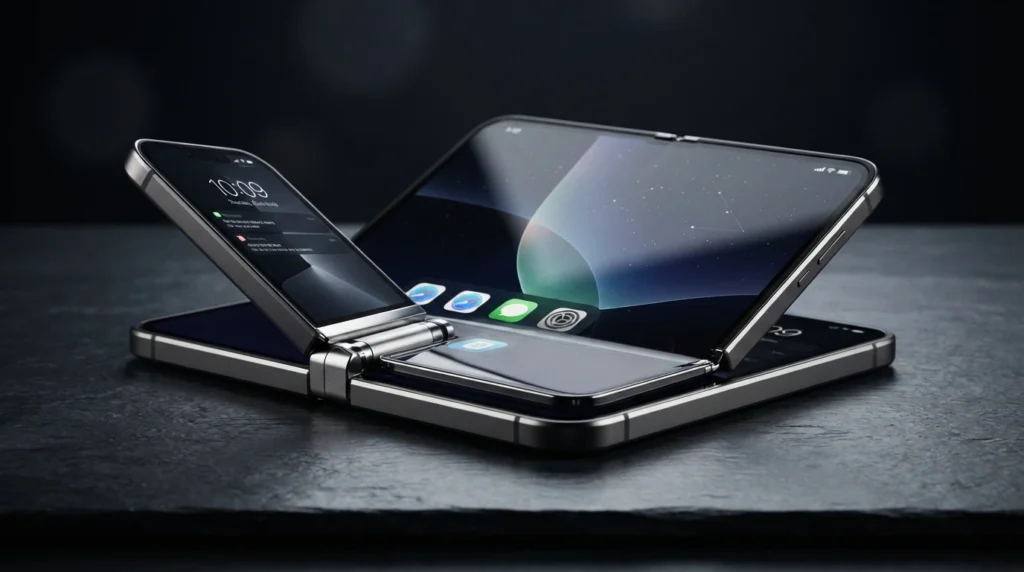
iPhone Ultra Design: An Entirely New iPhone
The anticipated iPhone Ultra will fold, which is the most significant difference.
Before deciding on a book-style design, Apple reportedly examined a number of foldable designs, including various screen sizes and folding mechanisms. The smartphone is anticipated to open horizontally, displaying a significantly larger interior display, as opposed to folding vertically like a conventional flip phone.
The phone would work like a regular smartphone when it was closed. But when it was opened, it would resemble a small tablet.
Accordingly, the iPhone Ultra would essentially provide two experiences within a single device.
Daily activities including messaging, phoning, surfing, and brief conversations will be done on the external screen. When the gadget is opened, users may see a much larger screen intended for productivity, gaming, reading, video, and multitasking.
According to reports, the internal display should be between 7.6 and 7.8 inches, while the external display should be between 5.3 and 5.5 inches.
That combination is uncommon.
The inside screen may be oriented around 4:3, while the external panel is anticipated to be bigger and shorter than a typical iPhone display. The end product would have a significantly different appearance from almost all of the current iPhones.
The “weird” aspect starts at that point.
Apple’s Boldest Move to Date May Be the Passport-Shaped Design
The concept of an iPhone that resembles a passport is among the more intriguing descriptions that have surfaced in recent leaks.
It is anticipated that the device will be wider than a traditional smartphone when unfolded. Apple seems to be aiming for a broader tablet-like layout rather than a very tall and narrow screen.
Because of this, the iPhone Ultra might be very intriguing for productivity.
Imagine having enough horizontal room to put two apps next to each other as soon as you open your phone. You could be able to watch material while checking another program, reply to messages while perusing a paper, or browse the web while taking notes.
Additionally, software improvements tailored to the foldable form factor, like as improved multitasking and layouts that make use of the larger internal display, may be included in iOS 27, according to reports.
The odd dimensions, meanwhile, can also cause issues.
The well-known tall smartphone shape serves as the foundation for many iPhone apps. If Apple wants the inside screen to function more like a tiny tablet, developers might need to adapt their interfaces for a much broader display.
This implies that an equally important software redesign may be necessary in response to Apple’s hardware redesign.
One of Apple’s biggest problems is the crease issue.
Although foldable phones have been around for a while, one issue still plagues them: the crease.
A visible or tactile line appears across the screen as a result of the flexible display’s repeated bending at the hinge. Although several contemporary foldables have significantly lessened this impact, totally eradicating it is still a significant engineering problem.
According to reports, Apple intends to take a different approach.
According to several sources, the business has been aiming for a display that, when opened, looks virtually crease-free. According to recent reports, Apple may have produced a visibly crease-free test result.
If accurate, this might be one of the main selling factors of the iPhone Ultra.
It seems improbable that Apple will enter the foldable industry merely to replicate current products. Before releasing a technology into a popular product category, the corporation usually waits until it can meet its own requirements.
Apple’s delay in releasing a foldable iPhone may be explained by this attitude.
Apple might be attempting to make their version feel more finished rather than being the first.
Naturally, maintaining an amazing crease-free outcome over years of everyday folding differs significantly from getting such result during testing. One of the most important unresolved issues with the iPhone Ultra is its durability.
The iPhone Ultra Could Look Odd Due to Its Extremely Thin Body
Thinness is a key theme in the alleged design.
Apple’s design goals have already shifted due to its recent focus in ultra-thin gadgets. That idea seems to be further advanced by the predicted iPhone Ultra.
When unfolded, the device may be between 4.5 and 4.8 mm thick, according to some reports, however other sources have given other sizes.
Because the product hasn’t been formally introduced yet, that uncertainty is significant.
However, it appears that Apple wants the foldable iPhone to avoid feeling like two thick phones fused together.
The entire idea might feel more natural with a thin foldable, which would also be much easier to carry.
However, being skinny requires making concessions.
Less space is available for components. Batteries must fit into the device’s various portions. Internal space is contested by cameras. It gets harder to cool. It could be necessary to redesign buttons and ports.
And the iPhone Ultra seems to be experiencing precisely that.
Some Well-Known iPhone Features May Be Removed by Apple
This is arguably the most peculiar aspect of the purported design.
You might anticipate that Apple’s priciest iPhone will have every high-end feature.
Rather, there are rumors that the iPhone Ultra may actually lose a number of capabilities that are present in Pro models.
Face ID, a telephoto camera, MagSafe, the Action Button, and a physical SIM card are among the purportedly absent features, though these information have not yet been verified.
Why would Apple take features out of its priciest iPhone?
Space is the solution.
A foldable device’s incredibly small body must accommodate a hinge, flexible display components, batteries, cameras, and other hardware. Each part vies for millimeters.
Because its sensor technology needs internal space, Face ID is especially difficult to operate. Therefore, a smaller foldable might rely on another biometric technology; some reports have indicated Touch ID.
The camera position is intriguing as well.
A High-End iPhone With Just Two Rear Cameras?
Apple has been showcasing the most cutting-edge camera technology on its Pro models for years.
That custom might be broken by the iPhone Ultra.
According to recent sources, there will be two cameras: a 48MP primary camera and a 48MP ultra-wide camera. There might not be a dedicated telephoto camera.
For a phone that is anticipated to cost significantly more than conventional iPhone Pro versions, that would be an unexpected choice.
However, physical space may be the key to the explanation once more.
More space is needed for a huge telephoto camera module. Fitting practical cameras inside a foldable chassis without making the phone a huge brick is Apple’s issue, rather than just creating the greatest camera possible.
A more straightforward camera setup coupled with Apple’s computational photography could be the compromise.
Two powerful cameras can be more than plenty for many users.
However, the lack of a telephoto lens can be a real drawback for photographers who frequently employ optical zoom.
There May Be Two Front Cameras on the iPhone Ultra
Another unique necessity is created by the foldable design.
Apple may employ different front-facing cameras for each screen because the device has an external display and an inside display.
According to reports, the gadget might contain two front cameras, enabling users to capture pictures or make calls whether the phone is closed or open.
Although this is a workable option, it also adds to the unique interior design.
The front camera system of a traditional iPhone just needs to be positioned once.
A foldable iPhone needs to consider the device’s two sides.
For this reason, the Ultra may feel more like a completely new category of Apple hardware than a bigger iPhone.
The Hinge Could Be the Design’s True Star
People frequently concentrate on the screen while talking about foldable phones.
However, the hinge may be even more crucial.
The phone’s hinge controls how it opens, how flat the internal screen becomes, how noticeable the wrinkle is, and how well it withstands thousands of folding cycles.
According to reports, Apple is looking for a hinge solution that can both eliminate display wrinkle and support its slim design. Advanced hinge materials and an emphasis on long-term durability have been noted in certain sources.
There is still doubt here.
According to MacRumors, the hinge experienced quality-control issues during extended high-frequency testing.
That illustrates the main challenge Apple faces.
Making a gorgeous prototype is one thing.
It’s quite another to manufacture millions of devices that can withstand years of opening and closing.
Why is the design of Apple’s iPhone Ultra becoming so bizarre?
The simplest explanation is that Apple has run out of clear ways to make a conventional smartphone seem revolutionary.
The fundamental design of smartphones has evolved.
While not revolutionary, a somewhat slimmer body is beneficial.
While helpful, a brighter display is hardly innovative.
Although most people may not see it, a speedier chip is astounding.
The user-device connection is fundamentally altered by a foldable phone.
Rather than inquiring about the maximum size of a smartphone screen, Apple may pose an entirely different query:
What if your smartphone could transform into a tablet when you need it?
That is the true reason for the peculiar dimensions of the iPhone Ultra.
The design isn’t strange just because it is strange. Apple’s attempt to combine portability with a significantly larger display seems to have resulted in a number of sacrifices.
Advantages of the iPhone Ultra Design: 1. Larger Screen
The inside display is the main benefit.
Compared to a standard iPhone, a screen that is close to 7.8 inches may offer significantly more room for surfing, media consumption, gaming, and productivity.
- Two Gadgets in One
A smartphone and, for some people, a small tablet might be successfully replaced by the iPhone Ultra.
When portability is important, you get a standard external monitor; when productivity is important, you get a big screen.
- Possibly Outstanding Multitasking
Side-by-side applications might be much more useful with the larger interior screen.
This might be one of the device’s most beneficial features if Apple’s software is properly adjusted.
- very thin and foldable design
Apple might make one of the thinnest foldable smartphones on the market if the stated thickness targets are correct.
That would make the folding idea much more manageable on a daily basis.
- A New Apple Design
The Ultra may finally restore the excitement of the iPhone for those weary of incremental smartphone designs.
It would vary from all prior iPhones both mechanically and esthetically.
Cons of the iPhone Ultra Design
- Exorbitant Cost
According to current sources, the price is projected to be significantly higher than Apple’s standard iPhone lineup, with estimates ranging from about $2,000 to significantly higher depending on the source.
As a result, the iPhone Ultra would no longer be considered a common smartphone but rather a luxury item.
- Potential Absence of a Telephoto Camera
Photographers who depend on optical zoom might favor the iPhone 18 Pro Max if Apple actually eliminates the separate telephoto lens.
- The Absence of MagSafe May Be an Issue
MagSafe is now a part of the current ecosystem of iPhone accessories.
Users may need to reconsider their current charging and accessory arrangement if the Ultra’s thinness causes it to drop the magnetic system.
- Concerns about Durability
Compared to traditional smartphones, foldable displays and hinges inherently add greater mechanical complexity.
Apple will have to demonstrate that the Ultra can endure years of regular use.
- Odd External Display
It could take some time to adjust to the larger exterior screen.
Typing and program layouts may initially seem strange to users used to the tall, recognizable iPhone format.
Does the iPhone Ultra Make Sense?
That completely depends on what you’re looking for in a smartphone.
The iPhone Pro range might still be a better option if all you want is the quickest iPhone with the greatest conventional camera setup.
However, the iPhone Ultra might be Apple’s most intriguing product in years if you’re looking for something truly unique.
There is more to its appeal than merely its features.
It has to do with adaptability.
With a traditional iPhone, you have to decide between screen size and portability. The Ultra gives you both in an effort to address that issue.
Complexity is the trade-off.
With a hinge, a flexible display, and other tradeoffs, you are getting a more complex gadget. That extra flexibility will probably demand a premium from buyers.
Because of this, the iPhone Ultra is more of a technological exhibition than a clear upgrade.
Which Design Is Better, the iPhone Ultra or the Conventional iPhone?
The safer design is still the conventional iPhone.
It is dependable, well-known, and refined throughout many years of software development.
In contrast, the foldable Ultra is intended for those who like to have a larger screen without having to carry a separate tablet.
The conventional iPhone might really be more practical for messaging, social media, and quick shooting.
The Ultra’s larger internal display might significantly improve productivity, reading, video editing, and multitasking.
Therefore, it’s not always clear which design is superior.
What kind of phone best suits your lifestyle is the question.
The Bigger Picture: Apple Is Modifying the Definition of “iPhone
The iPhone Ultra’s camera, hinge, and screen may not be its most significant features.
It is what the product stands for.
The iPhone has been characterized by a single, fundamental shape for nearly twenty years.
That pattern might finally be broken with the Ultra.
The anticipated foldable from Apple is more than just an iPhone with a flexible screen. It seems to be a gadget designed with a distinct concept in mind: a phone that, when needed, can expand into a larger workspace.
This explains why the design appears so strange.
Every odd choice, including the tiny chassis, wide outer display, and streamlined camera system, seems to be related to the same objective.
Apple is looking for a foldable that doesn’t feel like a compromise.
Whether it ultimately succeeds is something only time will tell.
Final Decision
Apple seems to be attempting to solve multiple challenging engineering issues at once, which is making the design of the iPhone Ultra more bizarre.
It wants the phone to have a big internal display without being overly massive.
It desires a screen that is foldable and has no noticeable creases.
It desires a high-end style without being overly thick.
Despite having a little internal space, it requires powerful hardware.
It also wants the gadget to stay distinctly Apple.
Unusual outcomes are unavoidably produced by such objectives.
The iPhone Ultra may be unlike anything Apple has ever launched because to its reported passport-style form, thin titanium structure, huge interior display, and streamlined camera system.
Even so, many important details about the device remain unknown.
Many of the product’s specifications are based on leaks and reports rather than Apple’s own comments, the product hasn’t been formally launched, and the name hasn’t been confirmed.
The oddity might end up being the whole idea if Apple is able to provide a dependable hinge, a sturdy display, practical multitasking software, and a truly tiny body.
What happens if it doesn’t?
The iPhone Ultra might therefore turn into a costly experiment.
In any case, Apple’s first foldable iPhone appears to be one of the company’s most ambitious design innovations in recent memory.
FAQ
Has Apple officially confirmed the existence of the iPhone Ultra?
No, neither the term “iPhone Ultra” nor the speculated foldable iPhone have been formally confirmed by Apple. Current reports and leaks are the basis behind the name.
What is the anticipated release date of the iPhone Ultra?
According to current reports, it will ship in the fall of 2026, possibly concurrently with Apple’s iPhone 18 Pro versions, though availability may be impacted by production and supply problems.
Will it be possible to fold the iPhone Ultra?
According to recent speculations, Apple’s purported Ultra model is anticipated to be a foldable smartphone that resembles a book and has both an external and a larger inside display.
What is the anticipated size of the iPhone Ultra display?
An internal display of about 7.6–7.8 inches and an external display of about 5.3–5.5 inches are now the subject of rumors.
Will there be a noticeable crease on the iPhone Ultra?
According to reports, Apple is aiming for a foldable display that is visually crease-free. However, until Apple formally introduces the device, this feature is still only rumored and cannot be considered confirmed.
Will Face ID be available on the iPhone Ultra?
According to some reports, Touch ID may be used in place of Face ID due to the tiny foldable design’s limited internal space. There are yet unknown specifications.
Will there be a telephoto camera on the iPhone Ultra?
There may not be a specialized telephoto camera because current rumors point to a dual rear-camera system with main and ultra-wide cameras.
How much will the iPhone Ultra cost?
The price has not been confirmed. Although rumored pricing varies greatly between sources, current estimates often place the item above $2,000.
Will the iPhone Pro Max be replaced by the iPhone Ultra?
Most likely not. Rather than merely taking the place of the conventional Pro Max design, the Ultra seems to be meant to become a stand-alone high-end folding choice.
Why is the iPhone Ultra’s appearance so different?
Because Apple has to reconsider the screen, hinge, battery, camera location, and internal parts of a foldable phone. The attempt to combine a tablet-sized internal display with a smartphone-sized gadget is largely responsible for the unique shape.