Artificial intelligence has emerged as one of the most influential features shaping the appeal of today’s smartphones. AI is transforming how consumers search for information, edit photographs, write messages, interpret conversations, organize notes, and engage with their devices—rather than just making phones faster.
Apple and Samsung are two of the most well-known companies driving this change. While Samsung has created a wide range of tools under Galaxy AI, Apple has centered its AI effort around Apple Intelligence. Although both businesses are attempting to incorporate AI more deeply into the smartphone experience, their strategies differ significantly.
So, which is genuinely superior between Samsung AI and iPhone AI?
The right choice ultimately depends on what you expect your smartphone to deliver in everyday use. Apple prioritizes integration throughout its hardware and software ecosystem, privacy, and personal context. Samsung, on the other hand, has adopted a more feature-rich strategy, providing AI features for daily chores, photography, communication, productivity, search, and personalization.
The competition has grown even more intriguing in 2026. While Samsung’s Galaxy S26 generation is broadening its concept of an AI-powered smartphone that can comprehend intent and assist users in completing tasks, Apple has revealed its next generation of Apple Intelligence and a more powerful Siri AI.
Let’s examine the two platforms in more detail.
An Overview of Samsung AI vs. iPhone AI
The goal of Apple Intelligence is to integrate AI into the iPhone’s basic functionality. According to Apple, its intelligence elements are incorporated into all applications and experiences to facilitate communication, self-expression, and task completion. Additionally, Apple prioritizes Private Cloud Compute for more complicated requests and on-device processing.
The Samsung Galaxy AI employs a more comprehensive set of tools. Communication, creativity, productivity, personalization, and search are just a few of the domains where Galaxy AI features are accessible. Tools like Circle to Search, Writing Assist, Note Assist, Audio Eraser, Now Brief, Creative Studio, and Gemini-related experiences are all part of Samsung’s current Galaxy AI ecosystem.
To put it simply:
Personal intelligence and ecosystem integration are major areas of focus for iPhone AI.
Samsung AI places a strong emphasis on useful features and personalization.
Apple places a strong emphasis on managed integration and privacy.
A variety of visible AI tools are available from Samsung.
Both technologies integrate cloud-based and on-device AI features.
How you use your smartphone will determine which option is best for you.
Apple Intelligence: What Is It?
Apple’s AI technology for compatible Apple devices is called Apple Intelligence. Apple is incorporating intelligence into regular smartphone interactions rather than treating AI as a distinct chatbot application.
Tools for writing, creating images, editing photos, translating, and doing other system-level operations fall under this category. Features like Writing Tools, Genmoji, Image Playground, Clean Up in Photos, and Live Translation on the iPhone can be powered by Apple Intelligence.
Because Apple owns both its operating system and its hardware, its approach is especially intriguing. This allows Apple to create AI experiences centered around particular chips, iOS features, and apps.
Additionally, Apple has revealed a new version of Siri AI and Apple Intelligence. Richer responses, more organic dialogs, and greater connectivity with the Apple ecosystem are all planned features of the new Siri.
Because of this, Apple’s long-term AI strategy involves more than just text or image generation. The overarching objective is to enable the iPhone to comprehend user behavior and offer helpful support as needed.
Samsung Galaxy AI: What Is It?
Compatible Galaxy smartphones and other Galaxy goods come with a number of AI-powered capabilities called Samsung Galaxy AI.
Samsung has approached mobile AI in a very pragmatic manner. The company has integrated AI into numerous aspects of the phone rather than concentrating on just one AI helper.
Galaxy AI can assist with the following, depending on the device and compatible software:
Composing and editing messages
Interpreting dialog
Recapitulating the notes
Recording transcriptions
Looking up what’s on the screen
Photo editing
Eliminating undesired items
Producing imaginative pictures
Comprehending data displayed on a screen
Information organization
Giving tailored summaries and recommendations
Gemini Live, Creative Studio, Circle to Search, Now Brief, and other AI-powered applications are all part of Samsung’s current Galaxy AI ecosystem.
By focusing on AI that can comprehend human intent, predict needs, and assist in taking action, Samsung’s most recent Galaxy S26 generation expands on the idea.
Samsung AI vs. iPhone AI: Performance
Asking which phone has the quickest processor is only one aspect of AI performance.
While AI workloads also depend on neural processing hardware, memory, software optimization, AI models, and whether a task is completed locally or over the cloud, traditional smartphone performance may be evaluated using CPU and GPU benchmarks.
Apple gains from having joint control over the iPhone’s software and hardware. Apple Intelligence is integrated right into the operating system, and its unique silicon is built to handle demanding workloads. Dedicated hardware capabilities are also used by Apple’s current iPhone generation to provide AI-related experiences.
Samsung is focusing on hardware in a same manner. Samsung is further integrating AI into One UI and the Galaxy ecosystem, and the Galaxy S26 generation makes use of specialized processing technology intended to handle demanding AI tasks.
The crucial point is that raw speed isn’t the only factor in AI performance. Even if the underlying hardware is not significantly different, a feature may feel faster due to improved optimization.
Winner of the Performance: A Close Match
Both ecosystems provide incredibly powerful hardware for daily smartphone use.
In terms of AI in particular, Apple’s advantage stems from close hardware-software integration, whereas Samsung currently provides a greater range of very apparent AI functionalities.
Here, there isn’t a clear winner. The particular AI task determines which experience is better.
AI-Powered Camera and Image Editing
One area where smartphone AI has become very noticeable is photography.
Samsung has adopted generative AI editing with great vigor. Galaxy AI may assist users in creating new visual content, editing, and removing undesired parts from photographs.
While other Galaxy AI capabilities can assist users in interacting with and editing visual information, Samsung’s Creative Studio can create graphics from written descriptions, sketches, or photos.
Social media creators and regular users who wish to transform an average photo into something more artistic without launching a professional editing program may find this helpful.
AI-powered picture tools are also available from Apple. For instance, Clean Up can assist in eliminating unwanted distractions from images, while Apple’s image-generation tools enable users to produce visual content.
The philosophy is the main area of difference.
AI editing is frequently incorporated by Apple into the current Photos experience.
Samsung frequently offers customers AI-powered editing choices and more visible creative controls.
Winner of Camera AI: Samsung
Samsung has a significant advantage for consumers who expressly seek creative AI technologies and generative photo editing.
The iPhone is still quite competitive for anyone seeking a more straightforward photo-management and editing experience within the Apple ec
AI in Communication
When it comes to communication, AI can be especially helpful.
Samsung Galaxy AI has established a solid reputation as a communication and translation tool. Galaxy AI can help with writing recommendations, call translation, text translation, and other communication duties, depending on the device and supported languages.
Writing Assist and other translation-related features are part of Samsung’s Galaxy AI feature set, which aims to facilitate cross-linguistic communication.
Additionally, Apple is improving its communication skills. On compatible hardware and software versions, Apple Intelligence facilitates Live Translation in Messages, Phone, and FaceTime.
This indicates that the difference between the two platforms is getting smaller.
But Samsung has invested more time in making AI for communication and translation a prominent feature of the Galaxy experience.
Winner of Communication: Samsung
For consumers who frequently require translation, writing support, or multilingual communication, Samsung has a little benefit.
AI for Efficiency
The most practical justification for using smartphone AI might be productivity.
Imagine being able to record a meeting and get a summary and transcript without having to type everything by hand. or condensing and organizing a lengthy note.
Many of these features are immediately integrated into the Samsung Galaxy AI’s environment. While other features can assist with writing and transcription, Samsung Notes can employ AI-assisted tools for content organization and summarization.
Additionally, Samsung is testing proactive AI. Based on the user’s day and activities, features like Now Brief are intended to provide pertinent information and updates.
Apple Intelligence takes a more comprehensive approach to productivity. While Apple is increasing AI’s capacity to function across applications and comprehend individual context, writing tools can assist users in rewriting, proofreading, and summarizing material.
Because Apple is pitching Siri as a more proficient conversational assistant rather than just a voice-command tool, the company’s impending Siri AI is especially significant in this context.
Productivity Winner: Apple for Integration, Samsung for Features
Nowadays, Samsung provides a wider range of evident productivity tools.
The ability to incorporate intelligence into an already-existing workflow for the iPhone, iPad, and Mac is Apple’s edge.
That ecosystem connection might be really beneficial if you own several Apple products.
Privacy: Samsung AI vs. iPhone AI
One of the main distinctions between Apple and Samsung’s AI marketing approaches is privacy.
Apple places a high priority on privacy as a component of Apple Intelligence. According to the business, Private Cloud Compute can handle more complicated requests, although many AI activities are handled directly on the device. These cloud-based requests, according to Apple, are intended to protect customer privacy.
On-device AI capabilities are also supported by Samsung. Although the precise processing technique may differ depending on the feature, the Galaxy AI platform employs on-device artificial intelligence across all compatible Galaxy devices.
Customers should be aware that not every AI feature on either platform functions in the same way.
While more complex services might need cloud computing or an internet connection, other tasks can be completed locally.
Winner of Privacy: iPhone
Apple has the advantage in this situation since its AI architecture and marketing strategies place a greater emphasis on privacy.
While Apple has made private AI processing one of the hallmarks of Apple Intelligence, Samsung continues to offer robust privacy and security measures.
Experience of the User
Only when users can locate and utilize AI features will they be beneficial.
Apple has historically prioritized a user experience that is rather straightforward. Instead of placing dozens of controls in front of the user, the corporation typically aims to make technology feel integrated.
Samsung adopts a more adaptable strategy.
Users can engage with AI in a variety of ways thanks to Galaxy AI’s distribution throughout multiple applications and system functions.
Although such adaptability is a strength, it may also make things seem more difficult.
Winner of User Experience: Tie
Select an iPhone if you’d like:
An experience that is cleaner
Robust integration of ecosystems
A more regulated method of using AI
Very little setup
Select Samsung if you’d like:
Additional AI tools
Increased personalization
More imaginative choices
Additional methods for interacting with AI
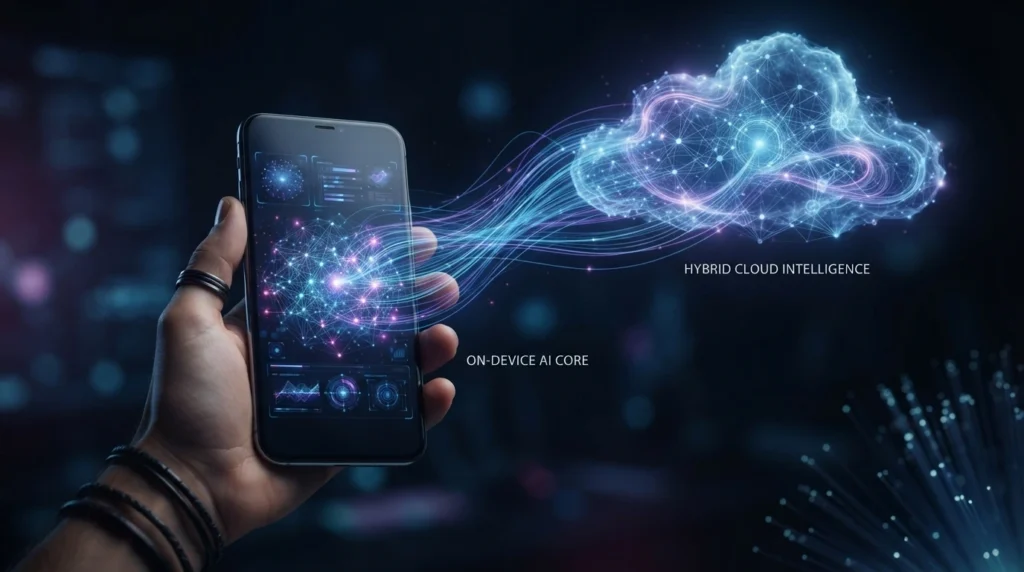
Cloud AI vs. On-Device AI
Where processing actually takes place is one of the most crucial technological concerns in mobile AI.
On-device AI refers to AI that is carried out directly on the phone. Benefits like reduced reliance on an internet connection and possibly increased privacy can result from this.
Cloud AI transmits data to distant servers so that more potent computer resources can handle the request.
Apple and Samsung both employ a mix of strategies.
Apple’s Private Cloud Compute is intended to employ server-based Apple hardware for more sophisticated AI tasks while preserving privacy.
While some Galaxy AI services may rely on network connectivity or other AI services, Samsung also makes use of on-device AI capabilities.
The next generation of AI is expected to rely on a balanced combination of on-device processing and cloud-based intelligence.
Smartphones will employ cloud computing when a task calls for a larger model or more processing power, and they will tackle smaller, faster AI tasks locally.
Samsung AI vs. iPhone AI for Students
Smartphone AI has a lot to offer students.
Samsung’s productivity features can aid with writing, organizing data, summarizing notes, and transcribing recordings.
Because of this, students who use their phones as study aids may find Galaxy AI very helpful.
Additionally, writing, summarizing, translating, and organizing information are all made easier using Apple Intelligence. The Apple ecosystem can improve a student’s overall workflow if they already own a MacBook and iPad.
Samsung is the student winner.
Samsung benefits from the abundance of integrated productivity and study-related AI technologies.
However, due to device continuity and integration, students who have already made an investment in the Apple ecosystem could favor the iPhone.
Samsung AI vs. iPhone AI for Content Producers
The priorities of content makers vary.
They require high-quality cameras, quick editing, dependable video capture, social media integration, and artistic tools.
For designers who wish to edit photos directly on their phones, Samsung’s AI photo-editing features are especially intriguing.
For some tasks, Creative Studio and generative editing can eliminate the need for different editing programs.
Because of its extensive professional app ecosystem and hardware-software interaction, the iPhone continues to be very appealing to producers.
The entire camera and software ecosystem may be more important to a creator who primarily records and edits video than just AI functions.
Depending on the workflow, the creator may win.
For built-in generative AI inventiveness, Samsung is superior.
iPhone: Better for those that value a well-established process for professional mobile video and Apple devices.
Which AI Is Better Suited for the Future?
The hardest question might be this one.
AI will undoubtedly play a major role in the upcoming iPhone experience, according to Apple. Apple plans to extend Apple Intelligence beyond its initial feature set, with Siri AI becoming more capable and conversational, according to its 2026 announcements.
Additionally, Samsung is making rapid progress toward what it terms a more agentic, intuitive AI experience. The Galaxy S26 generation is made to recognize intent, foresee requirements, and provide more proactive work assistance.
This indicates that both businesses are headed in the same long-term direction.
In the future, the smartphone might function more like an AI-powered personal assistant that comprehends context and completes tasks rather than just launching apps.
Winner of Future-Proofing: Too Close to Call
One of Apple’s advantages is that it controls its ecosystem.
Samsung has the benefit of providing a wide range of AI capabilities and experimenting swiftly.
Both will probably continue to be important participants in smartphone AI.
iPhone AI Benefits and Drawbacks
Robust architecture that prioritizes privacy
Outstanding software-hardware integration
AI incorporated into iOS
Tools for writing and communicating
Real-time Translation
Features of AI images
robust Apple ecosystem
Creating the Next Generation of Siri AI Cons
AI accessibility may vary by locale, language, and device.
Over time, some cutting-edge AI experiences might be released.
Compared to Samsung, there is less focus on very experimental creative tools.
Apple states that not all iPhone models, languages, and geographical areas have access to Apple Intelligence.
Samsung Galaxy AI Benefits and Drawbacks
A wide range of AI tools
Robust AI photo editing
Features for communication and translation
Writing support
Tools for taking notes and transcribing
To search, circle
Studio of Creativity
Integration of Gemini
Customized AI encounters
Strong personalization drawbacks
Different gadgets have different features.
An internet connection might be necessary for certain features.
Some services might need an account.
It can be overwhelming to have so many AI alternatives.
Availability may differ depending on the language and market.
Additionally, according to Samsung, the availability of Galaxy AI may vary based on the device, software version, location, and particular function.
Samsung AI vs. iPhone AI: Conclusion
So, which is superior, Samsung AI or iPhone AI?
For every smartphone user, there isn’t a single solution.
The iPhone is a great option if privacy, ecosystem integration, ease of use, and a strictly regulated software experience are your top priorities.
The Samsung Galaxy AI now has a significant advantage if you desire further AI functions, creative photo editing, translation, productivity tools, customisation, and proactive support.
Samsung is incorporating AI into every aspect of the Galaxy experience. The camera, notes, communication tools, search, creative features, and individualized data all have it.
Apple is going in a slightly different direction. With personal context, privacy, and deeper integration becoming more crucial, the business is striving to make AI feel like a natural layer of the operating system.
Winner in the overall comparison category
Variety of AI Features Samsung
iPhone privacy
Samsung Translation, AI Photo Editing, and Productivity FeaturesSamsung iPhone Ecosystem Integration
iPhone Customization Simplicity Samsung
Innovative AI Samsung
iPhone Personal Intelligence Future Prospects Tie
The AI smartphone that best suits your everyday workflow is ultimately the best one.
It might not make sense for an Apple consumer who already has a Mac, iPad, Apple Watch, or AirPods to move to Samsung solely for AI.
Similarly, a Galaxy phone would be more worthwhile for someone who wants robust AI editing, adaptable customisation, and a large number of built-in tools.
The fact that both businesses are heading toward a time where AI is more than simply an optional feature is the most significant development. The operating system itself is starting to incorporate it.
FAQ
- Is Samsung AI inferior to iPhone AI?
Your priorities will determine this. While Samsung Galaxy AI offers a wider range of AI functions for productivity, creativity, communication, and personalization, iPhone AI excels in privacy and ecosystem connectivity.
- Which phone’s AI picture editing is superior?
For those seeking creative and generative photo-editing tools, Samsung Galaxy AI currently has an advantage. On compatible Galaxy handsets, Samsung provides AI-powered editing and Creative Studio tools.
- Does the iPhone have AI capabilities?
Indeed. On compatible hardware and software versions, Apple Intelligence offers functions like Writing Tools, Genmoji, Image Playground, Clean Up, and Live Translation.
- Is AI present in the Samsung Galaxy?
Indeed. Communication, productivity, photography, search, personalization, and creative tools are all included in Galaxy AI. Samsung keeps adding new features to compatible Galaxy devices.
- Which is better for students, a Samsung or an iPhone?
For students who require integrated note-taking, transcription, writing, translation, and information management tools, Samsung might be a better option. For students who currently use Macs and iPads, the iPhone may be a superior option.
- Which is better for privacy, a Samsung or an iPhone?
When it comes to privacy-focused AI architecture, Apple has a significant advantage. For simple tasks, Apple Intelligence uses on-device processing; for more complicated requests, it uses Private Cloud Compute.
- Can the iPhone use AI to translate conversations?
Indeed. On compatible hardware and software, Apple Intelligence facilitates Live Translation in Messages, Phone, and FaceTime.
- Is Samsung AI capable of photo editing?
Indeed, on compatible devices, Galaxy AI offers AI-powered photo editing and creative features. Creative Studio and other visual AI features are part of Samsung’s current Galaxy AI ecosystem.
- What is the phone with the most AI features?
In general, Samsung provides a wider range of visible AI features for productivity, photography, communication, search, and customization.
- For AI, should I purchase an iPhone or a Samsung phone?
If privacy, ease of use, and integration with the Apple ecosystem are important to you, get an iPhone. If you’re looking for more AI features, creative tools, customisation, and productivity functions, go for Samsung.
In conclusion
The competition between Samsung AI and iPhone AI is no longer only about whether company’s chatbot is more intelligent.
It concerns the extent to which AI can be integrated into a smartphone.
Apple is working toward integrating a more private and individualized intelligence system into iOS and the larger Apple ecosystem.
From photography and communication to search, productivity, personalization, and creative work, Samsung is integrating AI into nearly every aspect of the Galaxy experience.
The Samsung Galaxy AI is hard to ignore for users who are feature-hungry. Apple Intelligence presents a compelling alternative for those who value simplicity, privacy, and a closely integrated environment.
Although the competition for smartphone AI is still in its early phases, both companies are obviously making significant investments in the future.
Samsung is the better option overall if you want the most AI features available now. The iPhone is a better option if you’re looking for a more integrated and privacy-focused AI experience.