One of the most significant additions to Apple’s smartphone portfolio may be the iPhone 18 2nm chip.
According to reports, Apple is developing a new A20 chip using TSMC’s cutting-edge 2nm manufacturing process.
Performance, power efficiency, artificial intelligence, and thermal control could all be enhanced by this new microprocessor.
All of the A20 chip’s specifications have not yet been formally confirmed by Apple, tho.
The information presented here draws partly from recent industry analysis, supply-chain developments, and reports surrounding Apple’s upcoming hardware.
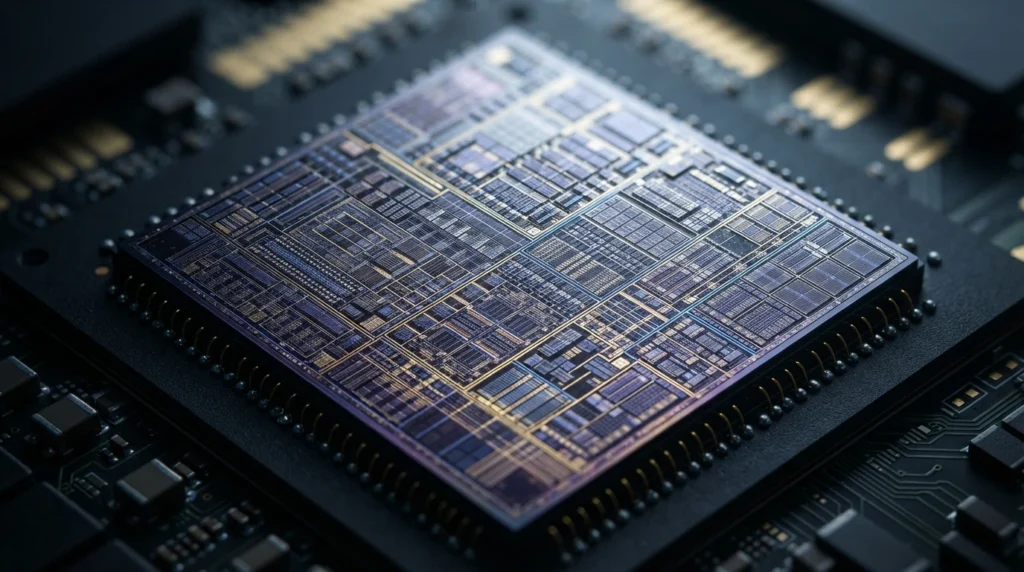
The iPhone 18 2nm Chip: What Is It?
Many people refer to the anticipated processor for the iPhone 18 as the Apple A20 chip.
Reports indicate that Apple may manufacture its next-generation A20 processor with TSMC’s N2 technology, moving the iPhone lineup beyond the 3nm chipmaking process.
The change would be a significant improvement above the 3nm technology found in the most recent iPhone processors.
Manufacturers can fit more transistors into a comparable amount of area by using a smaller semiconductor process.
Additionally, it can enhance performance per watt.
This might result in quicker processing for smartphone users without requiring a lot more battery life.
What Makes 2nm Technology Vital?
A new generation of semiconductor manufacturing technology is referred to as “2nm.”
It does not imply that every component of the chip is precisely two nanometers in size.
Instead, 2nm represents a newer chipmaking technology designed to pack more transistors into a smaller space while improving power efficiency and overall performance.”
This technology may provide Apple additional space to enhance its processing design.
Higher performance, longer battery life, or more sophisticated AI functions might all benefit from the company’s increased efficiency.
A20 Chip in Comparison to Earlier iPhone Chips
Over time, Apple has made consistent improvements to its A-series processors.
The switch to 2nm may present yet another significant chance to enhance the efficiency-performance ratio.
According to recent rumors, the A20 may perform better and use less power than chips from earlier generations.
Although these figures are not official Apple specs, some estimates suggest notable efficiency gains.
Apple’s ultimate processor design and software optimization will determine the real outcomes.
Anticipated A20 Performance
Apple could push the iPhone 18’s processing capabilities further, with the rumored A20 chip bringing redesigned CPU and GPU components for faster and more efficient operation.
Demanding apps might operate more quickly as a result.
When utilizing AI-powered apps, playing high-end games, or editing films, users might notice the biggest benefits.
However, the change might not be as apparent for routine operations like chatting and web browsing.
For typical smartphone tasks, modern iPhones are already incredibly fast.
A20 Pro for Models of the iPhone 18 Pro
Additionally, Apple is anticipated to release an A20 Pro CPU for a few high-end iPhone models.
When compared to the normal A20, the A20 Pro may offer more performance.
Apple used a similar approach with earlier iterations of the iPhone.
Usually, the Pro models come with better graphics power or a more potent processing arrangement.
According to recent reports, the A20 Pro may be used in the iPhone 18 Pro series.
The precise CPU and GPU specs, however, have not yet been made public.
Battery Life and iPhone 18 2nm Chip
One of the main advantages of switching to 2nm technology may be battery longevity.
Certain functions can be completed with less energy using a more efficient chip.
This does not guaranty a significantly longer battery life for the iPhone 18.
The display, modem, battery capacity, software, and user behavior all affect battery performance.
Nevertheless, Apple has additional options thanks to a more effective processor.
The efficiency gains might be used by the business to boost performance while keeping battery longevity comparable.
As an alternative, Apple might concentrate more on prolonging battery life.
Enhanced Efficiency Per Watt
Performance per watt is one of the most significant benefits of modern chip fabrication.
This refers to the ratio of a processor’s processing power to its energy consumption.
In smartphones, a higher performance-per-watt ratio is quite helpful.
It can assist the gadget in carrying out difficult tasks without using up too much battery life.
Additionally, it can aid in lowering body temperature when working hard.
Is the iPhone 18 Going to Be Cooler?
Thermal efficiency might be enhanced by the 2nm device.
A processor can produce less heat when it consumes less energy for the same workload.
In particular, lower heat can be helpful when editing videos and playing games.
But there are other factors outside processor efficiency that affect smartphone temperature.
Heat management is also influenced by the battery, software, cooling system, and internal design of the iPhone.
Artificial Intelligence and the iPhone 18
In smartphones, artificial intelligence is becoming more and more significant.
With Apple Intelligence and its proprietary silicon, Apple is making significant investments in on-device AI.
For AI tasks, the A20 might offer additional processing capability.
The iPhone might be able to handle some AI activities directly on the device with the aid of a more sophisticated neural engine.
This could decrease the requirement to submit every task to cloud servers and increase responsiveness.
Improved On-Device AI
On-device AI has a number of benefits.
Because the gadget does not constantly need to communicate with a distant server, it can lower latency.
In the event that an internet connection is not available, it can also offer helpful functions.
Another possible advantage is privacy.
Apple might have greater headroom for upcoming AI features in iOS with a more potent A20 processor.
Advanced Packaging for Chips
There are other fascinating aspects of the A20 narrative beyond the production procedure.
According to some reports, Apple’s next-generation processor may employ more sophisticated semiconductor packaging techniques.
Wafer-Level Multi-Chip Module, or WMCM, is one suggested option.
Modern packaging can facilitate more effective communication between various parts.
As more AI tasks are handled by smartphone CPUs, this may become more crucial.
The Significance of Memory
A strong CPU is not enough for modern AI applications.
They also need quick and effective memory access.
Certain tasks may be completed more quickly if the CPU can interact with memory more effectively.
This is especially crucial for jobs involving image processing and AI models.
Therefore, integrating cutting-edge 2nm production with better chip packing could be advantageous for Apple.
Gaming Performance of the iPhone 18
Another area where the A20 might have an impact is gaming.
It can take a lot of CPU and GPU power to play modern mobile games.
Complex surroundings, sophisticated lighting, and high-resolution graphics can strain a smartphone’s processor.
Smoother gaming performance on the iPhone 18 might be possible with a more potent GPU.
Increased productivity may also aid in sustaining performance throughout extended gaming sessions.
Long-Term Performance
There are other factors that are more important than peak performance.
For a little time, a smartphone can perform at an extremely high level.
However, the system may operate worse if it gets too hot.
Thermal throttling is the term used to describe this phenomenon.
The iPhone 18 may be able to sustain better performance for longer thanks to improved efficiency.
Professional developers and gamers may find that very helpful.
The A20 Chip and Photography
In contemporary smartphone photography, the processor is crucial.
When you snap a picture with your iPhone, it is frequently processed using a number of computational methods.
Processing power is needed for HDR, noise reduction, image fusion, and portrait effects.
Apple could be able to complete these tasks faster with a more potent A20 chip.
Additionally, it might offer more computing power for upcoming computational photography technologies.
Recording Videos
Compared to photography, video recording can be considerably more difficult.
Continuous processing is necessary for high-resolution video.
Processor workload can also be increased by features like real-time effects, HDR video, and stabilization.
Apple may be able to manage power more effectively for these tasks because to the anticipated efficiency of the A20.
This extra processing power could be very useful for professional users.
Two Nm Does Not Equate to Two Times Faster
Regarding 2nm chips, there is a widespread misconception.
The iPhone 18 won’t necessarily be twice as quick just because it has a 2nm chip.
Numerous factors affect chip performance.
Clock rates, cache, memory bandwidth, CPU architecture, GPU design, and software optimization are some of these.
Apple just has a more sophisticated foundation thanks to the 2nm manufacturing process.
Apple still needs to include that technologies into the processor’s design.
Apple’s 2nm Technology and TSMC
Apple’s upcoming 2nm chips are anticipated to be produced by TSMC.
In advanced semiconductor production, Apple and TSMC have a long-standing partnership.
It is anticipated that TSMC’s N2 process will play a significant role in the company’s technological strategy.
One of the main consumers interested in the technology is thot to be Apple.
The process of switching to a new manufacturing node is difficult.
It needs sophisticated production equipment and a large investment.
Why It’s Hard to Make 2nm Chips
Advanced chip manufacturing is a very complex process.
Manufacturing tolerances increase with the size of transistor structures.
Chip production yields can be impacted by even minute flaws.
This is one of the reasons why only a few businesses are able to produce the most sophisticated processors in the world.
For the semiconductor industry as a whole, TSMC’s capacity to manufacture 2nm chips on a broad scale will be crucial.
Will the same chip be used by all iPhone 18 models?
Most likely not.
Apple might keep differentiating between its Pro and basic versions.
The A20 is anticipated to be used by the standard iPhone 18.
The A20 Pro could be used with the more expensive iPhone 18 Pro devices.
Additionally, there have been claims of several iPhone 18 models having varied debut timetables.
These data should be regarded as reports rather than verified specifications until Apple makes an official announcement.
How Will the A20 Affect Regular Users?
The typical user might not notice a significant difference right away.
On contemporary iPhones, opening apps, sending messages, and visiting websites are already quite quick.
During challenging activities, the improvements may become more apparent.
Professional photography, video editing, gaming, and AI applications could all gain more from the new processor.
The long-term benefit might be even more significant.
Apple has more performance headroom for upcoming iOS versions thanks to a more efficient processor.
iPhone 18 2nm Chip: Anticipated Advantages
According to recent reports, the A20 could provide a number of significant enhancements.
These could consist of:
Improved efficiency per watt
Increased density of transistors
Enhanced CPU efficiency
Improved GPU efficiency
Improved AI processing
An increase in thermal efficiency
Quicker processing of images
Improved processing of videos
More effective gaming
Potentially longer battery life
These are not final specifications, but rather anticipated benefits.
When Apple launches the next generation of iPhones, the official details will be made public.
Is the 2nm Upgrade Something to Look Forward to?
Yes, but expectations ought to be reasonable.
Technically, the switch to 2nm is significant.
It provides Apple with access to a more recent semiconductor platform that may enhance several aspects of the iPhone experience.
But the phone’s performance cannot be determined by the process node alone.
Both program optimization and Apple’s processor architecture will be crucial.
When these technologies are combined, the A20 may become an extremely powerful mobile processor.
FAQ
1-Will a 2nm chip be used in the iPhone 18?
According to recent sources, Apple is working on a 2nm A20 processor for the upcoming iPhone 18.
Apple has yet to officially disclose the complete details and specifications of its upcoming chip
2-What will be the name of the processor in the iPhone 18?
Most people anticipate that the next generation of chips will be known as the A20.
The A20 Pro might be the name of a more powerful variant.
3-Will the A20 outperform the A19 in speed?
It is anticipated to be quicker.
Apple has yet to reveal the exact performance figures for the upcoming chip
4-Will battery life be enhanced by 2nm?
It might increase electricity efficiency.
However, a number of other factors, such as the display, battery, and modem, will affect the battery’s ultimate lifespan.
5-Will Apple Intelligence be enhanced by the A20?
More resources for on-device AI might be available with a more potent processor.
Future iOS apps and Apple’s AI capabilities will also affect the real AI advancements.
6-Is the transistor really 2 nm in size?
Not precisely.
“Today’s semiconductor process labels are primarily used to identify different generations of chip manufacturing technology and their technological advancements.”
They shouldn’t be taken as a straightforward assessment of each transistor.
7-Will A20 be used by all iPhone 18 models?
According to recent reports, Apple may employ various CPU variants in its portfolio.
While pro models might utilize A20 Pro, regular models might use A20.
8-Is the 2nm chip for the iPhone 18 finally confirmed?
Apple has not officially released the complete technical details of its upcoming A20 processor yet
Most of the latest details currently available come from semiconductor analysts, industry research, and ongoing supply-chain developments
Final Decision
One of Apple’s most significant CPU enhancements may be the iPhone 18 2nm chip.
The switch to TSMC’s 2nm technology may simultaneously increase efficiency and performance.
Additionally, the A20 might offer more processing power for video, gaming, photography, and artificial intelligence.
Efficiency rather than speed might be the greatest benefit for average users.
With a speedier processor that uses less power, Apple may be able to add more demanding features without significantly affecting battery life.
This could be advanced in the iPhone 18 Pro lineup with the anticipated A20 Pro.
However, consumers shouldn’t consider leaked specs to be definitive until Apple makes an official announcement.
The switch to 2nm silicon for the iPhone 18 is promising overall.
Apple might employ the A20 to provide a superior mix of performance, efficiency, AI capability, and prolonged power if the current reports are correct.
Benchmark statistics by themselves might not be as significant as that combo.