One of the most intriguing foldable phones that Samsung released in 2026 is the Galaxy Z Fold 8. With the basic Fold 8, Samsung has adopted a different strategy rather than only making the previous Fold generation faster or slimmer. The phone’s form has been altered by the firm, making it shorter and wider than previous Galaxy Z Fold models.
On paper, that modification seems straightforward, but it drastically changes how the phone feels in daily use.
The Galaxy Z Fold 8 features a smaller, passport-like profile when it is closed. When you open it, a sizable 7.6-inch folding display with a 4:3 aspect ratio is revealed. To put it another way, Samsung wants the Fold to feel more like a little tablet that you can carry in your pocket rather than a tall smartphone that just so happens to unfold.
After using the device for a while, it’s evident that Samsung has a target market in mind. The Fold 8 is intended for those who desire a high-end smartphone with a bigger screen for work, gaming, reading, watching movies, and multitasking.
The phone isn’t flawless, the.
Some consumers might reconsider upgrading due to its exorbitant cost, absence of a dedicated telephoto camera, and peculiar outer-screen dimensions. So, is it worthwhile to get the Samsung Galaxy Z Fold 8?
Let’s examine it more closely.
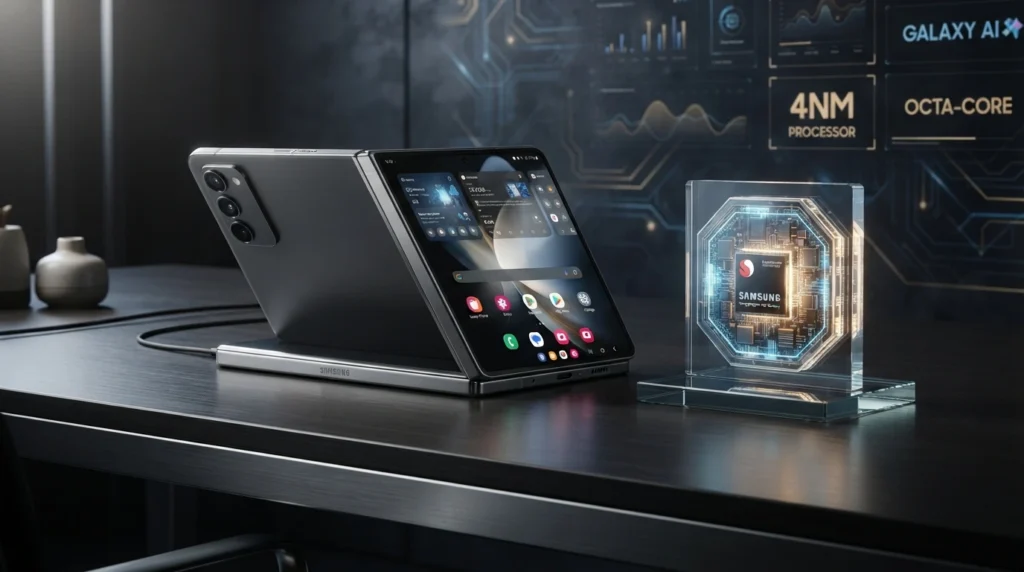
Overview of the Samsung Galaxy Z Fold 8
Samsung’s most recent regular book-style foldable smartphone is the Galaxy Z Fold 8. In the company’s 2026 lineup, it is positioned underneath the more costly Galaxy Z Fold 8 Ultra.
Its new form factor is the most significant modification. With its larger cover display and 4:3 internal screen, the Fold 8 feels like a tiny tablet when unfurled.
Additionally, Samsung has concentrated on enhancing mobility and minimizing noticeable creases. The Fold 8 is much lighter than many people may anticipate for a folding phone, at only 201 grams.
The Snapdragon 8 Elite Gen 5 for Galaxy chipset from Qualcomm powers the phone. Storage can exceed 1TB, while RAM options can reach up to 16GB.
Along with a number of Galaxy AI capabilities centered around the larger foldable screen, the gadget also runs Android 17 with Samsung’s One UI 9 software.
Key Features of the Samsung Galaxy Z Fold 8
7.6-inch LTPO AMOLED internal display
Aspect ratio of the inside display: 4:3
5.5-inch LTPO AMOLED cover display
Refresh rate: 120 Hz maximum
Processor: Galaxy Snapdragon 8 Elite Gen 5
RAM: 12GB to 16GB
256GB, 512GB, and 1TB of storage
4,800mAh battery
Up to 45W for wired charging
50MP primary and 50MP ultrawide rear cameras
IP48 water resistance
System software: One UI 9; operating system: Android 17
Weight: around 201 grams
Samsung has focused on the complete foldable experience rather than just chasing the highest statistics, as evidenced by the specifications.
Design and Construction Quality
Perhaps the most compelling argument for the Galaxy Z Fold 8 is its design.
The tall, narrow design of previous Galaxy Z Fold phones has been abandoned by Samsung. When folded, the Fold 8 seems more compact because it is shorter and wider.
When holding the phone, that makes a discernible difference.
Because the outside display is not as small as earlier Fold models, it feels more natural for many daily chores. Notifications, browsing, and messaging feel less constrained.
For a gadget that can be converted into a 7.6-inch tablet, the phone is also quite light.
Samsung reinforced the foldable frame with high-quality materials and a novel Flex Titanium technique. Compared to previous generations, the crease is less noticeable because to the hinge and display design.
The drawback is that it takes some time to get used to the new shape.
The broader outer display may seem strange at first if you are used to a conventional tall smartphone. Additionally, certain programs struggle to adjust to the new aspect ratio. Black bars or somewhat strange scaling may appear in some social media and video apps.
Nevertheless, the design eventually starts to make sense.
Experience with Display
The Galaxy Z Fold 8 truly shines on the inner screen.
The phone comes with a 7.6-inch LTPO AMOLED display from Samsung that can refresh at 120 Hz. The 4:3 format works especially well for tablet-optimized apps, reading, online surfing, and documents.
The Fold 8 feels much more like a little tablet because to its bigger canvas, which makes watching films fun.
Samsung’s anti-reflective treatment helps lessen annoying reflections, and the display can achieve extremely high brightness levels. Another good change is the less obvious wrinkle.
The inside screen is far more helpful than a traditional smartphone display for users who read PDFs, edit papers, browse websites, or consume long-form information.
In contrast, the external 5.5-inch screen is intended for simple daily chores.
Without unlocking the phone, you can utilize numerous apps, check your email, respond to messages, and browse websites.
One of the main benefits of a foldable is its two-screen design.
Performance
When it comes to performance, the Galaxy Z Fold 8 is a top phone.
It has enough processing power for demanding apps, gaming, multitasking, and AI capabilities thanks to the Snapdragon 8 Elite Gen 5 for Galaxy.
Users who choose to retain the phone for a number of years have plenty of hardware headroom with up to 16GB of RAM and 1TB of storage.
Apps open swiftly when used normally, and switching between them is seamless.
The huge interior display also has an impact on gaming. The strong chipset offers the performance needed for demanding games, and games have greater screen real estate.
As is typical with powerful tiny devices, prolonged gaming sessions can still cause heat, but early reviews indicate the Fold 8 manages sustained performance better than some previous-generation worries would suggest.
The Fold 8 is even more remarkable in terms of output.
You can work with documents without continually switching displays, watch a movie while conversing, or browse the web while taking notes because you can run many apps side by side.
The Fold 8 begins to justify its high cost at this point.
Galaxy AI and software
The folding experience is only half hardware.
The bigger display of the Fold 8 is intended to be utilized by Samsung’s One UI 9. Up to three apps can be used on the screen in supported scenarios thanks to the software’s multitasking and multiple application support.
Additionally, Samsung has released more recent AI-powered technologies like Gemini Intelligence and Now Nudge.
Adding AI for marketing objectives is not the only objective. Rather, Samsung is attempting to integrate AI into the entire operating system.
These functions have greater space to operate thanks to the wide display.
Because Samsung has years of expertise creating One UI for foldable devices, its flexible software continues to be one of its greatest advantages.
There are still certain software restrictions, nevertheless.
Because to the Fold 8’s unique aspect ratios, some third-party apps are not fully optimized. Although it may not be Samsung’s responsibility, this could negatively impact the user experience.
It will take some time for app developers to optimize their program in accordance with the daring wider design.
Performance of the Camera
Although the Galaxy Z Fold 8 has a good camera system, photography isn’t its best feature.
The phone includes two cameras: a 50MP primary camera and a 50MP ultrawide camera. In excellent lighting, the cameras can take detailed pictures and provide the processing power one would expect from a high-end Samsung smartphone.
In general, colors are vivid, dynamic range is robust, and challenging settings are enhanced by Samsung’s computational photography.
The ultrawide camera can be used for group pictures, architecture, and landscapes.
One glaring omission, tho, is a special telephoto lens.
This implies that the Fold 8 will be less versatile than some rival flagship phones for those who frequently snap far-off subjects or depend on optical zoom.
Given the cost, this is particularly apparent.
In order to keep the basic Fold 8 lighter, smaller, and less expensive than the Fold 8 Ultra, Samsung has obviously made some concessions.
The cameras should be more than sufficient for informal photography.
However, it might be hard for dedicated mobile photographers to overlook the absence of telephoto zoom.
Charging and Battery Life
A 4,800mAh battery is included with the Galaxy Z Fold 8.
For a gadget with a huge internal display, its capacity might not seem all that amazing at first. But Samsung has paired the battery with a more effective flagship chipset and more recent silicon-carbon technology.
The phone’s actual battery life is mostly dependent on how you use it.
Battery life can be rather reasonable if you use the cover display for simple tasks for the majority of the day. Naturally, prolonged usage of the 7.6-inch display, intense gaming, and video recording will take more power.
The Fold 8 can last around a full day of normal use, according to recent testing, tho power users might still want a charger close at hand.
Up to 45W of cable charging is supported by the phone.
That is helpful, but in the market for high-end foldables, it is not the best.
Given that rivals are promoting far quicker charging solutions, Samsung still has space to improve charging speeds.
Sturdiness
One of the main concerns about foldable cellphones has always been their durability.
With better materials, a redesigned hinge, and IP48 water and dust protection, the Galaxy Z Fold 8 allays some of those worries.
Although the IP48 classification offers defense against exposure to water and bigger solid particles, it shouldn’t be mistaken for total dust protection.
That distinction is important.
Users should exercise caution when handling sand, dust, and other tiny particles because foldable phones still have a more complex mechanical construction than traditional smartphones.
Although the enhanced hinge and decreased crease are positive indicators, no foldable smartphone should be handled precisely like a conventional slab smartphone.
Multitasking with the Samsung Galaxy Z Fold 8
Multitasking is one feature that sets the Fold 8 apart from nearly all other smartphones.
You have a considerably bigger workspace when you open the gadget.
You can use a messaging app on one side and a browser on the other. Depending on your workflow, you can additionally integrate media, communication apps, and productivity tools.
This can be quite helpful for professionals, business users, and students.
Compared to a standard phone, the Fold 8 makes it considerably simpler to read a document while taking notes.
The device also has a tablet-like appearance thanks to its 4:3 internal screen.
People who don’t want to carry a small tablet and a smartphone will find the Fold 8 especially intriguing.
What Makes the Galaxy Z Fold 8 Great — and Where It Falls Short
Small, foldable design:
Many customers find the Fold 8 more comfortable and simpler to handle thanks to its new, broader shape.
Outstanding internal display
A pocketable tablet-like experience is offered by the 7.6-inch 4:3 AMOLED screen.
Excellent performance
For Galaxy, the Snapdragon 8 Elite Gen 5 offers flagship-caliber performance.
Outstanding multitasking
The huge internal display is effectively utilized by one user interface.
Better crease
Compared to earlier Fold models, the fold is less obvious.
High-end construction:
The phone feels more sophisticated because to its lighter design and better hinge.
Beneficial AI characteristics:
The most recent Galaxy AI tools from Samsung include useful software features.
1TB of storage:
Large storage configurations are available to power users.
Drawbacks
Very costly:
The initial cost is still significantly more than that of the majority of traditional flagship smartphones.
Absence of a telephoto camera
One obvious drawback is the absence of a specialized zoom lens.
Limited defense against dust:
Although IP48 is helpful, it is not completely dust-resistant.
Problems with app compatibility:
Unusual display ratios cause some third-party apps to not be fully optimized.
Faster charging is possible:
While not the best in its class, 45W charging is respectable.
The learning curve
For consumers used to conventional smartphones, the broader outer display may seem odd at first.
Cost and Availability of the Samsung Galaxy Z Fold 8
In the US, the 12GB/256GB version of the Galaxy Z Fold 8 costs approximately $1,899.99. The 1TB model is at the luxury end of the market, and higher-storage variants are more expensive.
In Pakistan, official availability, taxes, PTA permission, and the seller can all have a big impact on the ultimate retail price.
As a result, rather than depending just on one unofficial listing, buyers should examine the actual market price.
The Fold 8 is undoubtedly a high-end smartphone at this price.
It goes beyond just purchasing speedier hardware.
The ability to carry a smartphone and a small tablet in one gadget is what you are paying for.
Does the Samsung Galaxy Z Fold 8 Make Sense to Purchase?
What you anticipate from a smartphone will determine the response.
The Fold 8 might not be the best option if you’re looking for the best traditional camera setup available.
Competitors may provide greater hardware if you’re looking for the fastest charging or the longest battery life.
However, the Galaxy Z Fold 8 becomes much more appealing if you’re looking for a phone that can also be used as a tablet.
The foldable format feels more approachable because of its larger shape.
The phone’s small folded footprint makes carrying it easier, and its 7.6-inch display is great for reading, entertainment, and multitasking.
The redesigned form factor, display experience, lightweight design, and multitasking capabilities have all received high marks in recent evaluations.
Whether you are prepared to spend about $1,900 for that experience is the most important question.
The answer will be “yes” for certain buyers.
For everyone else, a tablet and a traditional flagship phone might still be more cost-effective.
Conventional Smartphone vs. Samsung Galaxy Z Fold 8
Flexibility is the Fold 8’s greatest benefit.
There is only one screen on a typical smartphone.
You can have a huge inner display and a small exterior display with the Fold 8.
This implies that you can open it when you need extra room and use it like a regular phone while you’re out and about.
Those who regularly read, browse, watch movies, or work from their phones may find this flexibility especially helpful.
Thickness, intricacy, and cost are the trade-offs.
A conventional flagship often has a more flexible camera system, is simpler, and is less expensive.
Therefore, the Fold 8 is not inherently superior.
It’s just made for a different kind of user
Final Decision
The Samsung Galaxy Z Fold 8 seems to be a significant development in the company’s folding phone lineup.
Samsung has embraced the Fold’s potential as a tablet rather of viewing it as a traditional smartphone that just so happens to open.
The main feature is the new, broader form.
When the device is closed, it is more compact, and when it is open, it is more pleasant to consume material. Performance is flagship-caliber, the 7.6-inch 4:3 AMOLED display is outstanding, and Samsung’s foldable software is still among the best in the business.
There are concessions.
There isn’t a telephoto lens in the camera arrangement, charging speeds could be improved, and certain third-party apps still need to be adjusted for the unique display size.
Another significant obstacle is the cost.
However, the Galaxy Z Fold 8 is among the most comprehensive options available in 2026 if your top priority is a high-end foldable that combines portability, entertainment, multitasking, and productivity.
Our assessment: 4.5 out of 5
Not everyone will find the Galaxy Z Fold 8 to be the ideal smartphone. However, it is one of Samsung’s most persuasive foldable designs to date for those who desire a pocket-sized phone that can be converted into a real mini-tablet.
FAQ
Is it worthwhile to purchase the Samsung Galaxy Z Fold 8?
Yes, particularly if you appreciate portability, multitasking, and a large folding display. However, standard flagship phones might be more appealing to consumers that are primarily concerned with camera zoom, charging speed, or value for money.
What is the screen size of the Samsung Galaxy Z Fold 8?
The Galaxy Z Fold 8 has a 7.6-inch foldable display inside and a 5.5-inch external display. The interior screen has a tablet-like look due to its bigger 4:3 aspect ratio.
What is the RAM capacity of the Galaxy Z Fold 8?
While the more expensive 1TB configuration can reach 16GB of RAM, the Galaxy Z Fold 8 comes with 12GB of RAM.
Is there a telephoto camera on the Galaxy Z Fold 8?
No. Instead of having a specialized telephoto camera, the regular Galaxy Z Fold 8 has 50MP primary and ultrawide rear cameras. When compared to flagships that are more camera-focused, this is one of the phone’s biggest drawbacks.
What Chipset Is Inside the Samsung Galaxy Z Fold 8?
The Snapdragon 8 Elite Gen 5 for Galaxy from Qualcomm powers the Galaxy Z Fold 8, providing flagship-level performance for demanding apps, gaming, and multitasking.
What is the battery size of the Galaxy Z Fold 8?
Up to 45W cable charging is supported by the phone’s 4,800mAh battery. In order to increase energy density, Samsung has also employed more recent battery technology.
Does the Galaxy Z Fold 8 have water resistance?
Indeed. The IP48 rating applies to the Galaxy Z Fold 8. Users should keep in mind, nevertheless, that this does not imply that the phone is completely shielded from fine particles.
Is multitasking supported by the Galaxy Z Fold 8?
Indeed. One of its greatest advantages is its ability to multitask. Samsung’s software can support many programs at once, and the huge inner display enables compatible apps to operate side by side.
What distinguishes the Galaxy Z Fold 8 from previous Fold phones?
The revised form factor, which is shorter and wider, is the major change. With the inner panel getting closer to a 4:3 tablet size and the outer display getting broader, Samsung has shifted toward a passport-style design.
Who ought to get the Galaxy Z Fold 8?
Those looking for a high-end smartphone with tablet-like features are best suited with the Fold 8. It is especially appealing for mobile productivity, reading, gaming, streaming, and multitasking.
Who ought to forego the Galaxy Z Fold 8?
If you want the best camera zoom, incredibly quick charging, the largest battery capacity, or the best value for your money, you might want to forego it. For less money, a traditional flagship may offer those priorities.