From being basic devices for taking short pictures, smartphone cameras have advanced significantly. These days, individuals use their phones to make short films, TikToks, Instagram Reels, vacation content, product evaluations, and even professional-looking photographs. Manufacturers of smartphones are therefore searching for novel approaches to improve the flexibility and intelligence of mobile cameras.
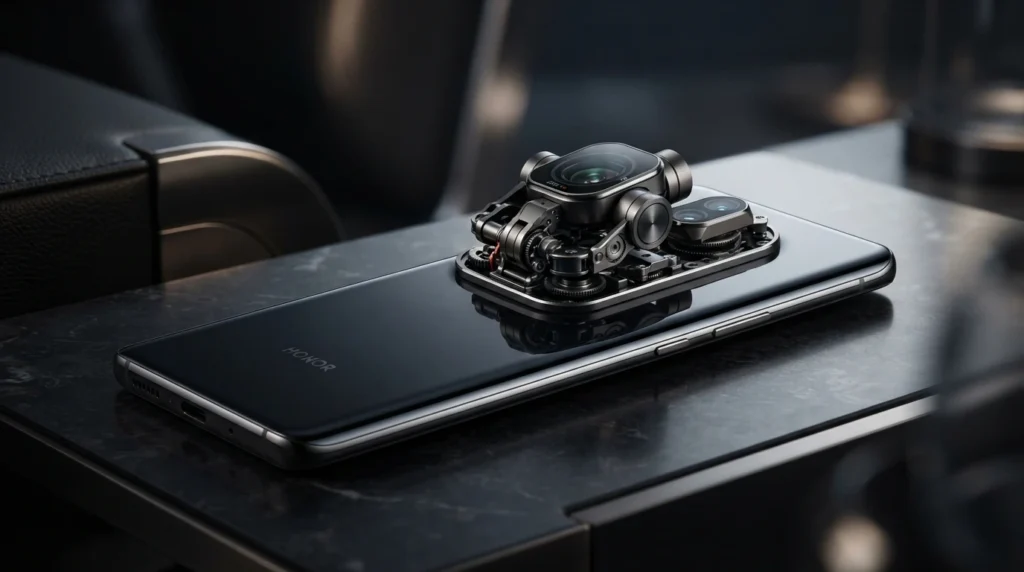
An intriguing move in that direction is the Honor Robot Phone with Gimbal. The idea integrates a smartphone with a physically moving gimbal-style camera system, as opposed to only depending on conventional fixed camera modules and software stabilization. The concept is straightforward yet ambitious: enable the honor phone’s camera to follow objects, move, and change its perspective in ways that are not possible with a traditional smartphone camera.
For those who regularly film content on their own, this strategy might have a significant impact. A cameraman, tripod operator, or specialized gimbal might not always be available to a creator. Some of those duties might be automatically completed by a smartphone with clever camera position adjustment.
The technique shows where mobile photography might go even though it is still a relatively new idea in the smartphone market. Customers may soon be inquiring about the camera’s ability to move, track, stabilize, and frame an image rather than just how many megapixels it has.
The Honor Robot Phone with Gimbal: What Is It?
The Honor Robot Phone with Gimbal is based on the concept of integrating a mechanical gimbal system with a smartphone camera. The lenses of traditional phone cameras have little physical mobility because they are often installed inside the device’s body.
That idea is altered by a gimbal.
While the user maintains the phone relatively stationary, a motorized camera mechanism may be able to move independently of the phone, enabling the camera to tilt, rotate, or change its position. This could result in a more dynamic photography and video experience when paired with artificial intelligence and subject tracking.
Consider taking a video of yourself while exploring a city. If you have a regular smartphone, you may need to use a tripod, hold the phone properly, or ask someone else to take pictures. It may be possible for a smart gimbal camera to follow your movements and maintain your position.
Because of this, vloggers, influencers, tourists, photographers, and independent content producers will find the idea especially intriguing.
The Significance of the Gimbal Camera
A gimbal’s greatest benefit goes beyond just allowing the camera to move. It is the result of combining both movement and stability.
Even slight hand motions might give handheld video footage a wobbly appearance. Electronic and optical picture stabilization are already used in modern smartphones to lessen this issue, but mechanical stabilization can offer an additional degree of control.
By physically modifying the camera, a gimbal can correct for undesired movement. The mechanism can try to maintain the camera pointing in a steady direction rather than letting the lens follow every tiny movement of the user’s hand.
That can be very helpful for designers who photograph while moving around a room, strolling, or traveling.
The potential to combine this mechanical movement with software intelligence is the most intriguing aspect of the Honor Robot Phone concept. The camera may be able to comprehend what it should be looking at in addition to just stabilizing the image.
AI-Driven Subject Monitoring
One of the most crucial components of contemporary smartphone cameras is artificial intelligence. AI has the ability to identify people, identify objects, enhance exposure, optimize colors, and assist smartphones in automatically selecting better settings.
That concept is expanded upon by a robot-style camera.
The phone may be able to employ AI to affect the camera’s actual movement rather than just processing the final image.
Consider making a video of yourself walking, for instance. The camera might theoretically change its position to keep you in the frame if it recognizes your face and body.
For independent creators in particular, this could be helpful.
A person filming a dance routine, workout video, fashion clip, cooking tutorial, or trip vlog might move around without having to stop all the time to reposition the camera.
What sets the concept apart from a typical smartphone is the combination of AI tracking, mechanical movement, and image stabilization.
A Novel Experience for Vloggers
One of the most popular uses of smartphone cameras is vlogging. Without lugging a bulky camera gear, people want to document their everyday lives, travels, culinary adventures, events, and personal narratives.
The problem is that producing visually appealing video typically involves more than just hitting the record button.
Framing, camera angle, stability, lighting, and focus are all important considerations. It can be difficult to keep track of everything when you’re filming by yourself.
Some of that complexity might be reduced with a robot gimbal camera.
An intelligent camera system might be able to monitor the scene and make adjustments automatically, saving you the trouble of setting the phone on a tripod and constantly checking to see if you’re centered.
That does not imply that it would always take the place of qualified camera operators. Nonetheless, it might significantly simplify smartphone filmmaking for regular makers.
Improved Portraiture
Another usage for a moving camera is in portrait photography.
A person’s face, clothes, backdrop, and overall composition can all be significantly altered by a small shift in camera angle. When using a fixed smartphone camera, the photographer must manually move the device in order to try out various viewpoints.
More flexibility might be possible with a gimbal-based system.
The primary body of the phone might remain reasonably stable while the camera moves around the subject. This creates opportunities for automatic camera motions, dynamic video portraits, and imaginative portrait shots.
Because short-form platforms reward visually beautiful material, this could be especially enticing to social media providers.
Travel Images and Videos
One of the best applications for a phone with sophisticated stabilization and clever camera movement is travel.
It’s not always a good idea to travel with a standard camera, tripod, and gimbal. The setup may be far more convenient with a smartphone that integrates multiple of those features into a single device.
Imagine going to a popular tourist spot and wishing to take a video while exploring the area. You might be able to position the phone and let the smart camera system take care of tracking instead of asking someone else to record you.
Convenience frequently takes precedence over visual quality for tourists.
A pocket-sized gadget with advanced tracking and stabilization capabilities may be an effective travel companion.
Engineering and Design
It is a difficult engineering task to include a moving camera mechanism into a smartphone.
Batteries, CPUs, antennas, cooling systems, speakers, cameras, and other parts are already included in modern smartphones. Careful internal design is necessary when adding motors and mechanical components.
Another important issue is durability.
The camera on a conventional smartphone lacks a huge exterior moving mechanism. Additional mechanical parts that could be subjected to deterioration, dust, unintentional collisions, or routine handling are introduced by a robotic camera system.
Thus, the engineering of a robot phone may be as crucial as the camera sensor itself.
In order to keep the phone slim and comfortable enough for daily use, manufacturers would need to strike a balance between flexibility and dependability.
Does a Gimbal Take the Place of a Conventional Camera Gimbal?
Not always.
Because it is made especially for camera stabilization and frequently has larger motors, physical controls, and more movement freedom, a dedicated handheld gimbal can still have benefits.
Convenience is one benefit of incorporating a gimbal inside a smartphone.
The camera system is integrated within the phone itself, eliminating the need for a separate phone and gimbal. Removing an additional item could be quite advantageous for everyday users, tourists, and casual artists.
The user will determine the optimal solution.
While regular producers would value having sophisticated tracking and stabilization built right into their smartphone, professional filmmakers might still want specialized camera gear.
Possibilities for Making Videos
Video producers would find the Honor Robot Phone concept particularly intriguing.
Movement is a key component of modern short-form video. While static footage can be effective, filmmakers frequently employ camera movement to give their projects a more dynamic and polished feel.
Automated pans, tracking shots, subject-following movements, and dynamic transitions might all be produced by a moving smartphone camera.
For instance, a creator might start a video with their back to the camera and then move in the direction of a product. While keeping a steady composition, the camera might be able to follow the movement.
Without having to learn complex camera methods, these capabilities might make it simpler for novices to create material that looks more professional.
Possible Effects on Batteries
Battery usage is one possible issue.
While a motorized gimbal adds mechanical movement, a traditional smartphone camera mostly uses electronic components. Power is needed for motors, and frequent camera adjustments may use more energy than a system with a stationary camera.
Battery optimization will therefore be crucial.
Honor would have to make sure that the advantages of the moving camera don’t result in a noticeably shorter battery life. By employing low-power tracking techniques when feasible and simply turning on motors when required, intelligent software could be helpful.
Customers will probably take battery economy into account when assessing this kind of smartphone.
Durability May Be a Crucial Question
When a device relies on mechanical components that move, long-term durability naturally becomes an important consideration.
Users could understandably question how well the system will withstand years of everyday use if the camera module physically rotates or shifts position.
Normal pocket use, unintentional drops, dust, temperature fluctuations, and frequent mobility would all require a sturdy construction.
In this case, practical testing will be more important than written specifications.
There would be no practical purpose for a camera that moves elegantly but becomes unstable after prolonged use. The mechanical system needs to be both creative and reliable for the technology to be successful.
Intelligent tracking and privacy
An intriguing privacy issue is also brought up by AI camera tracking.
A smart camera that can track subjects and identify faces must constantly process visual data. Customers will want to know how that data is managed.
Intelligent tracking features should ideally analyze as much data as possible immediately on the device and have easy-to-use controls that let users switch them on or off.
While privacy isn’t always a reason to stay away from AI cameras, as these technologies improve, producers should make this explicit.
Who Would Get the Most Out of the Honor Robot Phone?
Many diverse groups may find the technology appealing.
Content Producers
Automated tracking and stabilization could be advantageous for YouTubers, TikTok makers, Instagram users, and other creators.
Travelers
Instead than requiring someone else to operate the camera, travelers might use their phones to take pictures of themselves.
Vloggers
Solo vlogging may be considerably simpler if a moving subject could be captured in the frame.
Fans of Photography
A camera that can move can be appealing to those who like experimenting with different viewpoints.
Regular Users
Smoother films and simpler hands-free recording could be beneficial even for casual smartphone users.
Benefits and Drawbacks
Creative gimbal-style camera design
Possibly enhanced mechanical stability
Possibilities for intelligent topic tracking
Beneficial for independent filmmakers
More imaginative camera angles
Excellent potential for travel-related content
could lessen the requirement for an additional smartphone gimbal
An intriguing fusion of AI and hardware
Possibility of automated motion pictures
could make it simpler for novices to create content.
Complexity may be increased by mechanical components.
Durability is still a crucial factor.
Battery usage may be impacted by moving devices.
Manufacturing prices could go up with a robotic camera.
Professional filmmakers could still favor specialized gear.
For the technology to realize its full potential, software improvement could be necessary.
Performance in the real world is more important than just the idea.
Does the Honor Robot Phone Make Sense?
Depending on how you use your smartphone, a robot phone may or may not be worthwhile.
A moving camera might not be necessary if your primary activities are social media browsing, messaging, calling, and taking sporadic pictures.
But the technology becomes much more fascinating if you make movies on a regular basis, take pictures while traveling, record yourself, or like experimenting with photography.
Better image quality isn’t the main benefit. It is the potential to increase the overall intelligence of the shooting process.
Users may eventually rely on the phone to comprehend the scene, follow the subject, steady movement, and choose a good composition rather than manually manipulating every aspect of a shot.
That might signify a significant change in how people see smartphone cameras.
The Prospects for Smartphone Cameras
A more general trend in smartphone development is exemplified by the Honor Robot Phone with Gimbal. More and more manufacturers are eschewing the conventional strategy of merely boosting camera megapixels.
Computational photography, artificial intelligence, mechanical innovation, automated tracking, and customized content creation are anticipated to be the main areas of concentration in the future.
In the future, a smartphone camera might act more like an intelligent camera operator than a passive sensor.
This does not imply that conventional cameras will become obsolete. Larger sensors, interchangeable lenses, robust accessories, and comprehensive manual controls are still necessary for professional photographers and filmmakers.
However, the difference between smartphone photography and specialized camera gear is getting smaller for regular consumers.
Adding a larger camera to a phone might not be the true innovation. Making the camera comprehend what the user is attempting to accomplish could be the key.
Final Decision
Because it takes a fresh approach to smartphone photography, the Honor Robot Phone with Gimbal is a fascinating concept. It adds physical movement, stability, intelligent tracking, and creative framing to the equation rather than concentrating only on camera characteristics.
This kind of technology may provide a genuinely helpful benefit for vloggers, tourists, social media makers, and anyone who regularly video themselves.
Practical concerns about long-term dependability, cost, battery usage, and durability still exist. Whether robotic camera phones become a common smartphone feature or continue to be a niche breakthrough will ultimately depend on those elements.
However, the idea provides an intriguing window into the future. It’s possible that the upcoming smartphone cameras may do more than just improve image quality. They might actively assist users in producing better images and videos.
FAQ
The Honor Robot Phone with Gimbal: What is it?
It is a smartphone concept that revolves around a gimbal-style camera mechanism that moves mechanically. In comparison to a traditional fixed smartphone camera, the objective is to offer more camera flexibility, stabilization, and intelligent tracking.
What is the gimbal used for?
A gimbal can lessen undesired shaking and aid in controlling camera movement. This kind of mechanism might also enable a smartphone’s camera to alter its physical angle without affecting the phone’s body.
Does vlogging work well with the Honor Robot Phone?
Because automated tracking and stabilization could make it simpler to record yourself while walking or moving about, the idea is especially well suited to vloggers.
Is it possible for a robot camera to follow an individual?
AI-based subject recognition and tracking may be used by an intelligent camera system to maintain a person in the frame. The hardware and software implementation determine the precise capabilities.
Does a gimbal enhance the quality of a video?
By minimizing undesired camera movement and producing smoother motion, a gimbal can enhance the presentation of video. However, the sensor, lens, processor, illumination, and recording software all affect overall image quality.
Would it take the place of a high-end camera?
Not entirely. Smartphones might not have the same features as professional cameras, such as larger sensors, interchangeable lenses, and sophisticated controls. The main benefits of a robot phone would be advanced automation and convenience.
Is it possible to travel with a gimbal phone?
Indeed. Stabilization, tracking, and hands-free recording without the need for a separate smartphone gimbal could be advantageous for travel creators.
Could a larger battery be needed for the moving camera?
Possibly. Maintaining a long battery life will need effective software and hardware design because motorized components need power.
How long-lasting is the robotic camera?
One of the most important factors for any smartphone with moving parts is durability. The mechanism’s engineering, materials, protection, and quality control will determine its long-term dependability.
What distinguishes the Honor Robot Phone from a typical smartphone?
The idea of a physically moving camera coupled with intelligent tracking and stabilization is the main distinction. Conventional smartphone cameras often have far less mobility.