In 2026, the smartphone market is more competitive than it has ever been, and two of the biggest names in the business are once again facing off. Because both phones have flagship-level performance, high-end designs, sophisticated cameras, excellent displays, and potent AI features, the comparison between the iPhone 17 and Galaxy S26 is particularly intriguing.
The key features of Apple’s iPhone 17 are a flawless iOS experience, strong A19 performance, top-notch video capture, and easy connection with the Apple ecosystem. With Android, One UI customization, a flexible triple-camera system, a lightweight design, and a feature-rich Galaxy ecosystem, Samsung’s Galaxy S26 adopts a fresh strategy.
Which phone, though, is truly worth purchasing?
It’s not as easy as looking at the specifications. What matters most to you will determine which smartphone is better: camera versatility, gaming performance, battery life, software experience, design, or ecosystem connectivity.
We’ll examine both phones in every significant category in our thorough comparison of the iPhone 17 and Samsung Galaxy S26 to assist you in selecting the flagship that best suits your requirements.
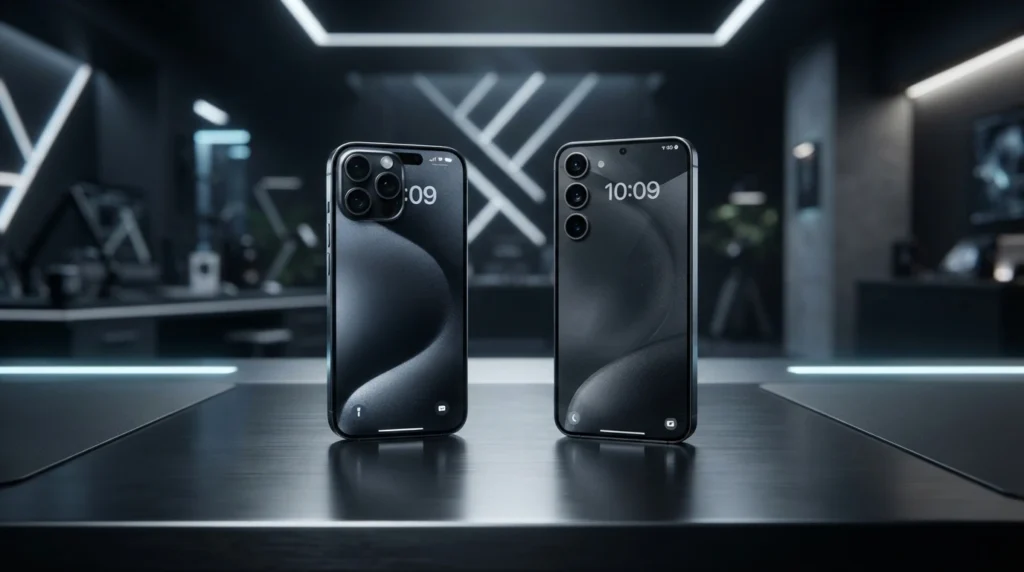
A Brief Comparison of the iPhone 17 and Galaxy S26
Apple’s popular flagship iPhone for 2026 is the iPhone 17. It has a 6.3-inch Super Retina XDR OLED screen with refresh rates of up to 120 Hz and ProMotion technology. The phone has 256GB and 512GB of storage and is powered by Apple’s A19 CPU.
Samsung’s little top Android smartphone is called the Galaxy S26. A 6.3-inch display is also included, however Samsung’s Dynamic AMOLED 2X technology is used. The phone has three cameras: a 50MP primary camera, a 12MP ultra-wide camera, and a 10MP telephoto camera.
Both smartphones are incredibly powerful on paper. But they have totally distinct strengths.
Those who need a straightforward, well-designed operating system, robust performance, and robust video capabilities will find the iPhone 17 very tempting. Android users who want customisation, a dedicated telephoto camera, and a lighter body will find the Galaxy S26 more appealing.
iPhone 17 vs Galaxy S26: Specifications
| Feature | iPhone 17 | Galaxy S26 |
|---|
| Display | 6.3-inch Super Retina XDR OLED | 6.3-inch Dynamic AMOLED 2X |
| Refresh Rate | Up to 120Hz | Up to 120Hz |
| Processor | Apple A19 | Galaxy S26 flagship processor |
| Storage | 256GB / 512GB | 256GB / 512GB |
| Main Camera | 48MP | 50MP |
| Ultra-Wide | 48MP | 12MP |
| Telephoto | No dedicated telephoto | 10MP, 3x optical zoom |
| Front Camera | 18MP Center Stage | 12MP autofocus |
| Battery | Not officially specified in mAh | 4,300mAh |
| Weight | 177g | 167g |
| Thickness | 7.95mm | 7.2mm |
| Operating System | iOS | Android / One UI |
| Charging Port | USB-C | USB-C |
| Connectivity | Wi-Fi 7, Bluetooth 6 | Wi-Fi 7, Bluetooth 5.4 |
| Biometrics | Face ID | Fingerprint |
| Water Resistance | IP68 | IP68 |
| Storage Expansion | No | No |
Artecharena disclaims all liability for any mistakes or omissions as well as the outcomes of using this information. All of the information on this website is offered “with no guaranty of completeness, accuracy, timeliness, or the results obtained from the use of this information.”
Disclaimer.We can not guarantee that the information on this page is 100% correct
Design and Construction Quality
Both phones have the appearance and feel of high-end flagship smartphones.
The iPhone 17’s elegant aluminum body and glass back adhere to Apple’s well-known design esthetic. Its small size makes it quite pleasant to hold, and its flat-edged form gives it a contemporary appeal.
The Galaxy S26 weighs even less than the iPhone 17, which weighs 177 grams.
The Samsung Galaxy S26 is under 167 grams in weight and is about 7.2 mm thick. As a result, it is significantly thinner and 10 grams lighter than the iPhone 17.
On paper, the difference might not seem significant, but if you spend many hours a day on your phone, it can become apparent.
Additionally, both smartphones are made to provide robust defense against water and dust.
The Galaxy S26 is the design winner.
The Galaxy S26 has an edge if you’re looking for a flagship phone that is lightweight and thin.
The iPhone 17 may still be more appealing to those who favor Apple’s design esthetic, though.
Show Comparison
Another area in which both phones excel is display quality.
The 6.3-inch Super Retina XDR OLED display of the iPhone 17 has a resolution of 2622 × 1206 pixels. Additionally, Apple offers ProMotion technology, which has an adaptable refresh rate of up to 120 Hz.
This makes navigating menus, social media feeds, and webpages quite easy. Wide color, HDR content, and an Always-On display are also supported by the display.
The Galaxy S26 from Samsung has a 6.3-inch Dynamic AMOLED 2X display. Strong contrast, vivid colors, and deep blacks are hallmarks of Samsung’s AMOLED technology.
Additionally, the Galaxy S26 has a refresh rate of up to 120Hz, which makes scrolling and animations feel fluid.
Both phones are great for watching movies and YouTube videos.
Winner of Display: Tie
While the Galaxy S26 features Samsung’s superior AMOLED technology, the iPhone 17 offers superior brightness, resolution, and ProMotion.
Performance: Galaxy S26 compared. iPhone 17
When comparing premium smartphones, performance is one of the most crucial aspects.
Apple’s A19 processor powers the iPhone 17. One of the main benefits of the iPhone has always been Apple’s proprietary silicon, and the A19 maintains that strategy.
Without making the phone feel slow, the processor is built to handle demanding apps, gaming, video editing, and AI-related jobs.
Additionally, flagship-level performance is a design feature of the Galaxy S26. Samsung’s high-end chipset and ample RAM enable the phone to easily manage demanding Android apps and multitasking.
Both phones are fairly quick in daily use.
Animations are fluid, apps launch fast, and moving between apps is usually simple.
The software philosophy shows the greatest disparity.
Apple is able to carefully optimize iOS for its processors because it controls both the software and the hardware. Samsung, on the other hand, employs One UI and Android, which gives consumers a lot more control over how their phone functions.
The iPhone 17 is the performance winner.
The iPhone 17 has a small edge in terms of efficiency and raw performance.
However, the Galaxy S26 can be preferred by those who love multitasking and personalization.
Comparison of Cameras
One of the main distinctions between the iPhone 17 and Galaxy S26 is the camera.
A 50MP primary camera, a 12MP ultra-wide camera, and a 10MP telephoto camera make up Samsung’s triple-camera setup for the Galaxy S26.
The specialized telephoto lens is the main benefit here.
Users of the Galaxy S26 can take pictures of far-off subjects without completely depending on digital zoom because to its 3x optical zoom. Because of this, the phone is very helpful for taking portraits, traveling, and taking pictures of distant subjects.
With its dual-camera setup, the iPhone 17 adopts a new strategy. Apple places a lot of emphasis on image processing, video recording, and computational photography.
The iPhone can easily create detailed, realistic-looking photos for daily use. Another important factor in the preference of many content creators for iPhones is their video capabilities.
Another area that Apple has improved is the front camera. With its 18MP Center Stage front camera, the iPhone 17 offers more options for taking selfies and making video calls.
Galaxy S26 is the camera winner due to its versatility.
Because of its dedicated telephoto lens, the Galaxy S26 is the best choice if you want greater photography flexibility.
For consumers who value simple point-and-shoot photography and video recording, the iPhone 17 is still a great option.
Charging and Battery Life
Because Apple and Samsung optimize their hardware and software differently, it is challenging to evaluate battery performance based only on battery capacity.
Samsung provides a 4,300mAh battery for the Galaxy S26. Under its defined testing settings, the business claims to be able to play videos for up to 30 hours.
The main selling feature of the iPhone 17 is not its battery capacity, which is not widely marketed. Rather, Apple places a strong emphasis on battery performance through software and hardware optimization.
A number of variables, such as screen brightness, cellular connectivity, 5G usage, gaming, camera use, and background apps, will affect battery life in real-world use.
Both phones should offer consistent battery performance for someone who spends the majority of the day using messaging apps, watching movies, and perusing social media.
Winner of Battery: Galaxy S26
The Galaxy S26’s greater stated battery capacity and robust endurance give it an advantage.
However, battery capacity is not the whole picture due to the iPhone 17’s effective A19 chip and iOS optimization.
Which Software Is Better, iOS or Android?
This may be the most significant distinction between these two phones.
The Galaxy S26 runs Android with Samsung’s One UI interface, whereas the iPhone 17 runs Apple’s iOS.
iOS stands out for delivering a smooth, familiar, and user-friendly experience across Apple devices.
The ecosystem, software, and hardware are all under Apple’s control, resulting in a highly integrated experience.
The iPhone 17 gets even more appealing if you also have an iPad, MacBook, or Apple Watch.
Moving between Apple devices is very straightforward because to features like AirDrop, iCloud, FaceTime, and cross-device interoperability.
Samsung provides an alternative experience.
Users have a lot more customization choices with a single user interface. Numerous system-level settings, including layouts, widgets, and themes, are modifiable.
Additionally, Samsung offers DeX, which can give users a more desktop-like smartphone experience, and sophisticated multitasking functions.
Winner of Software: User-dependent
If you desire simplicity and the Apple ecosystem, go for the iPhone 17.
If you desire personalization, multitasking, and the versatility of Android, go with the Galaxy S26.
Features of AI
A significant component of contemporary flagship phones is artificial intelligence.
Apple incorporates AI-powered tools for writing, communication, image-related operations, and other daily chores into its ecosystem.
Additionally, Samsung has integrated Galaxy AI into the Galaxy experience.
The Galaxy S26 integrates Samsung’s photography, communication, and productivity tools with AI-powered features.
There is more to the difference than just which phone has more AI features. The way these functions are incorporated into each operating system is what really makes a difference.
While Samsung incorporates AI elements into the Android and One UI experience, Apple prioritizes an ecosystem-centered strategy.
Winner of AI: Tie
The victory mostly relies on your preferred ecosystem because both phones have cutting-edge AI capabilities.
Experience with Gaming
Both smartphones are capable of playing games.
Apple’s potent A19 CPU and improved iOS software are advantageous for the iPhone 17. There is a good assortment of high-end mobile games in Apple’s ecosystem.
The Galaxy S26 has a 120Hz display and outstanding graphics performance. Additionally, Android offers users more customization and gaming options.
There isn’t much of a difference between the two for casual gaming.
The iPhone 17’s chipset offers a significant boost in long-term performance for demanding games.
The iPhone 17 is the gaming winner.
The iPhone 17 is a superior option for customers who are primarily concerned with high-end gaming performance.
Security and Connectivity
Both phones are compatible with Wi-Fi 7 and USB-C, two contemporary communication technologies.
Face ID is used for biometric authentication on the iPhone 17. Face recognition is quick and easy, especially for phone unlocking and payment authentication.
An in-display fingerprint sensor is used by the Galaxy S26.
Because it lets you unlock your phone without having to glance at the screen, fingerprint authentication is still widely used.
There is no objective superiority between either strategy. Ultimately, the choice comes down to your personal preferences and what feels right for you.
Pros and Cons of the iPhone 17
Strong A19 processor
Superb OLED display
ProMotion technology at 120 Hz
Robust video capture
Outstanding integration of ecosystems
256GB of initial storage
Superior construction quality
Face ID
Excellent performance in games
Outstanding software optimization drawbacks
No specialized telephoto lens
Less personalization compared to Android
Greater weight than the Galaxy S26
The Apple ecosystem can get pricey.
Certain features are most compatible with other Apple products.
Galaxy S26 Benefits and Drawbacks
167g lightweight body
7.2mm thin design
Superb Dynamic AMOLED 2X screen
120 Hz refresh rate
Three-camera setup
Specialized 3x telephoto lens
4,300 mAh capacity
Customization for Android
sensor for fingerprints
Support for Samsung DeX
Excellent multitasking skills
Drawbacks
iOS users might not find the Android UI appealing.
High digital zoom can degrade the quality of an image.
In the flagship market, charging isn’t the fastest.
If you already utilize Apple goods, the Samsung ecosystem is less beneficial.
Depending on the scene, camera processing can occasionally yield various results.
Which Is Better, the Galaxy S26 or the iPhone 17?
Your priorities will ultimately determine which of these two cellphones you choose.
For those seeking a quick, dependable, and high-end smartphone experience, the iPhone 17 is a superior choice. Users of the Apple environment, gamers, filmmakers, and iOS enthusiasts find it especially appealing.
For Android enthusiasts seeking a lightweight flagship phone with a customizable camera system and a dedicated telephoto lens, the Galaxy S26 is a superior option.
The Galaxy S26 offers a clear advantage if versatility in photography is your top concern.
The iPhone 17 is possibly a better option if video recording and ecosystem integration are more important.
Purchasing the iPhone 17 is the best option if you already own many Apple products.
The Galaxy S26 is the obvious pick if you prefer Android or currently use Samsung Galaxy accessories.
Final Decision
Which smartphone is better, the Galaxy S26 or the iPhone 17?
No single option can be considered the perfect fit for every user.
With strong performance, a high-end display, outstanding video capabilities, and extensive ecosystem integration, the iPhone 17 is a fantastic all-around flagship.
The lightweight design, AMOLED display, adaptable Android experience, and triple camera configuration with a specialized 3x optical zoom make the Galaxy S26 stand out.
Select the iPhone 17 if you’re looking for performance, iOS, and Apple ecosystem connection.
Select the Galaxy S26 if you’re looking for a lighter design, Android customisation, and camera adaptability.
Our Final Decision
The iPhone 17 is ideal for consumers of the Apple ecosystem, gaming, video, and performance.
Galaxy S26: Great for Android users, camera customization, and adaptability.
In the end, both are great flagship smartphones, and it can depend on your current ecosystem.
FAQ
Is the Galaxy S26 inferior to the iPhone 17?
For consumers who value iOS, strong performance, gaming, and Apple’s ecosystem, the iPhone 17 is preferable. For those who prefer a dedicated telephoto camera and Android customisation, the Galaxy S26 is a superior option.
Is the camera on the Galaxy S26 superior to that of the iPhone 17?
The Galaxy S26 has a dedicated 3x telephoto lens, which increases photographic versatility. For video and simple point-and-shoot photography, the iPhone 17 is especially powerful.
Which is faster, the Galaxy S26 or the iPhone 17?
Although both phones offer flagship-level performance, the iPhone 17 has a significant edge in terms of raw performance and efficiency thanks to Apple’s A19 CPU.
Does the Galaxy S26 weigh less than the iPhone 17?
Indeed. The iPhone 17 weighs 177 grams, whereas the Galaxy S26 weighs about 167 grams.
Does the iPhone 17’s display run at 120 Hz?
Indeed. ProMotion with adjustable refresh rates of up to 120Hz is a feature of the iPhone 17.
Is 3x optical zoom supported by the Galaxy S26?
Indeed. A dedicated telephoto camera with 3x optical zoom is included in the Galaxy S26.
Which phone is most suitable for gaming?
Because to Apple’s A19 CPU and improved software, the iPhone 17 is the better option for users that value gaming performance.
In 2026, which phone should I purchase?
If you like iOS, Apple products, and powerful video capabilities, get the iPhone 17. If you want Android, customisation, and a more flexible camera arrangement, go with the Galaxy S26.