The iPhone 17 and Google Pixel 10 are two of the most intriguing choices for consumers in the fiercely competitive smartphone market. High-end screens, potent processors, sophisticated cameras, AI-powered features, and extended software support are all features of both phones. They do, however, approach performance, photography, battery life, and the user experience in quite different ways.
The iPhone 17 sports a 48MP dual-camera system, a 6.3-inch Super Retina XDR OLED display with ProMotion up to 120Hz, and Apple’s A19 CPU. In the meantime, Google unveiled the Pixel 10, which boasts a triple camera configuration with a specialized 5x telephoto lens, a Tensor G5 engine, 12GB RAM, and a 4,970mAh battery.
Which is superior, the iPhone 17 or the Pixel 10?
What you value most will determine the response. The iPhone 17 is an appealing option if you’re looking for powerful raw performance, outstanding video capturing, a refined ecosystem, and a lightweight design. The Pixel 10 might be a better choice if you value photography versatility, AI features, Android customisation, and a bigger battery.
Let’s take a closer look at the two phones.
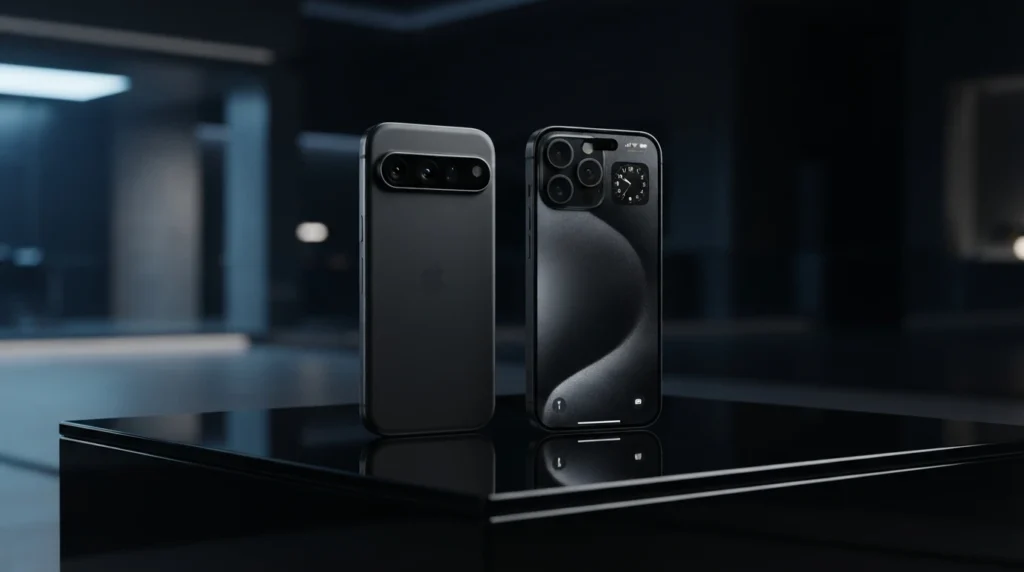
iPhone 17 vs Pixel 10: Quick Comparison
| Feature | iPhone 17 | Google Pixel 10 |
|---|
| Processor | Apple A19 | Google Tensor G5 |
| Display | 6.3-inch OLED | 6.3-inch OLED |
| Refresh Rate | Up to 120Hz | 60–120Hz |
| RAM | Not officially listed by Apple | 12GB |
| Storage | 256GB / 512GB | 128GB / 256GB |
| Main Camera | 48MP | 48MP |
| Ultrawide | 48MP | 13MP |
| Telephoto | 2x optical-quality | 10.8MP 5x optical |
| Front Camera | 18MP | Advanced Pixel front camera system |
| Battery | Up to 30 hours video playback | 4,970mAh |
| Wired Charging | Up to 50% in 20 minutes | Up to 55% in about 30 minutes |
| Wireless Charging | MagSafe | Qi2 Pixelsnap |
| Water Resistance | IP68 | Premium water resistance |
| Operating System | iOS | Android |
Artecharena disclaims all liability for any mistakes or omissions as well as the outcomes of using this information. All of the information on this website is offered “as is,” with no assurance on its timeliness, accuracy, completeness, or the outcomes of using it.
Design and Construction Quality
Apple’s simple design concept is carried over into the iPhone 17. It has Ceramic Shield 2 on the front, a color-infused glass back, and an aluminum design. Despite having a 6.3-inch display, its weight of just 177 grams makes it rather portable.
Google’s contemporary Pixel design language is also used in the Pixel 10. Its 6.3-inch form size makes it comfortable for daily usage, and its design is simple and identifiable.
The iPhone 17 provides an advantage for those who want a lightweight phone. It is especially appealing to those who don’t want a bulky flagship smartphone because of its 6.3-inch screen and 177-gram frame.
On the other hand, the Pixel 10 provides the kind of hardware experience that Android customers have grown accustomed to from a high-end Google phone.
Show Comparison
One area in which both smartphones excel is display quality.
The 6.3-inch Super Retina XDR OLED screen of the iPhone 17 has an adjustable ProMotion refresh rate of up to 120Hz and a resolution of 2622 x 1206. Additionally, Apple claims a maximum outdoor brightness of 3,000 nits.
The 6.3-inch Actua OLED display on the Pixel 10 has a smooth refresh rate of 60–120 Hz and a resolution of 1080 x 2424. Up to 2,000 nits of HDR brightness and up to 3,000 nits of peak brightness are listed by Google.
Both screens should feel responsive and fluid in regular use. The rapid refresh rate makes it easier to scroll through menus, social media feeds, and webpages.
While the Pixel 10 provides a similarly seamless 120Hz experience with powerful outdoor brightness, the iPhone 17 has an advantage in pixel density and Apple’s display calibration.
Winner of the Display: iPhone 17
The iPhone 17 is superior for consumers who value resolution, color accuracy, and Apple’s superior display calibration.
Performance: Pixel 10 compared. iPhone 17
The main distinction between these two phones may be their performance.
Apple’s A19 chip, which has a six-core CPU, a five-core GPU with neural accelerators, and a sixteen-core neural engine, powers the iPhone 17. Apple also provides hardware-accelerated ray tracing.
The Pixel 10 has 12GB of RAM and a Tensor G5 CPU from Google. Tensor processors are made for Google’s AI and machine-learning capabilities in addition to conventional performance.
Both phones should seem incredibly quick for daily chores. Demanding games are handled smoothly, apps open promptly, and multitasking is seamless.
However, high-performance CPU and GPU workloads have always been a major focus of Apple’s A-series CPUs. Because of this, the iPhone 17 is especially appealing for demanding apps like video editing and gaming.
The Pixel 10’s connectivity with Google’s AI ecosystem is its greatest benefit. Google uses Tensor to enable image processing, smart features, and other AI-driven experiences rather than only concentrating on benchmark statistics.
The iPhone 17 is the performance winner.
The iPhone 17 is a better option for demanding workloads and sheer performance. If you prioritize AI functionality, the Pixel 10 is more intriguing.
Comparison of Cameras
The iPhone 17 vs. Pixel 10 comparison becomes considerably more intriguing when it comes to camera performance.
The 48MP Fusion primary camera of the iPhone 17 has an f/1.6 aperture and sensor-shift optical image stabilization. A 48MP Fusion ultrawide camera with a 120-degree field of view is also included. Apple offers up to 10x digital zoom and a 12MP optical-quality 2x telephoto mode.
A 48MP wide camera, a 13MP ultrawide camera, and a 10.8MP 5x telephoto camera make up the Pixel 10’s triple camera setup. Super Zoom up to 20x is also supported by Google.
This makes a significant difference.
The Pixel 10 boasts a dedicated 5x telephoto lens, but the iPhone 17’s ultrawide camera has a greater resolution.
Both phones should produce great images if you mostly take pictures of people, food, pets, landscapes, and ordinary moments.
However, the Pixel 10 has a distinct hardware advantage if you regularly take pictures of far-off things thanks to its 5x optical telephoto camera.
Strengths of the iPhone 17 Camera
Superb hardware for the main camera
Ultrawide high-resolution camera
Excellent portraiture
Superb 4K Dolby Vision video recording
18MP Center Stage front camera with robust stabilization
48MP macro photography
With the iPhone 17, Apple formally offers improved stabilization and audio features in addition to 4K Dolby Vision recording at up to 60 frames per second.
Strengths of the Pixel 10 Camera
Specialized 5x telephoto lens
Up to 20x Super Zoom
Robust computational photography
Google’s image processing powered by AI
Macro-capable primary camera
Outstanding adaptability for zoom photography
Camera Winner: iPhone 17 for video, Pixel 10 for photography
The Pixel 10 is perhaps the more flexible choice if zoom and computational photography are your top priorities.
The iPhone 17 is a safer option if you film a lot of movies, social media posts, trip videos, or handheld footage that looks professional.
Charging and Battery Life
Another crucial element is battery life.
Apple claims that the iPhone 17 can play videos for up to 30 hours and stream them for up to 27 hours. With a 40W adapter or more, the phone may get a 50% charge in about 20 minutes.
According to Google, the Pixel 10 typically has a 4,970mAh battery that lasts more than 24 hours. Google promises a battery life of up to 100 hours with Extreme Battery Saver. With a compatible 30W USB-C PPS charger, the phone can reach up to 55% in about 30 minutes.
The crucial fact is that real-world battery life is not solely determined by battery capacity. The iPhone’s robust durability is made possible by Apple’s hardware and software integration, which eliminates the need for a large battery.
On the other hand, the Pixel 10 boasts a larger physical battery and robust power-saving features.
Pixel 10 is the battery winner.
On paper, the Pixel 10 has an advantage for customers who value battery capacity and aggressive battery-saving capabilities.
Experience with Software
The Pixel 10 runs Android, and the iPhone 17 runs iOS.
iOS is renowned for its straightforward user interface, reliable app experience, robust ecosystem integration, and long-term optimization. The iPhone gets much more appealing if you already have an Apple Watch, MacBook, or AirPods.
The Pixel 10 delivers a highly customizable, clean Android experience from Google. Numerous elements of the operating system, including the home screen, widgets, and notifications, are customizable by users.
AI is also a key component of Google’s Pixel software.
As a result, the decision is mostly subjective.
If you desire simplicity, ecosystem connection, and consistency, go with the iPhone 17.
If you want customisation, Google services, and AI-focused features, go with the Pixel 10.
Pros and Cons of the iPhone 17
Strong A19 processor
Superb 6.3-inch 120Hz screen
177g lightweight design
Robust primary and ultrawide cameras
Outstanding video capture
Video playback for up to 30 hours
IP68 defense
robust Apple ecosystem
Cons: 256GB of basic storage
Lack of a specialized long-range telephoto camera
Some consumers may find Apple’s ecosystem to be constrictive.
Accessories for charging could be more expensive.
Less customization akin to Android
Pixel 10 Benefits and Drawbacks
Advantages
12GB RAM and a Tensor G5 processor
Big 4,970mAh battery
Specialized 5x telephoto lens
Super Zoom up to 20x
Outstanding AI-focused features
120 Hz screen
Pixelsnap Qi2 wireless charging
Cons of a clean Android experience
Ultrawide camera with a lower resolution than the iPhone 17
AI is given priority over plain benchmark performance in the Tensor performance method.
Some users could feel constrained by 128GB of base storage.
Not everyone will find heavy camera processing appealing.
Which Is Better for Gaming, the Pixel 10 or the iPhone 17?
The iPhone 17 is a more appealing choice if gaming is your main motivation for purchasing a flagship smartphone.
High-performance CPU and GPU workloads are intended for the A19 processor, and compatible games may benefit from Apple’s hardware-accelerated ray tracing.
While Google’s Tensor platform is more closely linked to AI and computational work, the Pixel 10 can play contemporary games.
The distinction might not be significant for casual gaming. The iPhone 17 is a superior option for those who spend a lot of time playing demanding games.
Which Phone Is Ideal for Taking Pictures?
The kind of photography you like will determine this.
With its dedicated 5x optical telephoto camera, the Pixel 10 is the best option for zoom photography.
With its 48MP ultrawide camera, the iPhone 17 offers a major hardware edge for ultrawide photography.
Because of its sophisticated video features, such as 4K Dolby Vision recording, the iPhone 17 is the superior option overall for video recording.
The Pixel 10 is very competitive when it comes to AI-powered photo processing.
Therefore, rather of asking which phone has the “best camera,” find out what kind of camera you require.
Which Phone’s Battery Lasts Longer?
Apple boasts that the iPhone 17 can play video for up to 30 hours, however the Pixel 10 has a bigger 4,970mAh battery.
Both should offer good battery endurance for typical daily use.
Those who need a larger battery and robust battery-saving settings will find the Pixel 10 appealing. The iPhone 17’s remarkable durability stems from Apple’s mix of hardware and software.
Conclusion: Pixel 10 vs. iPhone 17
Which phone should you choose, the iPhone 17 or the Pixel 10?
A universal winner does not exist.
In terms of performance, gaming, video recording, ecosystem connectivity, and a lightweight, high-end experience, the iPhone 17 is the superior option overall. It is a great all-around flagship thanks to its A19 processor, 120Hz OLED display, 48MP dual-camera system, and robust battery performance.
For customers who value Android, AI capabilities, zoom photography, battery capacity, and personalization, the Pixel 10 is a better choice. It has a clear advantage in a number of areas because to its Tensor G5 engine, 12GB RAM, 4,970mAh battery, and specialized 5x telephoto camera.
The iPhone 17 is the best option if you are already a part of Apple’s ecosystem. The Pixel 10 is worth serious consideration if you want more camera versatility and prefer Google’s OS.
Our Final Decision
Performance-wise, the iPhone 17 is the best
The iPhone 17 is ideal for video.
Pixel 10 is the best camera for zoom photography.
The Pixel 10 has the best battery capacity.
The iPhone 17 is the best for gaming.
Ideal for AI features: iPhone 17 is the best ecosystem for the Pixel 10.
The Pixel 10 is the best for customizing Android.
In the end, both are superb flagship smartphones. Your decision should be based on whether you like Google’s AI-focused Android experience or Apple’s refined ecosystem and performance-first philosophy.
FAQ
Is the Pixel 10 inferior than the iPhone 17?
For raw performance, gaming, video recording, and Apple ecosystem integration, the iPhone 17 is superior. In terms of zoom photography, AI capabilities, Android customisation, and battery life, the Pixel 10 is superior.
Is the camera of the Pixel 10 superior to that of the iPhone 17?
The Pixel 10’s specialized 5x telephoto camera gives it an advantage for long-range shooting. On the other hand, the iPhone 17 boasts better video capabilities and an ultrawide camera with a higher quality.
Which has a longer battery life, the Pixel 10 or the iPhone 17?
While Apple claims that the iPhone 17 can play video for up to 30 hours, the Pixel 10 sports a 4,970mAh battery. Usage, network conditions, brightness, and apps will all affect how long a battery lasts.
Is the iPhone 17 suitable for gaming?
Indeed. The iPhone 17 is an excellent option for demanding mobile games because of its A19 CPU and hardware-accelerated graphics features.
Is the Pixel 10 suitable for taking pictures?
Yes, those who desire computational photography, AI-powered image processing, and a dedicated 5x telephoto camera will find the Pixel 10 very appealing.
In 2026, which phone should I purchase?
Select the iPhone 17 if you like iOS, gaming, video, and Apple’s ecosystem. Select the Pixel 10 if you like Android, AI capabilities, zoom photos, and a bigger battery.
Which is more affordable, the iPhone 17 or the Pixel 10?
The price that is offered in your market determines value. The price of the iPhone 17 varies according on the country and storage configuration, whereas the Pixel 10 starts at $799 in Google’s US listing. Before making a purchase, always check the local retail price.