Selecting a new flagship smartphone involves more than just picking the device with the fastest processor or the biggest megapixel camera. Artificial intelligence, photography, battery economy, software upgrades, display quality, and daily convenience are just a few of the many aspects that make up modern phones.
The Galaxy S26 vs. Pixel 10 comparison is particularly intriguing because of this.
Google and Samsung have approached their flagship phones in various ways. Strong hardware, a high-end AMOLED display, multiple cameras, Samsung’s One UI, and Galaxy AI are the main features of the Galaxy S26. In contrast, the Google Pixel 10 prioritizes clean Android software, computational photography, Google’s AI ecosystem, and clever features driven by the Tensor G5 processor.
The Pixel 10 has a 6.3-inch OLED Actua display with a refresh rate of 60–120 Hz, while the Galaxy S26 has a 6.3-inch Dynamic AMOLED 2X display with an adaptive refresh rate of 120 Hz. Because they are both little flagship phones, they are appealing substitutes for more substantial and bulky high-end smartphones.
Which one should you get, then?
In terms of design, display, performance, battery life, cameras, software, artificial intelligence, and overall value, let’s compare the two phones.
Galaxy S26 vs Pixel 10:
| Feature | Samsung Galaxy S26 | Google Pixel 10 |
|---|
| Display | 6.3-inch Dynamic AMOLED 2X | 6.3-inch OLED Actua |
| Refresh Rate | Up to 120Hz | 60–120Hz |
| Processor | Snapdragon 8 Elite Gen 5 / Exynos 2600 depending on market | Google Tensor G5 |
| RAM | 12GB | 12GB |
| Base Storage | 256GB | 128GB |
| Maximum Storage | 512GB | 256GB |
| Main Camera | 50MP | 48MP |
| Ultra-wide | 12MP | 13MP |
| Telephoto | 10MP 3x | 10.8MP 5x |
| Battery | 4,300mAh | 4,970mAh typical |
| Wired Charging | Up to around 55% in 30 minutes | Up to around 55% in 30 minutes |
| Wireless Charging | Supported | Qi2/Pixelsnap up to 15W |
| Software | Android 16 / One UI | Android 16 / Pixel UI |
| Best For | Performance, display, gaming, versatility | Photography, AI, clean Android |
Artecharena disclaims all liability for any mistakes or omissions as well as the outcomes of using this information. All of the information on this website is offered “as is,” with no assurance on its timeliness, accuracy, completeness, or the outcomes of using it.
Design and Construction Quality
Although both smartphones appear to be high-end, small flagships at first glance, their design philosophies differ significantly.
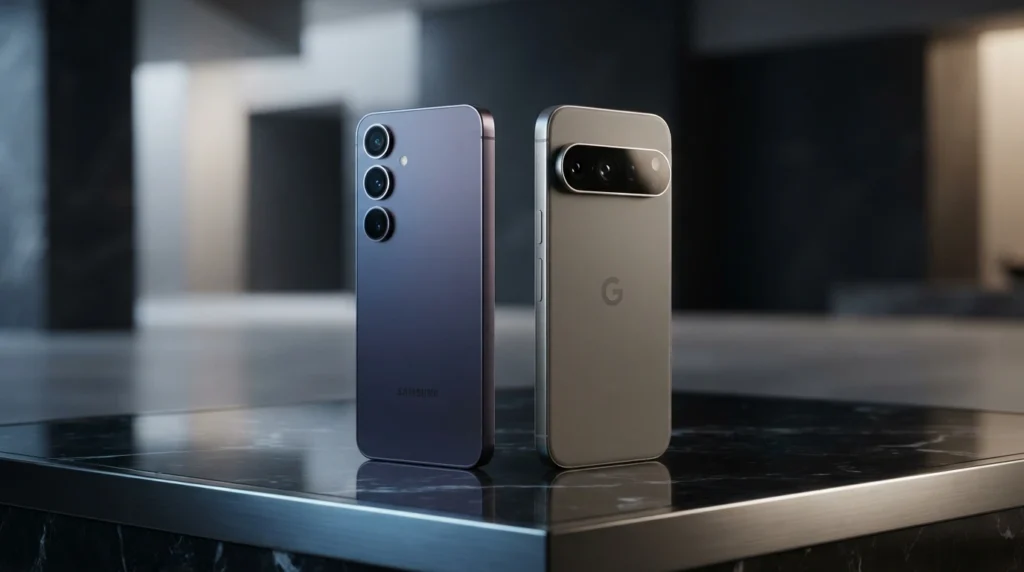
The Galaxy S26 adheres to Samsung’s well-known premium Galaxy design esthetic. Its body is slender, its display is flat, its corners are rounded, and its camera arrangement is elegant. Because the phone weighs only about 167 grams, using it with one hand is not too difficult. Additionally, Samsung awards the S26 an IP68 grade for water and dust protection.
The Pixel 10 adopts Google’s own Pixel methodology. It is instantly distinguished from the majority of other Android phones by its horizontal camera bar. The phone feels more modest than ostentatious, and its design is straightforward but identifiable.
Both gadgets are excellent options for consumers looking for a phone that is small and stylish.
But if you like Samsung’s elegant hardware and lightweight design, the Galaxy S26 has an advantage. If you particularly enjoy Google’s Pixel identity, the Pixel 10 is more enticing.
The Galaxy S26 is the design winner.
Display: Pixel 10 vs. Galaxy S26
Neither phone is overly big because they both have 6.3-inch screens. They are therefore great choices for those who desire premium hardware without having to carry a large phone.
The Dynamic AMOLED 2X display on Samsung’s Galaxy S26 has an adjustable refresh rate of 120 Hz. Additionally, Samsung offers Vision Booster technology, which is intended to enhance sight in difficult lighting situations.
Google’s 6.3-inch Actua OLED display, which has a 1080 × 2424 resolution and a 60–120Hz Smooth Display refresh rate, powers the Pixel 10. Peak brightness of up to 3,000 nits under certain conditions is listed by Google.
Scrolling, browsing, social media, and gaming should all be incredibly fluid on both displays.
Presentation is what makes a difference. While Pixel displays typically strive for a more natural visual experience, Samsung has historically been recognized for its vivid AMOLED panels with strong contrast and bright colors.
The Galaxy S26 is possibly a more appealing choice if your top priorities are gaming, Netflix, YouTube, and having a bright, vivid screen.
Winner of the display: Galaxy S26
Performance: Pixel 10 vs. Galaxy S26
One of the main distinctions between these phones is this.
Google’s Tensor G5 CPU powers the Pixel 10, which also has 12GB of RAM. Instead of only pursuing benchmark numbers, Google built Tensor around AI, photography, voice processing, and Google’s software ecosystem.
The Galaxy S26 adopts a more performance-focused strategy. Samsung employs either the Exynos 2600 or the Snapdragon 8 Elite Gen 5 for Galaxy, depending on the market. The chip is intended to enhance CPU, GPU, NPU, AI, multitasking, photo processing, and efficiency, according to Samsung.
For the S26 series, Samsung has also unveiled a new vapor chamber. In comparison to the design of the previous generation, the business claims that its thermal design enhances heat dissipation by 29%.
Both phones are quick for daily tasks. It should be easy to open apps, navigate between social media, browse, message, take pictures, and stream video.
With severe workloads, the difference becomes more significant.
The Galaxy S26 is a safer option if you play mobile games, edit movies frequently, utilize demanding programs, or want the most raw performance.
Although Google’s Tensor philosophy focuses more on making the phone smarter than making it a benchmark winner, the Pixel 10 is still strong enough for the majority of users.
The Galaxy S26 is the performance champion.
Performance in Games
The Galaxy S26 has a distinct advantage when it comes to gaming.
For demanding graphical applications, Samsung’s flagship CPU arrangement is more appropriate. The S26 is a more convincing gaming device thanks to its potent GPU, high-refresh-rate display, and enhanced thermal management.
The extra graphics performance can help demanding games like PUBG Mobile, Call of Duty Mobile, Genshin Impact, and others.
Although the Pixel 10 isn’t mainly intended as a gaming phone, it can manage casual and mainstream gaming rather well.
Because both devices may feel equally quick when used normally, this distinction is crucial. When you stress the hardware for long periods of time, you can see the difference.
The Galaxy S26 is the gaming winner.
Charging and Battery Life
An intriguing aspect of the Galaxy S26 vs. Pixel 10 competition is battery capacity.
The battery of Samsung’s Galaxy S26 is 4,300mAh. Under their testing conditions, Samsung claims to be able to play videos for up to 30 hours.
Google claims that the Pixel 10’s battery lasts more than 24 hours and has a higher standard 4,970mAh capacity. Under the right circumstances, Extreme Battery Saver significantly increases battery life. Additionally, the Pixel can be charged up to 15W via Pixelsnap wireless charging, which is based on Qi2.
Pixel appears to have a bigger battery.
Battery capacity alone doesn’t tell the full story when it comes to how long a phone can actually last in everyday use.
Endurance is influenced by a number of factors, including processor efficiency, display brightness, software optimization, network circumstances, camera use, gaming, and background apps.
Both phones should be able to support a full working day for many consumers with moderate daily use.
Because Samsung was able to keep the handset tiny while still aiming for good endurance, the Galaxy S26’s smaller battery is especially noteworthy.
On the other hand, the Pixel 10 features a larger battery.
The Pixel 10 is the battery winner.
Pixel 10 vs. Galaxy S26 Camera
This comparison becomes much more intriguing when it comes to camera performance.
A 50MP primary camera, a 12MP ultra-wide camera, and a 10MP telephoto camera with 3x optical zoom make up Samsung’s triple-camera setup for the Galaxy S26. Additionally, it has a digital zoom of up to 30x.
Google’s layout differs from that of the Pixel 10, which also has three cameras. It has three cameras: 10.8MP 5x telephoto, 13MP ultra-wide, and 48MP wide. Super Zoom up to 20x is also listed on Google.
On paper, Pixel’s 5x optical telephoto is particularly intriguing since it gives a non-Pro Pixel model dedicated long-range zoom.
Primary Camera
With Samsung’s image processing, the 50MP primary sensor of the Galaxy S26 is intended to generate detailed images.
Vibrant photos with significant HDR processing and strong contrast are typically produced by Samsung. These images frequently appear ready for social media right away.
Computational photography has always been a major focus of Pixel phones. Excellent dynamic range, skin tones, shadows, and challenging lighting effects can be produced using Google’s processing.
Both are great for informal point-and-shoot photography.
Zoom Images
The Pixel 10 has a significant advantage in this regard.
The Galaxy S26 offers 3x optical zoom, but the Pixel 10 has a specialized 5x optical telephoto lens.
The longer optical reach of the Pixel can be quite helpful if you regularly take pictures of far-off subjects, buildings, concerts, pets, vacation scenes, or outdoor details.
Google’s hardware gives the Pixel 10 a significant 5x advantage over Samsung’s zoom processing and wider camera controls.
Photography at Nite
Both phones are capable of taking stunning nighttime pictures.
Samsung integrates AI-based processing and low-light enhancements with its camera technology. Google extracts detail from challenging settings using computational photography and Nite Sight.
Those who just want to aim the camera at a dark area and get a good result without changing settings may find the Pixel technique very tempting.
The Pixel 10 camera won.
Recording Videos
For those who value video versatility, Samsung is still a great option.
The Galaxy S26 has several slow-motion options and can record up to 8K footage at 30 frames per second.
Along with other computational video features, the Pixel 10’s rear camera can record in 4K at 24, 30, and 60 frames per second.
Samsung has an advantage if you prioritize versatility in recording and video resolution.
Pixel is still very capable if you mostly produce brief social media videos and want Google’s computing power.
Winner of the video: Galaxy S26
AI Software and Features
AI is no longer an add-on for top phones.
Samsung incorporates Galaxy AI thoroughly into its software. The Galaxy S26 feels like more than a standard Android phone thanks to features in communication, productivity, image editing, search, and device interaction.
Google has a different stance on AI. Tensor was created especially to handle on-device and cloud-assisted AI operations, whereas Pixel phones are closely linked to Google’s AI ecosystem and Gemini.
Camera Coach, Add Me, editing tools, Magic Eraser, Best Take, Photo Unblur, and other computational photography features are all included in the Pixel 10.
Additionally, compared to Google’s more esthetically pleasing Pixel interface, Samsung’s One UI offers greater customization and productivity options.
This leads to a straightforward decision:
If you want a clean Android experience and intelligent, Google-centered AI, go with Pixel.
If you want multitasking, productivity tools, customisation, and a feature-rich UI, go with Samsung.
Winner of software/AI: Tie
Value and Storage
Another area where the two phones differ is in storage.
According to Samsung’s specifications for Pakistan, the Galaxy S26 comes with 12GB of RAM and 256GB or 512GB of storage.
Google sells the Pixel 10 with 12GB RAM and 128GB and 256GB capacities.
The 512GB option on the Galaxy S26 is useful for users who download big games, store a lot of 4K video, or store thousands of images offline.
While the Galaxy S26 has a higher launch price in a many of areas, the Pixel 10 is priced at $799 at Google’s US store. Depending on the country and merchant, current prices and incentives can differ significantly.
For consumers on a budget, this makes the Pixel 10 very appealing.
Pixel 10 is the value winner.
Galaxy S26 Benefits and Drawbacks
Superb 6.3-inch AMOLED screen
Excellent flagship performance
An improved option for challenging games
Three optical telephoto cameras
Up to 8K video capture
Options for 256GB and 512GB of storage
Lightweight, high-end style
One UI program with lots of features
Robust integration of Galaxy AI
Cons of IP68 water and dust resistance
On paper, a smaller battery than the Pixel 10
Charging doesn’t lead the class.
Certain characteristics differ by area.
Compared to standard Android, Samsung’s software may seem more complex.
Its value advantage may be diminished by higher prices.
Google Pixel 10 Benefits and Drawbacks
Advantages
Typically, a large 4,970mAh battery
A tidy Android experience
AI-focused Tensor G5 processor
Superb computational photography
Specialized 5x optical telephoto lens
Robust integration of Google AI
Pixelsnap wireless charging with Qi2 certification
Compact and appealing design
Superb photography equipment
Competitive beginning price drawbacks
Maximum game performance is not Tensor’s main goal.
128GB is the starting base storage.
Samsung provides more potent hardware that is focused on performance.
Compared to Samsung’s 8K support, the video standards are less demanding.
Certain AI functions are dependent on the locale and software availability.
Which Is Better, the Pixel 10 or the Galaxy S26?
There isn’t just one winner for everyone.
For those who prioritize performance, the Galaxy S26 is a better option. The S26 makes more sense if you play demanding games, want a bright AMOLED display, need extra storage, like Samsung’s customization, and want powerful video capabilities.
For photos and Google’s clever software, the Pixel 10 is a superior option. It is a very attractive flagship thanks to its 5x telephoto camera, computational photography, larger battery, sleek interface, and Google AI integration.
I would favor the Pixel 10 for photographers.
I would pick the Galaxy S26 for gamers.
The Galaxy S26 is the clear choice for users of the Samsung ecosystem.
The Pixel 10 is a superior option for anyone looking for a clean Android experience with Google’s AI features.
Final Decision
In the end, the Galaxy S26 vs. Pixel 10 conflict is a contest between two opposing ideologies.
With strong performance, an amazing AMOLED screen, flexible video capabilities, and a highly customizable software experience, Samsung offers you a flagship that is more hardware-focused.
With a larger battery, a dedicated 5x optical zoom, Tensor-powered AI, and a cleaner Android experience, Google offers you a smartphone that prioritizes photography.
The Galaxy S26 is the best option if you want the best overall performance and gaming experience.
The Pixel 10 is the best option if you want camera intelligence, AI features, battery life, and affordability.
The Pixel 10 might provide a more unique experience for the majority of regular users. However, the Galaxy S26 is still a great option if you want a phone that feels like a conventional high-end flagship with fewer performance tradeoffs.
The Galaxy S26 was the overall performance winner.
The Pixel 10 is the overall camera champion.
The Pixel 10 is the overall winner in terms of battery capacity.
The Galaxy S26 is the overall display champion.
The Galaxy S26 is the overall gaming winner.
Pixel 10 is the overall value winner.
To put it briefly, neither phone is a horrible investment. What you value most in a smartphone will determine the best choice.
FAQ
Is the Pixel 10 inferior to the Galaxy S26?
Performance, gaming, display quality, storage flexibility, and video recording are all improved with the Galaxy S26. For computational photography, 5x optical zoom, Google’s AI ecosystem, and battery life, the Pixel 10 is superior.
Which camera is superior, the Pixel 10 or the Galaxy S26?
When it comes to photography, the Pixel 10 stands out with Google’s advanced image processing and dedicated 5x telephoto lens. The Galaxy S26, on the other hand, offers a 3x optical zoom camera and delivers a stronger overall video-recording experience.
Does the Pixel 10’s battery last longer than the Galaxy S26’s?
The Galaxy S26’s 4,300mAh battery is smaller than the Pixel 10’s 4,970mAh standard battery. Usage, brightness, network conditions, gaming, and software all affect how long a battery lasts.
Which phone—the Pixel 10 or the Galaxy S26—is faster?
If you prioritize gaming performance and raw processing, the Galaxy S26 is typically a superior option. The Tensor G5 on the Pixel 10 is largely based on AI and Google’s software expertise.
Which phone is most suitable for gaming?
The Galaxy S26’s 120Hz display, enhanced thermal design, and performance-focused processor combination make it the superior gaming phone.
Does the Pixel 10 come with a telephoto lens?
Yes. Google has equipped the Pixel 10 with a 10.8MP telephoto sensor that offers 5x optical zoom, making it a useful option for capturing subjects from a distance without relying entirely on digital zoom.
Can the Galaxy S26 record videos in 8K?
Yes. The Galaxy S26 supports 8K video recording at 30fps, giving users the ability to capture highly detailed footage at a resolution above standard 4K recording.
Which phone costs less: Pixel 10 or Galaxy S26?
The Pixel 10 starts at $799 in the US, giving it a lower entry price than the Galaxy S26 in many configurations. However, the final amount you pay can differ depending on the country, retailer discounts, promotional offers, and the amount of storage you choose.
In 2026, should I purchase a Pixel 10 or a Galaxy S26?
If you value gaming, performance, display quality, Samsung’s ecosystem, and video, go with the Galaxy S26. If photography, AI, clean Android software, battery life, and value are more important to you, go with the Pixel 10.