The comparison between the Galaxy S26 and Pixel 10a is intriguing since these two Android phones are designed for distinct user demographics. The Galaxy S26 from Samsung is designed as a high-end flagship with robust hardware, an adaptable camera system, an excellent AMOLED display, and cutting-edge AI technologies. Google’s Pixel 10a adopts a different strategy, emphasizing computational photography, intelligent AI capabilities, clean software, and long battery life at a more affordable pricing.
Both phones appear to have a lot to offer. They have IP68 water and dust protection, 6.3-inch screens, excellent refresh rates, contemporary Android OS, and wireless charging. However, the differences become much more apparent when you examine performance, cameras, battery capacity, and overall gear in greater detail.
So, is it better to spend more money on the Galaxy S26 or does the Pixel 10a meet the needs of most people?
Let’s examine it more closely.
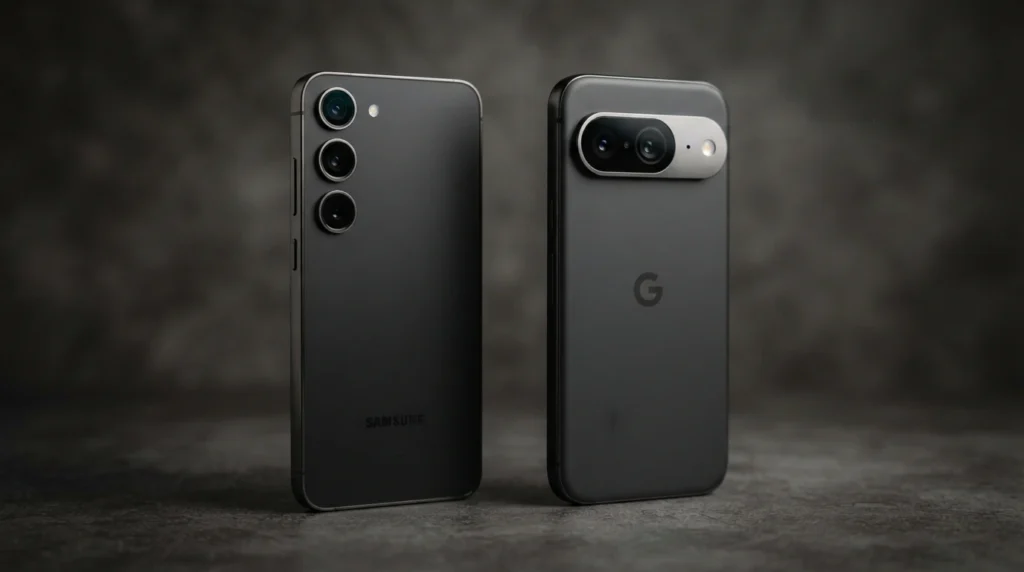
A Brief Comparison of the Pixel 10a and Galaxy S26
While there are some similarities between the Pixel 10a and the Galaxy S26, their hardware is built with different priorities.
The 6.3-inch Dynamic AMOLED 2X display on the Galaxy S26 has a refresh rate of up to 120 Hz. A 6.3-inch display with a refresh rate of up to 120 Hz is another feature of the Pixel 10a. While Samsung has the edge in terms of overall flagship display quality, both should feel fluid while navigating menus, reading websites, and scrolling through social media.
In terms of processing power, Google’s Tensor G4 CPU powers the Pixel 10a, while Samsung’s flagship-class Exynos 2600 processor powers the Galaxy S26. When it comes to demanding gaming, heavy multitasking, and processor-intensive apps, Samsung’s phone is the better option.
RAM is an additional distinction. The Pixel 10a has 8GB of RAM, whereas the Galaxy S26 has 12GB. Samsung has greater breathing room when juggling several demanding apps because to that more memory.
The Pixel 10a has 128GB and 256GB storage options, while the Galaxy S26 has 256GB and 512GB variants.
Additionally, the camera systems differ significantly. A 50MP primary camera, a 12MP ultrawide camera, and a 10MP telephoto camera with 3x optical zoom are all features of the Galaxy S26. The Pixel 10a lacks a specialized telephoto lens but features a 48MP primary camera and a 13MP ultrawide sensor.
The Pixel 10a sports a 13MP front-facing camera, whilst the Galaxy S26 has a 12MP selfie camera.
One area where Google leads is in battery capacity. The Pixel 10a has a significantly larger 5,100mAh battery than the Galaxy S26, which has a 4,300mAh battery.
Both phones include IP68 water and dust protection and wireless charging capabilities.
For those who prefer higher-resolution video recording, Samsung has an advantage because the Galaxy S26 can record at up to 8K. Up to 4K video is supported with the Pixel 10a.
In terms of software, Google offers the Pixel software experience with its own AI-powered capabilities, while Samsung uses One UI with Galaxy AI features.
To put it simply, the Pixel 10a prioritizes battery life, Google’s software experience, AI, photography, and value, while the Galaxy S26 prioritizes performance, high-end hardware, camera versatility, and gaming.
One area where Google leads is in battery capacity. The Pixel 10a has a significantly larger 5,100mAh battery than the Galaxy S26, which has a 4,300mAh battery.
Both phones include IP68 water and dust protection and wireless charging capabilities.
For those who prefer higher-resolution video recording, Samsung has an advantage because the Galaxy S26 can record at up to 8K. Up to 4K video is supported with the Pixel 10a.
In terms of software, Google offers the Pixel software experience with its own AI-powered capabilities, while Samsung uses One UI with Galaxy AI features.
To put it simply, the Pixel 10a prioritizes battery life, Google’s software experience, AI, photography, and value, while the Galaxy S26 prioritizes performance, high-end hardware, camera versatility, and gaming.
Design and Construction Quality
Although design is subjective, the flagship identity of the Galaxy S26 is more evident.
The S26 was designed by Samsung with a small, high-end form factor in mind. Compared to today’s larger smartphones, the phone’s 6.3-inch screen makes it comparatively easy to manage, and its high-end construction gives it a classy feel.
Because of its 6.3-inch screen, the Pixel 10a is likewise small. Without putting the phone in the same price range as Samsung’s flagship, Google has designed it to offer a premium-looking experience.
Both phones are dust and water resistant (IP68). As a result, you won’t be as concerned about rain, dust exposure on a daily basis, or unintentional splashes.
However, the Galaxy S26 has the advantage if you value the flagship-style design and the most upscale overall construction.
The Galaxy S26 is the design winner.
Display: Pixel 10a vs. Galaxy S26
The Galaxy S26 carries on Samsung’s longstanding reputation as one of the top manufacturers of smartphone screens.
With a refresh rate of up to 120 Hz, the 6.3-inch Dynamic AMOLED 2X display provides deep blacks, powerful contrast, vivid colors, and superior viewing experience thanks to AMOLED technology.
Because of this, the Galaxy S26 is particularly fun for gaming, social media browsing, movie streaming, and photo browsing.
A 6.3-inch display with a refresh rate of up to 120 Hz is another feature of the Pixel 10a. Strong brightness and seamless scrolling are features of Google’s Actua pOLED display.
Most users should be satisfied with either display for everyday use.
Nevertheless, Samsung prevails since the Galaxy S26 offers a more upscale display experience and is built as a flagship.
Winner of the display: Galaxy S26
Performance
One of the main justifications for selecting the Galaxy S26 is its performance.
Demanding customers are the target market for the Galaxy S26. For multitasking, gaming, picture and video editing, and other demanding tasks, its flagship-class processor and 12GB of RAM offer ample power.
You don’t have to worry about the phone’s memory running out all the time when switching between different apps. Additionally, it increases the device’s performance headroom for future releases of demanding programs.
Google’s Tensor G4 engine and 8GB of RAM power the Pixel 10a. Instead of only focusing on benchmark numbers, Tensor chips are created with Google’s AI and machine-learning technologies in mind.
The Pixel 10a should be more than capable for routine tasks. Flagship-level processing power is not necessary for browsing, texting, streaming, social networking, navigation, email, or daily photography.
When you start playing games or using demanding apps, the difference becomes more noticeable.
The Galaxy S26 is a better performance option if you use smartphones frequently.
The Galaxy S26 is the performance champion.
gAming Performance
Another area in which Samsung excels is mobile gaming.
The Galaxy S26 is better suited for demanding games with to its flagship chipset, 12GB of RAM, and 120Hz display.
Stronger hardware is advantageous for graphics-intensive games like Call of Duty Mobile, PUBG Mobile, Genshin Impact, and others.
Although it isn’t made to compete with flagship phones in demanding gaming conditions, the Pixel 10a can surely handle casual gaming.
The Galaxy S26 is the safer option if gaming is a major factor in your phone upgrade.
The Galaxy S26 is the gaming winner.
Life of a Battery
One of the main benefits of the Pixel 10a may be its battery life.
The 5,100mAh battery of the Pixel 10a is much bigger than the 4,300mAh battery of the Galaxy S26.
Of course, real-world endurance is influenced by many factors than just battery capacity. How long a phone lasts depends on a number of factors, including screen brightness, CPU efficiency, mobile network conditions, apps, camera usage, gaming, and personal settings.
Nevertheless, the Pixel 10a begins with a definite capacity edge.
The Pixel 10a might be a great choice for battery-conscious consumers if you spend the most of your day browsing, watching movies, using social media, taking pictures, and chatting with friends.
Although it lacks the same raw battery capacity, the Galaxy S26 still has robust battery management and charging capabilities.
The Pixel 10a won the battery.
Camera: Pixel 10a vs. Galaxy S26
This comparison becomes particularly intriguing when it comes to camera performance.
Thanks to Google’s computational photography, the Pixel series has gained a reputation for creating stunning images. Google employs software and AI processing to enhance exposure, detail, dynamic range, portraits, and challenging lighting circumstances rather than solely depending on camera hardware.
There is a 13MP ultrawide camera and a 48MP primary camera in the Pixel 10a. This setup should be more than sufficient for regular photography.
On the other hand, the Galaxy S26 provides a more flexible system.
Samsung equips the S26 with a 10MP telephoto camera with 3x optical zoom, a 12MP ultrawide camera, and a 50MP primary camera.
One significant benefit is that specialized telephoto lens.
Compared to just cropping into a conventional shot, optical zoom offers you more versatility when taking pictures of far-off subjects, travel vistas, buildings, pets, concerts, or portraits.
With compatibility for up to 8K video, Samsung also has an advantage in high-resolution video recording.
For those who prefer Google’s image processing technique and simple point-and-shoot shooting, the Pixel 10a is still appealing.
Therefore, there isn’t a single, obvious winner for every photographer.
The Galaxy S26 is the camera versatility winner.
Value and computational photography winner: Pixel 10a
AI and software
One area where individual preferences are more important than specifications is software.
Samsung’s One UI, which offers a plethora of functionality and personalization possibilities, powers the Galaxy S26. Additionally, Samsung incorporates Galaxy AI into a number of aspects of the experience.
Because of this, the S26 is a wonderful pick if you enjoy having a lot of controls and customization possibilities.
The Pixel 10a adopts a more tidy methodology.
With Google services and AI technologies deeply ingrained in the phone, Google’s Pixel OS is built around a simple Android experience.
The Pixel experience can feel especially natural if you regularly use Google Photos, Gmail, Maps, Calendar, and other Google services.
In terms of feature depth and personalization, Samsung is superior.
For those who prefer Google’s software ecosystem and a more straightforward UI, Google is superior.
Winner of software: tie
Storage and Daily Utilization
Surprisingly fast, storage can become crucial.
Having extra internal storage can be helpful if you frequently record videos, download games, maintain sizable photo galleries, or store movies offline.
Higher storage choices, such as a 512GB option, are available for the Galaxy S26. The maximum storage capacity of the Pixel 10a is 256GB.
128GB or 256GB may be plenty for a regular user who uses cloud storage and doesn’t download many large files.
However, the Galaxy S26 has an edge if you intend to retain your phone for a number of years due to its larger storage capacity.
The Galaxy S26 is the storage champion.
Which Phone Is More Economical?
The Pixel 10a has the best case here.
A flagship processor, a specialized telephoto lens, or sophisticated video capabilities are not necessary for everyone.
The Pixel 10a can meet all of your needs if your daily activities include messaging, social media, YouTube, web surfing, navigation, photography, and occasionally gaming.
Another significant benefit is the larger battery.
When you truly require the extra hardware, the Galaxy S26 becomes more sensible. Samsung’s phone will be more beneficial to heavy gamers, power users, content producers, photographers, and those seeking a high-end flagship experience.
As a result, the Pixel 10a is more affordable for consumers on a tight budget, while the Galaxy S26 is more feature-rich and capable for those who are prepared to spend more.
Pixel 10a is the value winner.
Galaxy S26 Benefits and Drawbacks
Pros of the Galaxy S26
High-end flagship design
Superb AMOLED screen
Powerful 12GB RAM
Specialized 3x telephoto lens
A more adaptable camera system
Improved performance in games
More possibilities for storage
Advanced aspects of AI
Charging wirelessly
IP68 resistance to dust and water
Up to 8K video capture
Cons of the Galaxy S26
Compared to the Pixel 10a, a smaller battery
An increased cost
For casual users, several flagship features might not be necessary.
Pixel 10a Benefits and Drawbacks
Pros of the Pixel 10a
Big 5,100mAh battery
Google software that is clean
Robust 120Hz display for computational photography
Features of Google AI
Excellent daily performance
High value
6.3-inch compact size
IP68 resistance to dust and water
Cons of the Pixel 10a: 8GB RAM
No specialized telephoto lens
Not as appropriate for tough games
Fewer hardware features at the flagship level
Reduce the maximum storage capacity
Which Is Better, the Pixel 10a or the Galaxy S26?
How you use your smartphone will determine which phone is ideal for you.
If performance is your top concern, go with the Galaxy S26. Gaming, multitasking, demanding programs, zoom photography, high-resolution video, and consumers seeking a premium flagship experience are all better suited for it.
If you want a phone that has all the features you need without spending money on gear you might never use, the Pixel 10a is a better option. It is a desirable smartphone for daily use because of its big battery, Google OS, AI features, and computational photography.
Samsung is the obvious option for photography enthusiasts who require optical zoom.
The Pixel 10a is still appealing to consumers who just want to take excellent daily pictures with no effort.
Select Samsung for gaming.
Go to Google for battery value and capacity.
Final Decision
Overall, the Galaxy S26 is the more potent and adaptable smartphone when compared to the Pixel 10a.
Performance, gaming, display quality, storage options, camera variety, optical zoom, and high-end video capabilities are all areas where Samsung excels.
The Pixel 10a isn’t attempting to outperform Samsung in every feature, though.
The goal of Google’s phone is to provide the functions that the majority of people use on a daily basis while maintaining a straightforward user interface and a huge battery. Everyday consumers find it especially enticing because of its clean software and computational photography.
In the end, the Pixel 10a is a superior option for consumers who value affordability, battery life, and Google’s software, while the Galaxy S26 is a better option for power users.
Choose the Galaxy S26 if you’re looking for the most powerful phone out of the two.
The Pixel 10a is worth serious consideration if you want to receive a current Android experience with a powerful camera and a long battery at a lower cost.
FAQ
Is the Pixel 10a inferior than the Galaxy S26?
In general, yes. Higher storage options, a specialized telephoto camera, more RAM, more powerful technology, and improved gaming capabilities are all features of the Galaxy S26. For regular users, the Pixel 10a might be a better bargain.
Which has a longer battery life, the Pixel 10a or the Galaxy S26?
At 5,100mAh, the Pixel 10a’s battery is greater than the Galaxy S26’s 4,300mAh. Each phone’s actual battery life varies depending on how it is used.