One of the most intriguing flagship smartphone competitions for those seeking a high-end phone without making significant sacrifices is the iPhone 17 Pro Max vs. Pixel 10 Pro XL comparison. Google and Apple approach the flagship experience very differently. While the Pixel 10 Pro XL prioritizes Google’s AI technology, computational photography, zoom capabilities, and Android experience, the iPhone 17 Pro Max places more emphasis on raw performance, video recording, battery life, ecosystem integration, and long-term stability.
Large, high-refresh-rate OLED screens, sophisticated camera systems, high-end construction, potent processors, wireless charging, and lots of storage are all features of both phones. Despite having differing storage configurations, they also start at the same $1,199 pricing in the US. Google’s Pixel 10 Pro XL and Apple’s iPhone 17 Pro Max both start at 256GB.
Which one should you get, then?
What matters most to you will determine the response. The iPhone 17 Pro Max is a better option if you want top-notch gaming and processing power, high-quality video, and a refined ecosystem. The Pixel 10 Pro XL is very appealing if photography, AI features, Android customisation, and Google’s computational photography technique are your top priorities.
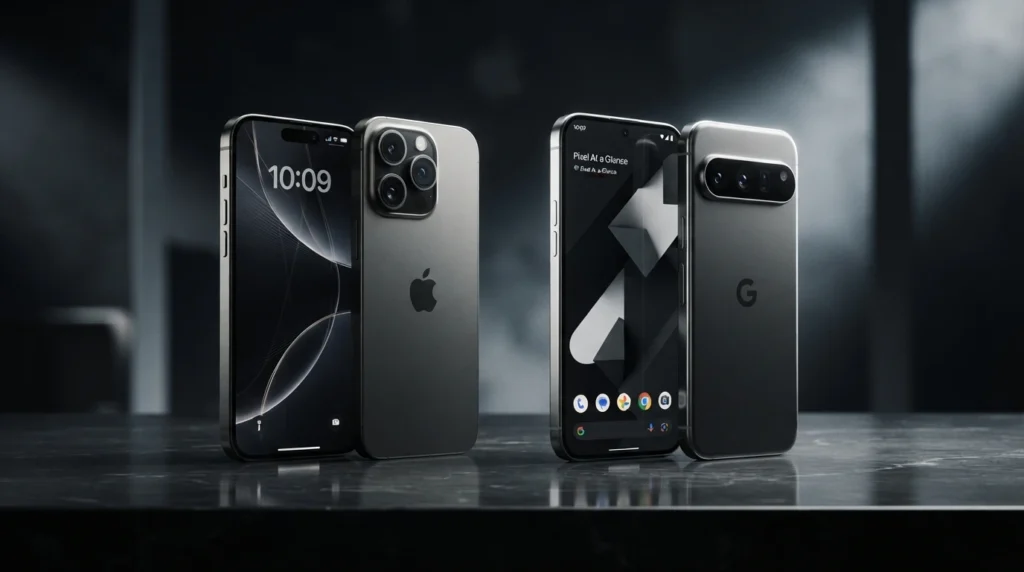
Pixel 10 Pro XL vs. iPhone 17 Pro Max: A Brief Conclusion
Although both the Pixel 10 Pro XL and the iPhone 17 Pro Max are high-end $1,199 smartphones, their design priorities differ.
For those seeking the fastest overall performance, top-notch gaming, professional-caliber video, robust battery life, and seamless connection with Apple’s ecosystem, the iPhone 17 Pro Max is a better option.
For customers who value AI-powered capabilities, computational photography, Google software, high-resolution zoom, and Android flexibility, the Pixel 10 Pro XL is a better option.
The 6.9-inch Super Retina XDR OLED screen of the iPhone 17 Pro Max features ProMotion up to 120Hz. The somewhat smaller 6.8-inch LTPO OLED display of the Pixel 10 Pro XL has a refresh rate of 1–120Hz and a maximum brightness rating of 3,300 nits.
To put it another way, neither phone is a clear victor in every category. The competition between Google’s AI-focused flagship and Apple’s performance-focused flagship is real.
Design and Construction Quality
With Ceramic Shield 2 on the front and Ceramic Shield on the back, Apple uses an aluminum unibody design for the iPhone 17 Pro Max. It is 8.75 mm thick and weighs about 233 grams. Additionally, Apple awards it an IP68 designation for dust and water resistance.
The design philosophy of the Pixel 10 Pro XL is slightly different. With its unique camera bar, Gorilla Glass Victus 2 cover glass, and a body weighing roughly 232 grams, Google employs a high-end build. The thickness of the phone is about 8.5 mm.
Because both phones are huge flagship smartphones, the weight difference is virtually insignificant in daily use. Neither is very light or compact.
Google’s Pixel design is more identifiable due to its horizontal camera bar, whereas Apple’s design feels more conventional and closely linked with the iOS environment.
Although both phones are made to withstand regular contact to dust and water, an IP classification does not imply that either device is totally waterproof.
Winner of design: tie
Show Comparison
One area in which both phones excel is display quality.
The 6.9-inch Super Retina XDR OLED display on the iPhone 17 Pro Max has a resolution of 2868 x 1320, 460 pixels per inch, Always-On capability, support for HDR, and ProMotion variable refresh rates up to 120 Hz. Apple claims that the maximum outdoor brightness is up to 3,000 nits.
A 6.8-inch Super Actua LTPO OLED screen is included with the Pixel 10 Pro XL. It features a resolution of 1344 x 2992, 486 PPI, an adjustable refresh rate of 1–120 Hz, and a maximum brightness of 3,300 nits.
On paper, Apple’s display technology is incredibly sophisticated and well-integrated with iOS, but the Pixel has a modest advantage in peak brightness and pixel density.
Both screens are great for gaming, social media browsing, movie watching, and photo editing.
Although the iPhone’s 6.9-inch screen is slightly larger, most consumers won’t select a phone based only on screen size.
Display winner: iPhone 17 Pro Max for overall elegance; Pixel 10 Pro XL for brightness
Performance: Tensor G5 vs. A19 Pro
The main distinction between these two phones is most likely their performance.
Apple’s A19 Pro chip powers the iPhone 17 Pro Max. A six-core CPU, a six-core GPU with neural accelerators, and a sixteen-core neural engine are all specified by Apple. The chip is made for professional workloads, video processing, gaming, machine learning, and demanding applications.
Google’s Tensor G5 processor and the Titan M2 security coprocessor are used in the Pixel 10 Pro XL. Because Tensor is primarily built around AI, machine learning, image processing, and Google software capabilities, Google’s strategy differs.
Both phones feel quick for routine tasks like surfing, messaging, social media, streaming, navigation, and photography.
However, the iPhone 17 Pro Max offers a better performance profile when it comes to intense gaming, prolonged processing, high-end video editing, and benchmark-heavy workloads.
Apple’s edge in bespoke silicon is especially apparent in this category.
The Tensor G5 in the Pixel 10 Pro XL is not slow. It’s a high-end processor for smartphones. Simply said, its strength is less about achieving the highest benchmark performance and more about AI and Google’s computational photography ecosystem.
The iPhone 17 Pro Max is the performance winner.
Performance in Games
The iPhone 17 Pro Max is the safer option if you’re purchasing a flagship phone primarily for mobile gaming.
Apple’s hardware and iOS optimization enables demanding games to run smoothly, while the A19 Pro offers significant CPU and GPU capability. The iPhone has enhanced graphical capabilities thanks to hardware-accelerated ray tracing.
Although Google’s Tensor processors have always focused on AI and machine-learning tasks rather than vying only for the greatest graphics benchmark scores, the Pixel 10 Pro XL is capable of handling contemporary games.
The distinction might not be significant for casual gaming.
The iPhone is superior for serious gamers who play graphically demanding games for hours on end.
The iPhone 17 Pro Max is the gaming winner.
Comparison of Cameras
The battle of the camera is considerably closer.
A triple 48MP Pro Fusion camera system is a feature of the iPhone 17 Pro Max. A 48MP main camera, a 48MP ultra-wide camera, and a 48MP telephoto camera make up its arrangement. With a digital zoom of up to 40x, the telephoto system provides 4x optical zoom and up to 8x optical-quality telephoto capability.
A 50MP wide camera, a 48MP ultra-wide camera with autofocus and Macro Focus, and a 48MP 5x telephoto camera are all used by the Pixel 10 Pro XL. Additionally, Google provides up to 100x Pro Zoom capabilities.
Because of this, the two camera systems are intriguing for several reasons.
The iPhone excels at taking natural-looking pictures, capturing videos, maintaining consistency between lenses, and creating material that is suitable for social media.
When it comes to AI processing and computational photography, the Pixel is incredibly powerful. The Pixel is more than just a camera phone thanks to Google’s Camera Coach, Nite Sight, High-Res Portrait Mode, Best Take, Magic Eraser, Zoom Enhance, and other AI-assisted features.
Primary Camera
In general, the iPhone strives for strong dynamic range, natural skin tones, balanced colors, and reliable outcomes.
The Pixel adopts a more computational strategy. Particularly under difficult lighting conditions, Google’s image processing may generate remarkable resolution and dynamic range.
Both phones can take great pictures if you just point and shoot.
Winner of the main camera: tie
Zoom
The advertized zoom range of the Pixel 10 Pro XL is clearly superior.
While Google’s Pro Res Zoom uses AI-assisted computational processing to stretch up to 100x, its 48MP telephoto camera offers 5x optical zoom. According to Google, Pro Res Zoom uses a generative imaging model and Tensor G5 to recover and enhance details at very high zoom levels.
With a digital zoom of up to 40x, the iPhone 17 Pro Max has an 8x optical-quality telephoto capabilities and a 4x telephoto camera.
The Pixel is the more ambitious camera for long-range photos, animals, concerts, far-off scenes, and travel photography.
Winner of Zoom: Pixel 10 Pro XL
Recording Videos
The iPhone is superior in this regard.
With its professional-focused video capabilities, the iPhone 17 Pro Max carries on Apple’s years-long development of its video pipeline.
The iPhone is among the safest options if you’re a YouTuber, TikTok creator, filmmaker, social media creator, or someone who regularly captures family footage.
Although the Pixel is capable of producing high-quality video, serious video producers find the iPhone more appealing due to Apple’s mix of stabilization, processing, consistency, and professional video tools.
The iPhone 17 Pro Max won the video.
Charging and Battery Life
When contrasting the iPhone 17 Pro Max with Pixel 10 Pro XL, battery life is yet another important factor.
Apple claims that the iPhone 17 Pro Max can play videos for up to 39 hours and stream them for up to 35 hours. Additionally, it enables rapid charging; according to Apple, a 40W or higher charger and cable can charge the phone to 50% capacity in around 20 minutes.
The standard battery of the Pixel 10 Pro XL is 5,200mAh. Google promotes battery life of more than 24 hours and up to 100 hours with Extreme Battery Saver. With a 45W USB-C PPS charger or more, it can reach up to 70% in about 30 minutes. Additionally, up to 25W of Qi2-certified Pixelsnap wireless charging is supported.
As a result, the Pixel has a simpler advantage in terms of battery capacity and charging speed.
However, Apple’s official movie playback statistics are great, and the iPhone continues to be incredibly efficient.
The Pixel’s rapid charging capacity can be especially helpful for heavy users who frequently require a quick charging boost.
Battery winner: iPhone is great for endurance, while Pixel has a slight advantage for charging.
AI and software
The iPhone 17 Pro Max has Apple Intelligence capabilities and runs Apple’s iOS environment.
The Android and Google AI ecosystem, which includes Gemini-powered features and Pixel-only tools, is the foundation of the Pixel 10 Pro XL.
The way AI is incorporated into regular phone functionality and photography is Google’s greatest edge. The extent to which AI has permeated the Pixel experience is demonstrated by features like Camera Coach, Magic Eraser, Best Take, and Pro Res Zoom.
Apple adopts a more restrained strategy. iOS is renowned for its dependability, ecosystem integration, privacy-focused features, and intimate connection between Apple’s software and hardware.
The iPhone is much more sensible if you already have an iPad, Mac, Apple Watch, or AirPods.
The Pixel might be a better fit for your lifestyle if you use Google services frequently and like Android’s customizable features.
Software winner: Ecosystem-dependent
Pricing and Storage
In the United States, the iPhone 17 Pro Max and Pixel 10 Pro XL both enter the market with a starting price of $1,199.
The iPhone 17 Pro Max comes with 512GB, 1TB, and 2TB storage options in addition to the standard 256GB. According to Apple’s current US price, the 256GB model costs $1,199, the 512GB model costs $1,399, the 1TB model costs $1,599, and the 2TB model costs $1,999.
With storage options of 256GB, 512GB, and 1TB, the Pixel 10 Pro XL is likewise priced at $1,199.
Therefore, if you require a lot of capacity, particularly if you capture a lot of high-resolution video, the iPhone has the benefit.
When it comes to storage capacity, the iPhone 17 Pro Max gives users more flexibility, with configurations reaching up to 2TB.
Pixel 10 Pro XL: The Biggest Advantages and Disadvantages
A19 Pro performance that is incredibly powerful
Outstanding performance in games
Excellent video capture
48MP trio of cameras
2TB of storage capacity
Outstanding battery longevity
High-end 6.9-inch OLED screen
Robust integration of the Apple ecosystem
Long-term assistance with software
Outstanding resale value Drawbacks
A really big, bulky phone
costly at larger storage capacities
Not as adaptable as Android
No computational zoom in the 100x style
The fast charger is offered separately.
Switching platforms can be difficult due of Apple’s ecosystem.
Pixel 10 Pro XL: Biggest Advantages and Limitations
Superb 6.8-inch LTPO OLED screen
16GB RAM and a really brilliant screen
AI-focused Tensor G5 processing
Superb computational photography
5x optical telephoto lens
Pro Zoom up to 100x
Robust AI editing tools
5,200 mAh battery
Quicker connected charging
Android customisation with up to 25W Qi2 wireless charging
Updates and new features for seven years
Drawbacks
Apple’s A19 Pro is more performance-focused than Tensor G5.
The phone’s best feature is not its gaming capabilities.
If you don’t use AI features, they may be less helpful.
Big bodies might feel heavy.
True optical zoom is not the same as extreme digital zoom.
Text-Based Comparison: Pixel 10 Pro XL vs. iPhone 17 Pro Max
Here is the same data in an easy-to-read text style rather than a conventional comparison table.
Display: The 6.9-inch Super Retina XDR OLED display on the iPhone 17 Pro Max offers a refresh rate of up to 120 Hz. The 6.8-inch LTPO OLED display of the Pixel 10 Pro XL has a refresh rate of 1–120 Hz.
Processor: Google’s Tensor G5 is used by the Pixel, while the A19 Pro is used by the iPhone.
RAM: The Pixel 10 Pro XL has 16GB of RAM. Direct RAM comparisons can be deceptive because Apple does not market iPhone RAM in the same consumer-facing manner.
The iPhone’s primary camera has a 48MP resolution. Pixel’s primary camera is 50MP.
48MP ultra-wide cameras are used in both phones.
Telephoto: Up to 8x optical-quality telephoto is possible with the iPhone’s 48MP 4x telephoto technology. Pixel boasts a 5x telephoto 48MP camera and a 100x Pro Zoom.
Front camera: The Pixel has a 42MP autofocus front camera, while the iPhone has a TrueDepth system.
Battery: The Pixel features a 5,200mAh battery that can quickly charge up to 70% in roughly 30 minutes, whereas the iPhone prioritizes lengthy playback endurance.
Modern wireless charging is supported by both, however Pixel provides up to 25W Qi2-certified Pixelsnap charging.
Storage: The Pixel can hold up to 1TB, whereas the iPhone can hold up to 2TB.
Starting price: In the US, both start at $1,199.
The iPhone 17 Pro Max is the best device for gaming.
The Pixel 10 Pro XL is the best camera for zoom photography.
The iPhone 17 Pro Max is the best for video.
The Pixel 10 Pro XL is the best camera for AI photography.
The iPhone 17 Pro Max is the best option for customers of the Apple ecosystem.
The Pixel 10 Pro XL is the best option for Android consumers.
Which Phone’s Camera Is Better?
Select the Pixel 10 Pro XL if flexibility in shooting and AI-powered image processing are your top priorities.
Select the iPhone 17 Pro Max if reliable camera performance and high-quality video are your top priorities.
Those who take pictures of far-off topics will find the Pixel’s 100x Pro Zoom especially appealing. Conversely, Apple’s camera system is more appropriate for those who desire high-quality photos along with professional-caliber video capabilities.
For this reason, it would be oversimplified to declare one phone to be the ultimate camera winner. They are skilled in several areas.
What Kind of Phone Should You Purchase?
Select the iPhone 17 Pro Max if you’d like:
The quickest total performance
Serious mobile gaming
Expert-caliber smartphone video
Outstanding battery longevity
2TB of storage capacity
The environment of Apple
A flawless and reliable iOS experience
Select the Pixel 10 Pro XL if you’d like:
Google’s top AI capabilities
sophisticated computational photography
Zoom at a long distance
16GB RAM for Android customisation
Quicker charging
An very bright LTPO OLED screen
Google’s editing tools and camera
Final Decision
The fight between the iPhone 17 Pro Max and Pixel 10 Pro XL is not about one phone totally outperforming the other. Although both are flagship-class smartphones, various user types find them appealing.
The more performance-focused model is the iPhone 17 Pro Max. For gamers, producers, professionals, and those already involved in Apple’s ecosystem, its A19 Pro chip, superior video system, huge display, extended battery life, and up to 2TB storage make it a formidable option.
Google’s solution for those seeking a smartphone that prioritizes artificial intelligence is the Pixel 10 Pro XL. It is one of the most intriguing Android flagships on the market because to its Tensor G5 chip, 16GB RAM, 5,200mAh battery, 5x telephoto camera, 100x Pro Zoom, and several AI photography capabilities.
In terms of overall performance and video quality, I would choose the iPhone 17 Pro Max.
The Pixel 10 Pro XL is my choice if I had to choose one for AI features, photography, and zoom.
In the end, a minor variation in specifications might not be as significant as your preferred ecosystem. An iPhone user who relies on the Mac, iCloud, Apple Watch, and AirPods will likely be more satisfied with the iPhone. The Pixel might seem more natural to an Android user who is accustomed to Google Photos, Gmail, Google Assistant/Gemini, Google Drive, and other Google services.
In summary, the Pixel 10 Pro XL is the expert in AI and computational photography, while the iPhone 17 Pro Max is the leader in performance and video.
FAQ
s the Pixel 10 Pro XL inferior to the iPhone 17 Pro Max?
Your priorities will determine this. Performance, gaming, video, and Apple ecosystem connectivity are all improved with the iPhone 17 Pro Max. In terms of AI features, computational photography, and extreme zoom, the Pixel 10 Pro XL is superior.
Which camera is superior, the Pixel 10 Pro XL or the iPhone 17 Pro Max?
Both are outstanding, yet their strengths are distinct. Pixel is especially good at long-range zoom and computational photography, but iPhone is better at video and general camera consistency.
Which has a longer battery life?
While the Pixel 10 Pro XL boasts a 5,200mAh battery and rapid charging, the iPhone 17 Pro Max boasts amazing official video playback numbers. Network conditions, screen brightness, apps, gaming, and camera usage all affect real-world battery life.
Which phone is most suitable for gaming?
Because its A19 Pro chip is built for high-performance CPU and GPU operations, the iPhone 17 Pro Max is a superior choice for demanding mobile gaming.
Which phone’s zoom is superior?
The zoom system on the Pixel 10 Pro XL is more forceful. With Google’s Pro Zoom technology, its 5x optical telephoto camera can achieve up to 100x magnification.
For photography, is the Pixel 10 Pro XL superior to the iPhone 17 Pro Max?
The Pixel may be a better option for extreme zoom, AI editing, and computational photography. The iPhone is a great option for video and reliable overall imaging.
Which is more affordable, the Pixel 10 Pro XL or the iPhone 17 Pro Max?
In the US, both start at $1,199; however, the effective price may vary depending on current discounts, trade-in deals, and retailer pricing.
In 2026, which phone should I purchase?
If performance, video, gaming, and Apple’s ecosystem are your top priorities, get the iPhone 17 Pro Max. If AI, photography, zoom, charging speed, and Android customization are important to you, go with the Pixel 10 Pro XL.