Samsung and OnePlus are two well-known brands when it comes to high-end Android handsets. While many smartphone customers may currently be looking for the OnePlus 14 online, the Samsung Galaxy S26 is a symbol of Samsung’s sophisticated flagship experience.
But before comparing the two phones, there is a crucial detail to comprehend. In 2026, OnePlus switched from the OnePlus 13 to the OnePlus 15, eschewing the OnePlus 14 designation, while Samsung formally introduced the Galaxy S26. The official flagship generation of the company is currently the OnePlus 15.
For those looking to compare the Galaxy S26 and OnePlus 14, this presents an intriguing scenario. Knowing the differences between OnePlus’s current flagship and Samsung’s newest compact flagship is crucial if you are investigating the upcoming OnePlus flagship or searching for a substitute for the Galaxy S26.
The design, display, performance, cameras, battery, charging, software, AI features, durability, and overall value will all be covered in this guide. We will also discuss which phone is best for daily use, gaming, photography, and long-term ownership.
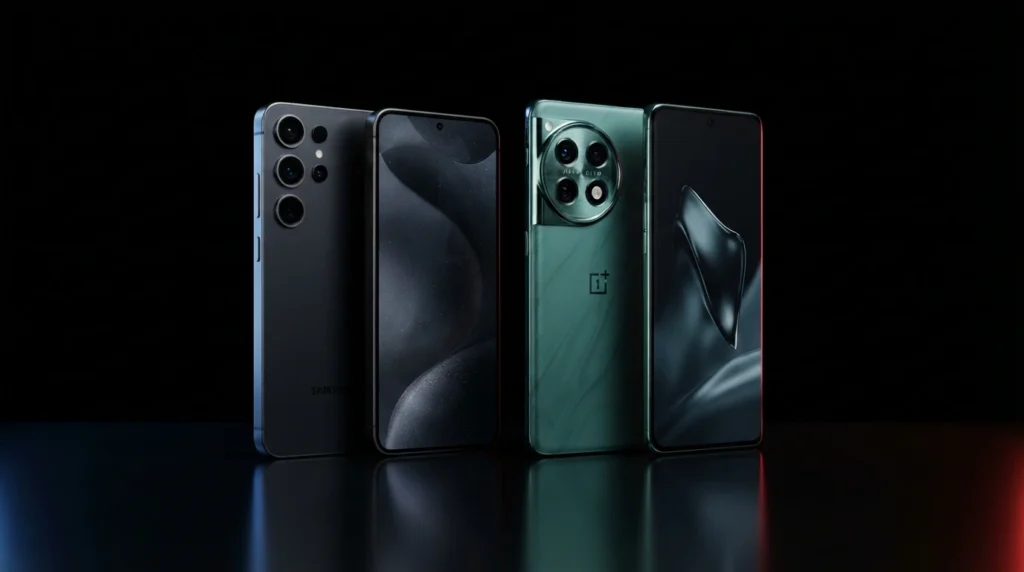
Overview of the Galaxy S26 vs. OnePlus 14
The Samsung Galaxy S26 is intended for consumers who desire a high-end, small smartphone without compromising flagship features. It has 12GB RAM, 256GB or 512GB of storage, a 6.3-inch Dynamic AMOLED 2X display, and a 120Hz adaptive refresh rate. A 50MP primary camera, a 12MP ultrawide camera, and a 10MP telephoto camera with 3x optical zoom make up Samsung’s triple rear camera arrangement.
Samsung’s software ecosystem, Galaxy AI features, Samsung DeX, SmartThings connection, and long-term software support are further advantages for the Galaxy S26. Security updates for the Galaxy S26 are listed by Samsung till February 2033.
However, the OnePlus 14 shouldn’t be regarded as a smartphone that has been officially released. The OnePlus 15, which has a 6.78-inch LTPO display with a 165Hz refresh rate, a Snapdragon 8 Elite Gen 5, a massive 7,300mAh battery, and triple 50MP rear cameras, is the main emphasis of current official OnePlus information.
Therefore, the Galaxy S26 vs. OnePlus 15 comparison is more realistic if your search is specifically for a real-world purchase choice. However, if the post explains the model-number scenario in detail, the keyword “Galaxy S26 vs. OnePlus 14” can still be used for informative SEO content.
Design and Construction of the Galaxy S26
With the Galaxy S26, Samsung has maintained its tiny flagship strategy. The phone is much easier to handle than many huge flagship smartphones, measuring about 149.6 x 71.7 x 7.2 mm and weighing about 167 kilos.
One of the main benefits of the Galaxy S26 is its small size. The S26 offers consumers a quality experience in a comparatively manageable form factor, whereas many contemporary flagship phones have grown bulky and hefty.
Additionally, Samsung offers IP68 dust and water resistance. This improves the phone’s suitability for commonplace circumstances including dusty areas, rain, and unintentional splashes.
The Galaxy S26 is especially attractive to consumers who want a phone that is comfortable to use with one hand.
What We Actually Know About the OnePlus 14 Design
Unlike the Galaxy S26, there isn’t an officially released OnePlus 14 to compare.
Rumored or anticipated features for a potential OnePlus 14 include a big LTPO AMOLED display, triple-camera technology, and a high-capacity battery, according to several third-party websites. But rather than being official specifications, these need to be considered leaks or conjecture.
Because smartphone specifications might vary significantly before to introduction, this distinction is important. A comparison article may become less reliable if rumored specifications are published as verified facts.
The OnePlus 15 is the appropriate model if you are genuinely looking to get a current OnePlus flagship. It features a 7,300mAh battery and a 6.78-inch LTPO 1.5K display with a refresh rate of up to 165Hz.
Show Comparison
One of the Galaxy S26’s best features is its display quality.
The 6.3-inch Dynamic AMOLED 2X display on the Samsung Galaxy S26 has an adjustable refresh rate of up to 120 Hz and a resolution of 2340 x 1080. Additionally, Samsung promises a maximum brightness of 2,600 nits.
In practical terms, this implies that the screen should be great for reading articles, playing games, viewing images, watching YouTube videos, and browsing social media.
Strong contrast and deep blacks are provided by AMOLED technology, and animations and scrolling feel fluid thanks to the 120Hz refresh rate.
The newer OnePlus 15 has a different strategy. It has a bigger 6.78-inch LTPO display with a refresh rate of up to 165 Hz. OnePlus explicitly targets consumers who desire incredibly fluid motion and responsive gaming with this increased refresh rate.
Most individuals won’t notice a significant difference between 120Hz and 165Hz when using a smartphone normally. However, users and gamers who are particularly interested in motion smoothness could like the OnePlus method.
Gaming and Performance
Both manufacturers also aim to attract flagship users in the area of performance.
The specific chipset used in the flagship processor of the Galaxy S26 varies according on the market. Depending on the location, Samsung offers the Exynos 2600 and Snapdragon 8 Elite Gen 5 for Galaxy. Additionally, the phone has up to 512GB of storage and 12GB of RAM.
The Galaxy S26 is more than capable of doing daily duties. Demanding games can run smoothly, apps open promptly, and multitasking is seamless.
Samsung places a lot of emphasis on AI processing as well. Rather than being viewed as a stand-alone feature, Galaxy AI functions are included into the entire program experience.
The Snapdragon 8 Elite Gen 5, which powers the OnePlus 15, is highly tuned for gaming. OnePlus claims to have improved GPU efficiency and CPU performance over the previous generation, and its gaming system is built to sustain high frame rates.
The OnePlus flagship provides a significant advantage for those who value high refresh rates, sustained performance, and gaming performance.
Comparison of Cameras
The Galaxy S26 upholds Samsung’s longstanding position as one of the top Android brands for smartphone photography.
A 50MP wide camera, a 12MP ultrawide camera, and a 10MP telephoto camera with a 3x optical zoom are all part of the back camera system. The 12MP front camera has autofocus. Additionally, Samsung allows 8K video recording at 30 frames per second.
The Galaxy S26 can generate superior zoom results than a phone that only uses digital zoom because it has a dedicated telephoto camera.
Additionally, Samsung’s image processing typically results in bright, social media-friendly images. For those seeking dependable point-and-shoot photography, the phone is especially appealing.
On paper, the OnePlus 15’s triple 50MP camera system goes even beyond. It has a 50MP primary camera, a 50MP ultrawide camera, and a 50MP periscope telephoto camera with 7x optical quality zoom and 3.5x optical zoom.
Additionally, OnePlus has unveiled its DetailMax Engine for computational photography and superior video recording capabilities, including as Dolby Vision video in 4K at 120 frames per second.
The ultimate winner in photography is mostly determined by personal taste. While OnePlus delivers outstanding hardware and robust video specifications, Samsung has the advantage of a well-developed camera processing engine.
Life of a Battery
One of the main distinctions between OnePlus’s strategy and Samsung’s compact flagship concept is battery capacity.
The battery of the Galaxy S26 is 4,300mAh. Although actual battery life will vary based on network circumstances, screen brightness, apps, and usage habits, Samsung claims up to 30 hours of video playback.
The Galaxy S26’s tiny design contributes to the smaller battery.
With its massive 7,300mAh silicon-carbon battery, the OnePlus 15 falls into a different category. OnePlus promotes the phone’s long-lasting battery performance and promises up to 31 hours of video playback.
OnePlus has a distinct advantage in terms of battery capacity for frequent users, tourists, and gamers.
Speed of Charging
Another area where Samsung and OnePlus have rather distinct approaches is charging.
Both wireless and 25W wired charging are compatible with the Galaxy S26. Samsung has placed more emphasis on ecosystem integration and efficiency than on excessively high charging wattage.
Fast charging has always been a priority for OnePlus, and the OnePlus 15 is compatible with high-speed SUPERVOOC charging. Support for 80W SUPERVOOC and 50W AIRVOOC is listed on the official OnePlus specification page. Higher charging capacity is possible with a compatible OnePlus adapter.
OnePlus is the more appealing choice if you need to fast charge your phone during a brief break.
User Experience and Software
Samsung’s One UI software is used with Android 16 in the Galaxy S26. One UI has a lot of features and works well with other Samsung devices.
One significant benefit is Samsung’s ecosystem. Deeper device integration is advantageous for users of Samsung devices such as the Galaxy Watch, Galaxy Ring, and Galaxy Buds. Additionally, Samsung supports technologies like Samsung DeX and SmartThings.
Another significant benefit is long-term software support. Security updates for the Galaxy S26 are listed by Samsung till February 2033.
OxygenOS, which OnePlus utilizes, places a greater emphasis on performance, speed, and customisation. The OnePlus 15 integrates Google’s Android ecosystem with gaming-focused technology and runs OxygenOS 16.
The Galaxy S26 may be preferred by those who enjoy Samsung’s ecosystem and productivity tools, while OnePlus may be preferred by those who prefer an Android UI that prioritizes performance.
A Simple Comparison of the Galaxy S26 and OnePlus 14
If we simplify the comparison, the Galaxy S26 is a better option for anyone looking for a small flagship with a great display, reliable cameras, robust software support, and an established ecosystem.
For those who value battery capacity, charging speed, gaming capability, and a larger display, the OnePlus flagship strategy is more appropriate.
But keep in mind that the OnePlus 14 is not a device that has been officially announced. The OnePlus 15 is currently the official flagship device from OnePlus.
Pros of the Galaxy S26
Lightweight and compact flagship design
Superb 6.3-inch Dynamic AMOLED 2X screen
Adaptive refresh rate of 120 Hz
Robust triple-camera configuration
3x optical telephoto magnification
IP68 resistance to dust and water
robust Samsung ecosystem
Support for Samsung DeX
Long-term assistance with security
Outstanding daily performance
Galaxy AI features that are helpful
Cons of the Galaxy S26
Compared to many rival flagships, the 4,300mAh battery is smaller.
Wired 25W charging is somewhat slow.
Bigger phones may provide more comfortable gaming.
High-end storage setups can get pricey.
Instead of using built-in magnets, additional accessories are needed for full magnetic Qi2 performance.
OnePlus 14 Benefits and Drawbacks
It would be deceptive to give a full list of the OnePlus 14’s advantages and disadvantages as it hasn’t been formally released.
Rather, if you want to contrast the current OnePlus flagship with Samsung’s Galaxy S26, the OnePlus 15 has a number of distinct advantages:
Pros of the OnePlus 15
An enormous 7,300mAh battery
Snapdragon 8 Elite Gen 5
LTPO display up to 165 Hz
Three 50MP back cameras
3.5x optical telephoto magnification
incredibly quick charging
Excellent performance in games
Big screen
Advanced features for filming videos
Cons of the OnePlus 15
Greater in size and weight compared to the Galaxy S26
Not every photographer will find camera processing appealing.
The Samsung One UI and OxygenOS have different user interfaces.
The experience with wireless charging and accessories can be different from Samsung’s ecosystem.
Not as small for one-handed use
Which Phone Is Better for Playing Video Games?
Larger screens, fast refresh rates, potent processors, and robust batteries are crucial for gaming.
Although the Galaxy S26 can readily handle intense games, its 4,300mAh battery and small 6.3-inch display make it more suited for balanced daily use.
Performance is the focus of the OnePlus 15’s more aggressive design. Mobile gamers will find it especially tempting because to its 165Hz display, Snapdragon 8 Elite Gen 5, and 7,300mAh battery. Additionally, OnePlus’s game optimization mechanism encourages steady high-frame-rate gaming.
Gaming winner: OnePlus
Which Phone Has a Better Camera?
With a specialized telephoto lens, robust picture processing, and Samsung’s proven computational photography, the Galaxy S26 is the safer option for those seeking a dependable camera experience.
With its triple 50MP configuration and 3.5x periscope telephoto camera, the OnePlus 15 boasts great photography hardware and is fiercely competitive.
Both are great for informal photography. The Galaxy S26 might be a superior option for those who particularly like Samsung’s color processing, zoom stability, and ecosystem features.
Overall camera experience winner: Galaxy S26
Which Phone’s Battery Lasts Longer?
It’s significantly simpler in this area.
The current OnePlus 15 has a 7,300mAh silicon-carbon battery, whereas the Galaxy S26 has a 4,300mAh battery.
For extended travel days, gaming, and intensive use, the OnePlus’s larger battery is a major benefit.
OnePlus is the battery winner.
What Kind of Phone Should You Purchase?
Your priorities will determine the response.
If you’re looking for a small flagship with a high-end AMOLED display, dependable cameras, long-term software support, Samsung AI capabilities, and robust ecosystem integration, go with the Samsung Galaxy S26.
If you want a bigger screen, a larger battery, quicker charging, and aggressive gaming performance, go with the OnePlus 15.
Remember that the OnePlus 14 is not an officially available phone if you explicitly searched for Galaxy S26 vs. OnePlus 14. The Galaxy S26 vs. OnePlus 15 comparison is more pertinent for a real buying decision in 2026.
Final Decision
The flagship philosophies of OnePlus and the Galaxy S26 target slightly different kinds of smartphone customers.
Samsung prioritizes equilibrium. The Galaxy S26 is small, elegant, packed with features, and built to function especially well in the Samsung ecosystem. It is a great all-around flagship thanks to its camera system, display, software support, and small size.
OnePlus places a greater emphasis on endurance and performance. The Snapdragon 8 Elite Gen 5, 7,300mAh battery, 165Hz LTPO display, quick charging, and potent triple camera configuration are all features of the current OnePlus 15.
There isn’t a universal winner as a result.
Choose the Galaxy S26 if the camera, small size, software support, and ecosystem are your top priorities.
The OnePlus flagship is a better option if gaming, battery life, charging speed, and sheer performance are your top priorities.
The Galaxy S26 is the safer all-around choice for the majority of consumers looking for a well-balanced high-end Android phone. OnePlus is worthy of serious consideration for heavy users who demand the longest battery life or spend hours gaming.
FAQ
Is the OnePlus 14 formally accessible?
No, OnePlus switched from the OnePlus 13 generation to the OnePlus 15, eschewing the OnePlus 14 brand. Therefore, unless OnePlus itself verifies the specifications, websites that list the OnePlus 14’s specs should be regarded as rumors or unofficial information.
Is the OnePlus 14 inferior to the Galaxy S26?
A straight, verified specs comparison is not feasible because the OnePlus 14 was not formally released. If you’re referring to the current OnePlus flagship, the OnePlus 15, then OnePlus offers a larger display, a larger battery, and faster charging, whereas the Galaxy S26 offers a more compact design and the Samsung ecosystem.
Does the Galaxy S26 display at 120 Hz?
Indeed. The 6.3-inch Dynamic AMOLED 2X display on the Galaxy S26 features an adjustable refresh rate of up to 120 Hz.
What is the battery size of the Galaxy S26?
The typical battery capacity of the Galaxy S26 is 4,300mAh. According to Samsung, the phone is designed to be used all day.
Is there a telephoto camera on the Galaxy S26?
Indeed. A 10MP telephoto camera with a 3x optical zoom is included with the Galaxy S26.
Is the Galaxy S26 suitable for gaming?
Indeed. It can handle demanding games thanks to its flagship processor, 120Hz display, and optimized software. However, a larger OnePlus flagship with a noticeably larger battery might be preferred by consumers who value prolonged gaming sessions.
Which is better for battery life, OnePlus or Samsung?
The Galaxy S26’s 4,300mAh battery is significantly less than the current OnePlus 15’s 7,300mAh battery. OnePlus has an advantage when it comes to endurance-focused hardware and battery capacity.
Is 8K video supported on the Galaxy S26?
Indeed. According to Samsung’s specifications, the Galaxy S26 can record 8K video at up to 30 frames per second.
Which phone is most suitable for extended use?
Because Samsung offers a long software and security support period, the Galaxy S26 is especially appealing for long-term ownership. Updates for security are listed by Samsung till February 2033.
Should I wait for OnePlus or purchase the Galaxy S26?
The Galaxy S26 is an officially available flagship phone if you need one right now. Instead of waiting for a OnePlus 14, consider the OnePlus 15 if you are a OnePlus fan. The OnePlus 14’s name was omitted.