One of the most intriguing Android flagship competitions for 2026 is the Galaxy S26+ vs. Pixel 10 Pro contrast. High-end displays, potent processors, sophisticated cameras, and an emphasis on artificial intelligence are all features of both smartphones. But when it comes to creating their flagship phones, Samsung and Google have adopted very different strategies.
The Samsung Galaxy S26+ is intended to be a well-rounded all-arounder. It has a Snapdragon 8 Elite Gen 5 for Galaxy, a 6.7-inch Dynamic AMOLED 2X display, 12GB RAM, a 4,900mAh battery, and a flexible triple camera setup. Additionally, Samsung prioritizes enhanced camera processing and Galaxy AI.
In contrast, the Google Pixel 10 Pro places a strong emphasis on long-term software support, computational photography, and Google’s AI ecosystem. According to Google, the Pixel 10 Pro is a phone designed for AI performance, high-quality images and videos, and seven years of new features and upgrades.
Which phone is superior, then?
What you anticipate from a high-end Android smartphone will determine the response. Users who desire a huge display, powerful gaming capabilities, quick charging, and an all-around flagship experience will benefit with the Galaxy S26+. Those who value Google’s software, AI features, and photography will find the Pixel 10 Pro more enticing.
Let’s examine it more closely.
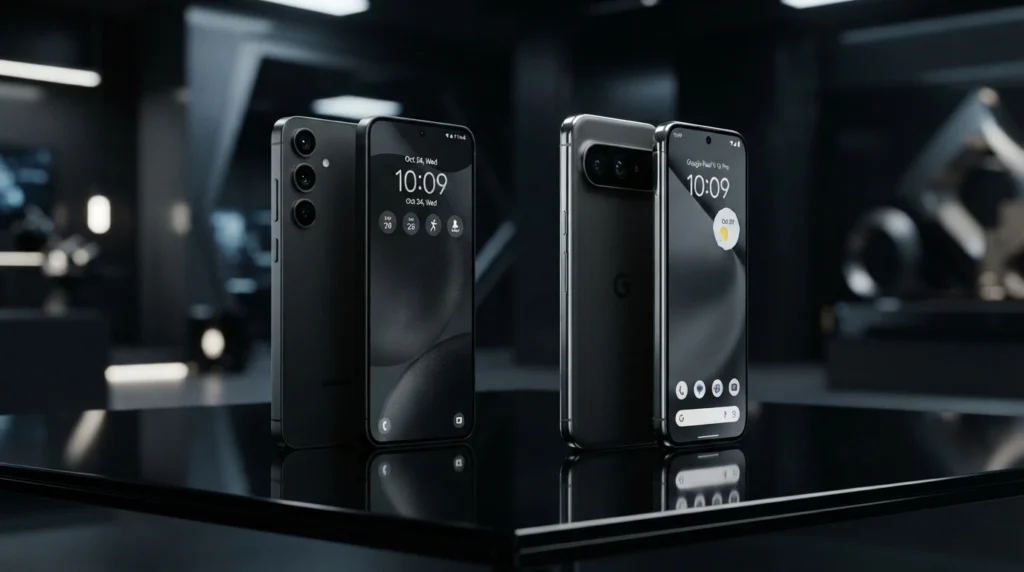
Pixel 10 Pro vs. Galaxy S26+: Design and Construction Quality
Instead of attempting to totally redesign the smartphone, Samsung has improved the Galaxy S26+’s design.
The phone weighs about 190 kilos and has a thin 7.3mm casing. Its 6.7-inch screen gives it a big flagship look without being overly enormous. Although color availability varies based on the market, Samsung offers a number of finishes.
People who watch movies, browse social media, read articles, or play games on their phones will find the Galaxy S26+ especially appealing because to its huge display.
The Pixel 10 Pro adopts a somewhat different strategy. Because of its more compact shape, using it with one hand may be simpler. The phone looks different from Samsung’s more traditional flagship design thanks to Google’s well-known Pixel design language.
Therefore, this is more about personal preference than it is about one phone having a better design across the board.
The Galaxy S26+ is the more appealing choice if you want a flagship with a large screen.
The Pixel 10 Pro is a better option if you’re looking for a small, high-end phone.
Show Comparison
One of the Galaxy S26+’s best features is its display quality.
The S26+ features a 6.7-inch Dynamic AMOLED 2X display from Samsung with an adjustable refresh rate of up to 120 Hz. Additionally, Samsung notes that the S26+ has a peak brightness of up to 2,600 nits and emphasizes advancements in ProScaler technology and image processing.
This translates to smooth scrolling, powerful contrast, and outstanding multimedia content visibility in daily use.
Additionally, the Pixel 10 Pro has Google’s Super Actua display technology and a high-end OLED display with a fast refresh rate.
The physical distinction is significant, though. The screen area of the Galaxy S26+ is significantly larger.
Therefore, the S26+ is the phone I would pick to watch movies, Netflix, and YouTube.
However, the Pixel 10 Pro’s smaller size can be a big benefit for those who don’t want a big phone in their pocket.
Performance: Pixel 10 Pro vs. Galaxy S26+
Another area where Samsung and Google have differing ideologies is performance.
According to Samsung’s official specifications, the Snapdragon 8 Elite Gen 5 for Galaxy powers the Galaxy S26+.
Fast CPU and GPU performance is the goal of this high-performance mobile platform. The S26+ provides enough power for demanding apps, multitasking, and gaming when paired with 12GB of RAM.
The Pixel 10 Pro is primarily focused on AI and machine-learning tasks and is based on Google’s Tensor platform.
This distinction is crucial.
Both phones will feel incredibly quick if you just open social media, surf websites, use chat applications, and watch videos.
However, the Galaxy S26+ is the more obvious option if you’re interested in demanding apps, intense gaming, or maximal raw performance.
Mobile gamers that desire excellent frame rates and powerful graphics performance may find the S26+ appealing due to Samsung’s Snapdragon platform.
The Pixel 10 Pro is more concerned with integrating AI into the smartphone experience than it is with breaking every benchmark.
Performance in Games
The Galaxy S26+ is clearly appealing for gaming.
The processing power required for contemporary graphics-intensive Android games is provided by the Snapdragon 8 Elite Gen 5 for Galaxy. Additionally, the 6.7-inch screen offers players additional control space and a more engaging experience.
Although the Pixel 10 Pro can play mobile games, Google does not market it as a gaming smartphone.
Therefore, I would pick the Galaxy S26+ if your smartphone doubles as your primary gaming device.
Either phone should be more than capable of casual gaming.
Camera of the Galaxy S26+
The Galaxy S26+ boasts a triple camera setup thanks to Samsung.
A 50MP wide camera, a 12MP ultra-wide camera, and a 10MP telephoto camera with a 3x optical zoom are all part of the package. Additionally, Samsung offers up to 30x digital zoom.
The S26+ is a versatile camera phone thanks to this combo.
While the ultra-wide camera is helpful for group shots, architecture, and landscapes, the main camera is appropriate for daily photography. You may get true optical zoom with the telephoto lens without having to use digital cropping right away.
Additionally, Samsung highlights its ProVisual Engine and Nightography enhancements, such as noise reduction for video in low light.
For those who take both pictures and movies, this makes the Galaxy S26+ very intriguing.
The Pixel 10 Pro Camera
The Pixel 10 Pro upholds the idea that photography has long been one of Google’s strongest areas.
Google highlights the Pixel 10 Pro’s superior images and videos, AI-powered photography, and cutting-edge camera features. Features like Pro Res Zoom and Camera Coach, which employs Gemini models to assist users in composing photos, are also highlighted in its official product material.
This is where the Pixel and Samsung experiences diverge.
Google processes the image after you press the shutter using computational photography and artificial intelligence (AI) rather than just camera hardware.
When taking pictures of people, challenging lighting, and complex locations, the outcome can be especially striking.
The Pixel 10 Pro is quite appealing for someone who just wants to point the phone at a subject and get a fantastic picture without manually changing settings.
Which Phone’s Camera Is Better?
Both phones are great, but they take distinct approaches to photography, making this a challenging category.
If you want Samsung’s colorful image processing, robust video features, and camera adaptability, the Galaxy S26+ is a better option.
If you want computational photography, Google’s AI camera features, and a software experience that prioritizes photography, the Pixel 10 Pro is more appealing.
While Google’s Pixel photography experience mainly depends on its computational zoom capabilities and AI processing, Samsung also features a dedicated 3x optical telephoto lens.
Both phones are capable of producing outstanding images for amateur photographers.
Because of Google’s software-driven strategy, photography fans should give the Pixel 10 Pro careful thought.
Charging and Battery Life
Another important factor to take into account when purchasing a premium smartphone is battery life.
With its 4,900mAh battery, Samsung claims the Galaxy S26+ can play videos for up to 31 hours under the conditions of its testing. Additionally, according to Samsung, the S26+ can attain a 69% charge in about 30 minutes.
For frequent users, the rapid charging and battery capacity combination is helpful.
Being able to swiftly recharge your phone can make a big difference if you spend a large portion of your day browsing, watching movies, using GPS, taking pictures, and playing games.
Strong battery performance is another feature of the Pixel 10 Pro; however, the total experience is contingent upon your usage, network circumstances, screen brightness, and background activity.
The Galaxy S26+ has a useful advantage in this category thanks to Samsung’s fast-charging technology.
Experience with Software
In the end, this might be the most important determining factor.
Samsung’s One UI is installed on top of Android in the Galaxy S26+.
One UI offers a wide range of Samsung-specific features along with a great deal of customisation. The larger Galaxy ecosystem is also advantageous to users who already possess tablets, Galaxy Watches, Galaxy Buds, or other Samsung devices.
Additionally, Samsung is incorporating other AI features into the S26 series. According to the business, the S26 and S26+ are its newest AI phones with more advanced Galaxy AI features.
Google adopts a different strategy.
Google’s version of Android and its Gemini-powered AI ecosystem serve as the foundation for the Pixel 10 Pro. Additionally, Google guaranties that the Pixel 10 Pro will receive upgrades and new features for seven years.
People who seek Google’s software experience and long-term update support will find the Pixel especially enticing because of this.
For consumers who enjoy ecosystem features and customisation, Samsung is superior.
For consumers who like Google’s clean Android approach and AI integration, Pixel is superior.
Google AI vs. Galaxy AI
n premium smartphones, AI is no longer an optional feature.
AI is included into the Galaxy S26+ from Samsung in a number of areas, including productivity and photography. AI and computational photography are becoming more and more integral to the camera experience, as demonstrated by Samsung’s upgraded image processing and Nightography features.
AI is perhaps now even more fundamental to the Pixel identity thanks to Google.
Google’s AI technology powers the Pixel 10 Pro’s camera assistance, image processing, and other smart features. For instance, Camera Coach use Gemini models to assist users with photo setup.
Therefore, the Pixel 10 Pro merits careful consideration if you are primarily purchasing a phone due to AI.
RAM and storage
The Galaxy S26+ from Samsung comes with 256GB or 512GB of storage and 12GB of RAM.
For the majority of users, 256GB is plenty for daily files, photos, movies, and programs.
However, those who install big games or capture a lot of high-resolution video would prefer 512GB.
High-end storage choices are another feature of the Pixel 10 Pro that makes it appropriate for those who wish to save sizable photo and video collections on their phones.
If you plan to keep the phone for a number of years, I would advise purchasing larger storage when deciding between storage options.
Pixel 10 Pro vs. Galaxy S26+ for Video
Another area where Samsung’s strategy works well is video.
The Galaxy S26+ has features like enhanced stabilization and Nightography video in addition to supporting high-resolution video recording. In particular, Samsung emphasizes improved color and detail retention and noise reduction for low-light video.
Because of this, the S26+ is a great choice for folks who frequently film videos, travel, and create content for social media.
Google places a lot of emphasis on AI-powered image, and the Pixel 10 Pro is positioned as a high-quality photo and video phone.
Samsung’s overall camera adaptability makes the S26+ a very safe option if you produce a variety of images, reels, short movies, and travel footage.
Which Phone Is Better for Daily Use?
Both smartphones are high-end devices for daily use.
For those who desire a big screen, strong hardware, quick charging, several cameras, and a ton of features, the Galaxy S26+ is perfect.
If you’re looking for a smaller flagship with great computational photography, Google software, and AI-focused features, the Pixel 10 Pro is a better choice.
Therefore, rather than just counting specs, the choice is based on your priorities.
Pixel 10 Pro vs. Galaxy S26+: Benefits and Drawbacks
The enormous 6.7-inch display, Snapdragon 8 Elite Gen 5 for Galaxy, 4,900mAh battery, quick charging, 12GB RAM, and adaptable triple-camera system are the main benefits of the Galaxy S26+.
The primary drawback is that not everyone will find its huge size appealing.
Google’s camera processing, AI capabilities, small flagship design, and long-term software support are the Pixel 10 Pro’s best features.
Its primary drawback is that Samsung’s Snapdragon-powered strategy would be more appealing to users seeking optimal gaming performance.
Conclusion: Pixel 10 Pro or Galaxy S26+?
Which one should you get, then?
The Samsung Galaxy S26+ is a superior option if you’re looking for a big flagship display, powerful gaming capabilities, quick charging, adaptable cameras, and an overall high-end Android experience.
The Google Pixel 10 Pro is the phone to think about if AI, photography, Google’s Android experience, computational photography, and frequent software upgrades are your top priorities.
Because the Galaxy S26+ offers a very well-balanced hardware package, I would give it the overall advantage for the majority of power users. It is a powerful all-around flagship with to its 6.7-inch display, Snapdragon 8 Elite Gen 5 for Galaxy, 4,900mAh battery, and adaptable camera system.
Fans of the Google ecosystem and photographers, meanwhile, might favor the Pixel 10 Pro.
In the end, this is not a poor decision. Google is concentrating on AI, photography, and intelligent software, while Samsung is emphasizing power, versatility, and a feature-rich experience.
The Galaxy S26+ vs. Pixel 10 Pro comparison in 2026 is fascinating because of this distinction.
FAQ
Is the Pixel 10 Pro inferior than the Galaxy S26+?
The Galaxy S26+ is the better choice in terms of overall hardware, gaming, large-screen use, and quick charging. For AI and photography, the Pixel 10 Pro is very appealing.
Which camera is superior?
Both smartphones deliver impressive camera performance, but they take different approaches to photography. The Pixel 10 Pro relies heavily on Google’s advanced image processing and AI-based photography tools, whereas the Galaxy S26+ offers a versatile camera setup with a 50MP primary sensor, 12MP ultra-wide lens, and 10MP telephoto camera supporting 3x optical zoom.
What is the faster phone?
Because it features the Snapdragon 8 Elite Gen 5 for Galaxy, the Galaxy S26+ is a superior option for customers that value gaming and sheer performance.
Which has a longer battery life?
Samsung claims that the Galaxy S26+’s 4,900mAh battery can play video for up to 31 hours during testing. Usage will determine the battery’s actual lifespan.
Which display is larger?
The larger 6.7-inch screen is found on the Galaxy S26+.
Is the Galaxy S26+ suitable for video games?
Indeed. It is an excellent option for demanding mobile games thanks to its huge 120Hz display and Snapdragon 8 Elite Gen 5 Samsung Galaxy CPU.
Is the Pixel 10 Pro suitable for taking pictures?
Indeed. High-quality photography, video, and AI-powered camera capabilities are the main selling points of Google’s Pixel 10 Pro.
In 2026, which phone should I purchase?
For performance, gaming, a huge display, and general adaptability, go with the Galaxy S26+. For photography, AI capabilities, Google’s software expertise, and frequent upgrades, go with the Pixel 10 Pro.