One of the most intriguing flagship smartphone comparisons of 2026 is between the Google Pixel 11 and Google Pixel 11 Pro. With a greater emphasis on artificial intelligence, photography, display technology, battery economy, and everyday usability, Google unveiled the latest Pixel generation.
While the Pixel 11 Pro offers premium display technology, a more flexible camera system, more sophisticated photography capabilities, and other flagship features, the ordinary Pixel 11 is made to provide the core Pixel experience at a lesser cost.
The Pixel 11 Pro costs $1,099 in the US, while the Pixel 11 itself starts at $899. Because of this $200 price difference, the decision is more about whether the Pro-exclusive features are worth the extra money than it is about raw performance.
Google’s new Tensor G6 processor powers both phones, which run the most recent version of Android with Google’s enhanced Gemini Intelligence features. While the Pixel 11 Pro is targeted at those who want the most comprehensive Pixel camera and display experience without upgrading to the larger Pixel 11 Pro XL, the ordinary Pixel 11 concentrates on value.
Which one should you get, then?
Let’s examine each feature of the Google Pixel 11 and Pixel 11 Pro.
A Brief Comparison of the Google Pixel 11 and Pixel 11 Pro
The Pixel 11 and Pixel 11 Pro may appear quite identical at first. Both phones include a small 6.3-inch screen, Tensor G6 processor, Google’s iconic camera-bar design, 12GB of RAM at the base model, and the most recent Pixel OS.
When you look more closely, the major discrepancies become apparent.
The Pixel 11 has two cameras and a regular OLED display. The Pixel 11 Pro features a triple camera system with a dedicated telephoto lens and an LTPO OLED display.
Additionally, Google has included additional AI and photography features to the Pixel 11 family, including as Magic Capture, Camera Looks, Pro Stable Video, Instant Nite Sight, increased Gemini Intelligence, and better video translation. Photographers and producers find the Pro versions especially appealing because they include some extra camera-focused features.
In a nutshell, Pixel 11
For consumers who want Google’s flagship software, AI, and photography experience without breaking the bank, the Pixel 11 is a better option.
One sentence about the Pixel 11 Pro
For customers seeking a brighter LTPO display, professional-grade camera versatility, improved zoom, and the most comprehensive Pixel experience, the Pixel 11 Pro is a superior option.
Google Pixel 11 vs Pixel 11 Pro: Comparison Table
| Feature | Google Pixel 11 | Google Pixel 11 Pro |
|---|
| Starting Price | $899 | $1,099 |
| Display | 6.3-inch OLED Actua | 6.3-inch Super Actua LTPO OLED |
| Refresh Rate | Up to 120Hz | 1Hz–120Hz |
| Resolution | 2424 × 1080 | 2856 × 1280 |
| Peak Brightness | Up to 3,000 nits | Up to 3,600 nits |
| Processor | Tensor G6 | Tensor G6 |
| RAM | 12GB | 12GB, with higher-memory configurations |
| Base Storage | 256GB | 256GB |
| Maximum Storage | 512GB | Up to 1TB |
| Rear Cameras | Dual-camera system | Triple-camera system |
| Main Camera | 48MP | 50MP |
| Ultrawide | 13MP-class sensor | 48MP |
| Telephoto | No dedicated telephoto | 48MP telephoto |
| Maximum Zoom | Up to 30x | Up to 120x Pro Zoom |
| Front Camera | 10.5MP | 42MP |
| Video | Advanced Pixel video features | Pro Stable Video and advanced creator tools |
| AI | Gemini Intelligence | Gemini Intelligence + Pro-exclusive features |
| Battery | Around 5,000mAh class | Around 4,800mAh class |
| Charging | Up to 30W wired | Up to 30W wired |
| Wireless Charging | Qi2 | Qi2 |
| Software | Android 17 | Android 17 |
| Best For | Value and everyday use | Photography and premium features |
Design and Construction Quality
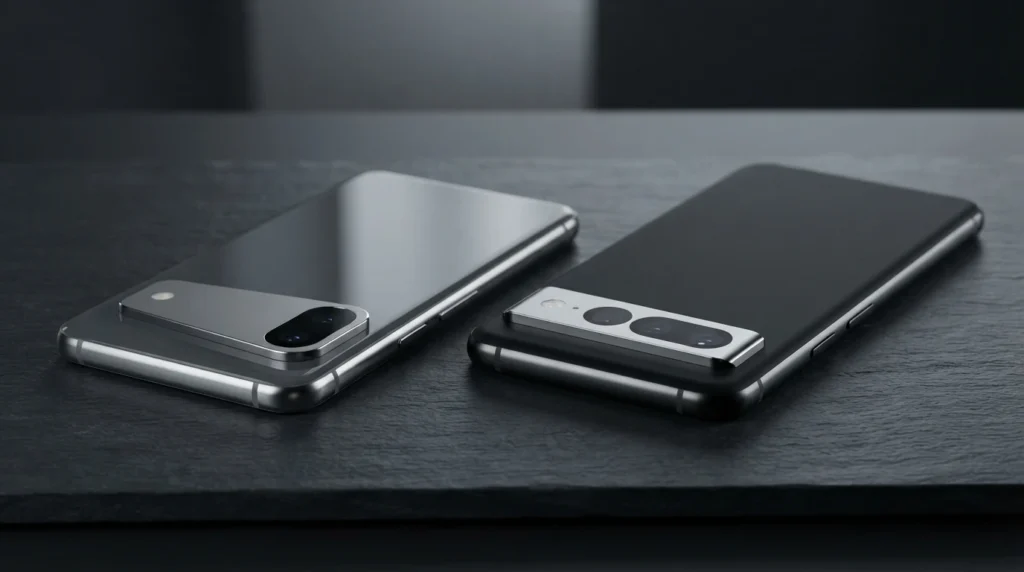
The Pixel design hasn’t been entirely redesigned by Google for 2026. Rather, the business has improved the current design language.
Compared to earlier models, the Pixel 11 has a cleaner look thanks to a thinner camera bar. Additionally, the ordinary model can be distinguished from the more conservative Pro variants by offering more dramatic color selections.
The Pixel 11 Pro has Google’s new HiLight feature and has a more upscale finish. An LED system called HiLight is placed around the camera flash and has the ability to display visual alerts. Even when the phone is face-down, it can still show things like calls or Gemini-related activities, depending on how the software is implemented.
The 6.3-inch dimension of both phones is quite small. The fact that many flagship smartphones are getting bigger makes this crucial.
Both versions make sense if you’re looking for a phone that fits comfortably in one hand. But without requiring you to purchase the bigger Pro XL, the Pixel 11 Pro delivers more high-end hardware.
The Pixel 11 Pro is the design winner.
Although there isn’t much of a difference, the Pro offers more hardware features and a more upscale overall package.
Show Comparison
One of the most obvious distinctions between the Pixel 11 and Pixel 11 Pro is the display.
A 6.3-inch OLED Actua display with a refresh rate of up to 120 Hz powers the Pixel 11. This should keep the phone somewhat efficient while enabling fluid scrolling, animations, and gaming.
The 6.3-inch Super Actua LTPO OLED display on the Pixel 11 Pro elevates the experience. Refresh rates can dynamically decrease as low as 1Hz when necessary and rise to 120Hz when smooth motion is needed thanks to LTPO technology.
Additionally, Google advertizes brightness levels of up to 3,600 nits for the Pro models, indicating that the Pro offers a greater resolution and peak brightness.
The Pixel 11 display should already be great for daily social media, YouTube, browsing, and messaging.
However, the Pixel 11 Pro has an advantage if you frequently use your phone outside, view HDR video, edit images, or just want the greatest screen Google offers in this size.
The Pixel 11 Pro is the display winner.
The Pro is the superior display option because to its LTPO panel, higher brightness, and higher resolution.
Tensor G6 performance
Google’s Tensor G6 processor powers both the Pixel 11 and Pixel 11 Pro.
The Pro model does not receive an entirely different processor, therefore this is a crucial factor. As a result, you shouldn’t purchase the Pixel 11 Pro in anticipation of significantly improved daily CPU performance.
Rather, Google’s Tensor strategy still places a strong emphasis on intelligent software features, photography, and AI processing.
The Tensor G6 is based on an improved AI-focused design and more recent CPU technologies. According to reports, the chip delivers significant gains in processing efficiency and performance over the previous generation.
Both phones should seem quick for everyday tasks.
Google’s AI tools are built to leverage the Tensor platform, apps open rapidly, and multitasking should be seamless.
There is a crucial warning for gamers, tho.
Instead of competing only on graphics performance with the most potent Snapdragon chips, Tensor processors have historically placed a higher priority on AI and Google’s computational photography features. Additionally, early Tensor G6 rumors suggest that the GPU might not be as significant a generational shift as the CPU and AI components.
Winner of performance: tie
Both phones are quite capable in terms of AI and daily functioning. In terms of performance alone, the Pro’s CPU distinction is insufficient to support its price.
Comparison of Cameras
The Pixel 11 Pro is noticeably superior in the camera.
The Pixel 11 generation maintains the computational photography reputation that Google’s Pixel phones have established.
The Pixel 11 Pro has a more adaptable triple camera arrangement than the basic Pixel 11, which has two cameras.
A 50MP primary camera, a 48MP ultrawide camera, and a 48MP telephoto camera are all included in the Pro model. Much longer-range photography is made possible by the telephoto mechanism, which also helps Google achieve its purported 120x Pro Zoom capabilities.
Although it lacks a dedicated telephoto camera, the basic Pixel 11 is said to be able to achieve up to 30x zoom utilizing Google’s computational Super Zoom engine.
That distinction is important.
The Pixel 11’s camera system should be more than sufficient if you mostly take pictures of family, pets, food, scenery, and ordinary moments.
However, a specialized telephoto camera is quite helpful if you want to take pictures of distant buildings, wildlife, concerts, sports, or travel subjects.
Primary Camera Quality
The improved 50MP primary sensor of the Pixel 11 Pro is intended to enhance image quality, particularly in difficult lighting conditions.
One of Pixel’s greatest advantages has always been Google’s computational photography. Pixel phones generate detailed photos by combining multiple exposures, AI processing, and Google’s picture algorithms rather than just using sensor hardware.
Google’s advancements in picture processing should help both phones, but the Pro model offers greater hardware flexibility.
Because it offers a lot of the Pixel photographic style without the Pro premium, the Pixel 11 might be a better deal for casual consumers.
The Pixel 11 Pro is the primary camera winner.
Because of its improved hardware and increased adaptability, the Pro prevails.
Zoom Images
This is most likely the main justification for purchasing the Pixel 11 Pro rather than the regular Pixel 11.
With its specialized telephoto technology and computational photography, the Pixel 11 Pro can achieve 120x Pro Zoom, while the Pixel 11 delivers up to 30x Super Zoom.
Maximum zoom numbers, of course, don’t provide a whole picture.
Image quality will inevitably deteriorate at very high digital zoom levels. Having a suitable telephoto camera for intermediate and longer-range images is the Pro’s true advantage.
For instance, taking pictures of a distant subject, a stage at a performance, a building while traveling, or a person across a huge room becomes much more feasible with the Pro.
Zoom winner: Pixel 11 Pro
The pro will easily win this.
Camera for Selfies
Additionally, the Pixel 11 Pro has a big advantage when it comes to front-facing video and selfies.
The standard Pixel 11 features a more modest selfie camera, while the Pixel 11 Pro steps up to a significantly higher-resolution 42MP front-facing camera for sharper selfies and video calls.
The Pro’s front camera offers additional hardware capabilities for group shots, selfies, video chats, and social media creators.
Once more, the majority of casual users won’t necessarily require the higher resolution.
However, the Pro is obviously more desirable for those who regularly use the front camera.
The Pixel 11 Pro is the best selfie camera.
Features of the Creator and Video Recording
With the Pixel 11 generation, Google is focusing more on video.
Pro steady Video, which aims to produce more steady footage, is one of the noteworthy upgrades. Additionally, Google is launching features and tools targeted at creators that facilitate video production and editing.
Those who wish to use their smartphone as a small camera for creating content will find the Pro models especially appealing.
When filming vacation films, short-form material, or social media clips, features like enhanced stabilization, sophisticated AI processing, and Google’s creator tools can have a significant impact.
Pixel 11 Pro is the video winner.
AI Software and Features
Perhaps the most crucial component of Google’s Pixel plan is artificial intelligence.
The Pixel 11 series incorporates Google’s Gemini Intelligence more thoroughly into the phone experience while running the most recent version of Android.
Improved voice-to-text capabilities, real-time video translation, improved Circle to Search, and AI-assisted photography tools are some of the new AI features.
Magic Capture is a particularly intriguing photography function that helps capture the perfect moment instead of only depending on the photographer to push the shutter at precisely the right moment.
More sophisticated camera-related AI functions, such as improved zoom processing and professional video tools, are added to the Pixel 11 Pro.
The crucial point is that you won’t lose out on the essential Google AI experience if you get the less expensive Pixel 11.
AI winner: Pixel 11 Pro, although by a slim margin
Google’s most recent AI ecosystem and Tensor G6 are advantageous to both phones. Because the Pro combines those AI features with superior camera hardware, it wins.
Life of a Battery
Because the ordinary Pixel 11 and Pixel 11 Pro don’t always follow the typical flagship pattern, battery capacity is an intriguing topic.
According to purported specifications, the Pixel 11 Pro has a battery in the 4,800mAh class and the Pixel 11 has a battery in the 5,000mAh class.
However, battery longevity is not solely determined by battery capacity.
When a high refresh rate is not necessary, the Pixel 11 Pro’s LTPO display may dynamically lower refresh rates. Additionally, Tensor G6 was created with increased efficiency in mind.
According to Google’s testing claims, the Pixel 11 generation can have a battery life of over thirty hours.
In practical applications, brightness, cell signal, camera use, gaming, GPS, and AI functions will all have a substantial impact on battery life.
Pixel 11 is the battery winner.
The regular Pixel 11 appears to have the capacity advantage. In daily use, tho, the change might not be noticeable.
Charging
Fast wired charging and improved wireless charging are supported by both phones.
Neither phone’s charging speeds are its main selling feature. Google still prioritizes all-day battery efficiency over competing only on very high charging wattages.
The Pixel 11 generation includes Qi2 wireless charging, which offers a cutting-edge wireless charging ecosystem.
Compared to certain Chinese Android flagships, neither Pixel is going to be the obvious pick if ultra-fast charging is your top priority.
Winner of charging: Tie
Both offer a decent contemporary charging experience, but neither is the industry leader.
RAM and storage
Another area where Google has significantly changed is storage.
Instead of continuing with a 128GB entry-level configuration, the Pixel 11 lineup begins at 256GB. Higher storage levels are also available from Google; the Pro devices can hold up to 1TB.
Higher-end Pixel 11 Pro versions may have more RAM than the basic Pixel 11, which comes with 12GB.
256GB is a far more comfortable starting point than 128GB for the majority of folks.
However, the Pixel 11 Pro’s 512GB and 1TB possibilities become appealing if you take a lot of 4K/8K video, play big games, or save years’ worth of images on your phone.
The Pixel 11 Pro is the storage winner.
The Pro is more appropriate for power users and has a higher maximum capacity.
Cost and Worth
The Pixel 11 becomes more intriguing when it comes to price.
In the US, the ordinary Pixel 11 costs $899, while the Pixel 11 Pro costs $1,099.
That $200 discrepancy is significant.
Already, the Pixel 11 provides you with:
Tensor G6
Google’s most recent AI capabilities
A 120 Hz screen
256GB of initial storage for powerful pixel photography
A little design
Google’s most recent Android experience
Why then invest an additional $200?
The camera and display are the main components of the solution.
The basic Pixel 11 is quite cost-effective if you don’t want a telephoto camera, 120x zoom, the brightest LTPO display, or the Pro-exclusive camera features.
Pixel 11 is the value winner.
For most buyers, the standard Pixel 11 delivers a more compelling combination of features and affordability.
Google Pixel 11 Benefits and Drawbacks
reduced starting price of $899
Tensor G6 processor
Outstanding experience using Pixel software
Robust AI capabilities
OLED display at 120 Hz
256GB of initial storage in a small 6.3-inch form
Big battery
Outstanding day-to-day camera performance
Entry-level pricing for the Pixel 11 generation Cons
No specialized telephoto lens
less sophisticated camera gear as the Pro
Less sophisticated display technology
Selfie camera with a lower resolution
Fewer aspects of professional photography
The maximum zoom is much less than that of the Pro
Google Pixel 11 Pro Benefits and Drawbacks
Advantages
Superb 6.3-inch LTPO OLED screen
Increased brightness and resolution
Performance of Tensor G6
Three-camera configuration
A specialized telephoto camera
Pro Zoom up to 120x
42MP camera for taking selfies
AI-powered advanced photography
Expert Stable Video
Additional storage choices
High-end design
HiLight alerting system
Cons: $200 more costly
heavier than the Pixel 11 standard
The sophisticated camera gear won’t be useful to some consumers.
Charging doesn’t lead the class.
Tensor G6 isn’t always the greatest option for games with a lot of visuals.
Which Google Pixel 11 or Pixel 11 Pro Should You Purchase?
What you anticipate from your phone will determine the response.
If you want value, choose the Pixel 11.
For the majority of regular users, the Pixel 11 is the superior choice.
You don’t really need the Pro if your smartphone is mostly used for social media, messaging, browsing, YouTube, photography, navigation, and occasionally gaming.
You still get a powerful camera system, a 120Hz display, Google’s Tensor G6 CPU, and contemporary AI technologies.
It is an attractive flagship package for $899.
If you enjoy taking pictures, get the Pixel 11 Pro.
For photographers and content producers, the Pixel 11 Pro makes even more sense.
A far more comprehensive flagship experience is produced by the specialized telephoto camera, 120x Pro Zoom, enhanced main sensor, higher-resolution selfie camera, sophisticated video functions, and brighter LTPO display.
The Pro is the more capable long-term option if you already spent $900 on a phone and are willing to invest a further $200.
Final Decision
The Google Pixel 11 Pro is technically superior to the Google Pixel 11, however the Pixel 11 is more affordable.
Without requiring you to pay for services you might never use, the Pixel 11 offers you the key components of Google’s flagship experience. It is a great option for regular users because of its Tensor G6 CPU, 120Hz display, AI features, big battery, and upgraded camera system.
For those who desire more, there is the Pixel 11 Pro.
Its telephoto camera has far better zoom capability, its LTPO display is superior, its camera system is much more adaptable, and its more creator and AI functions make it the superior choice for photography and video.
The Google Pixel 11 Pro was our overall winner.
However, the Google Pixel 11 is our value winner.
Purchase the Pixel 11 and take advantage of the flagship Pixel experience if your budget is approximately $900. The Pixel 11 Pro is worth the additional $200 if you value photography and are prepared to spend $1,099.
To put it another way, choosing between the Pixel 11 for value and the Pixel 11 Pro for the full flagship experience is straightforward.
FAQ
Is the Pixel 11 Pro superior to the Pixel 11?
Indeed. The Pixel 11 Pro boasts a better display, a more flexible triple-camera setup, a dedicated telephoto camera, a higher-resolution selfie camera, more storage options, and more sophisticated photography features. But the regular Pixel 11 is more affordable.
Is the additional $200 worth it for the Pixel 11 Pro?
Yes, for users, photographers, and designers who desire the best zoom and display capabilities. The basic Pixel 11 is probably a better option for casual users.
Does the Pixel 11 have Tensor G6?
Indeed. Google’s Tensor G6 processor powers both the Pixel 11 and Pixel 11 Pro.
Is there a telephoto camera on the Pixel 11 Pro?
Indeed. According to Google’s launch coverage, the Pixel 11 Pro sports a dedicated telephoto camera and supports Google’s improved Pro Zoom capabilities, which can go up to 120x.
Which Pixel 11 camera is superior?
Due to the addition of a specialized telephoto camera and more sophisticated camera hardware, the Pixel 11 Pro boasts a stronger overall camera system.
Which one lasts longer on batteries?
Although the stated battery capacity of the basic Pixel 11 is higher, real battery life is dependent on usage, apps, network conditions, and display settings. The LTPO display on the Pro can improve productivity.
Does the Pixel 11 Pro’s display run at 120 Hz?
Indeed. The LTPO display used in the Pixel 11 Pro can dynamically switch between 120Hz and extremely low refresh rates.
Is 128GB the starting memory for the Pixel 11?
No. According to current launch news, the Pixel 11 generation starts at 256GB.
For photography, which Pixel 11 should I purchase?
Select the Pixel 11 Pro. It is significantly more versatile thanks to its enhanced primary camera, dedicated telephoto camera, higher-resolution selfie camera, and sophisticated zoom.
For gaming, which is preferable?
There isn’t much of a processor difference between the two phones because they both run Tensor G6. Because it is the Pro variant, the Pixel 11 Pro does not offer a significant gaming-performance benefit. Before making a choice, buyers that prioritize demanding gaming should evaluate the Tensor G6’s graphics capabilities against those of rival flagships with Snapdragon processors.